Clear Sky Science · en
Characterization of the microstructural, magnetic, and thermal properties of Fe–45Ni fabricated by laser powder bed fusion
Metal That Keeps Its Shape and Its Magnetism
Modern satellites, telescopes, and precision instruments need metal parts that barely change size with temperature yet respond strongly to magnetic fields. This study explores a promising recipe for such parts: an iron–nickel alloy containing 45% nickel (Fe–45Ni), made not by traditional casting and machining, but by 3D-printing with a laser. The work shows how to tune the printing settings so the alloy comes out dense, strongly magnetic, and extremely stable when heated.
Why a 3D-Printed Alloy Matters
Iron–nickel alloys are already used in devices that need reliable magnetism and very low thermal expansion – from precision clocks to spacecraft structures. But conventional manufacturing methods struggle to create intricate shapes without cracks, wasted material, and costly extra machining. Laser powder bed fusion, a metal 3D-printing process, offers a way to build complex forms directly from powder. The catch is that the intense, rapidly moving laser also creates steep temperature changes that can leave behind pores, cracks, and locked-in stresses. The authors set out to see whether Fe–45Ni could be printed in a way that avoids these pitfalls while preserving its special combination of magnetic strength and dimensional stability.
How the Metal Is Printed and Examined
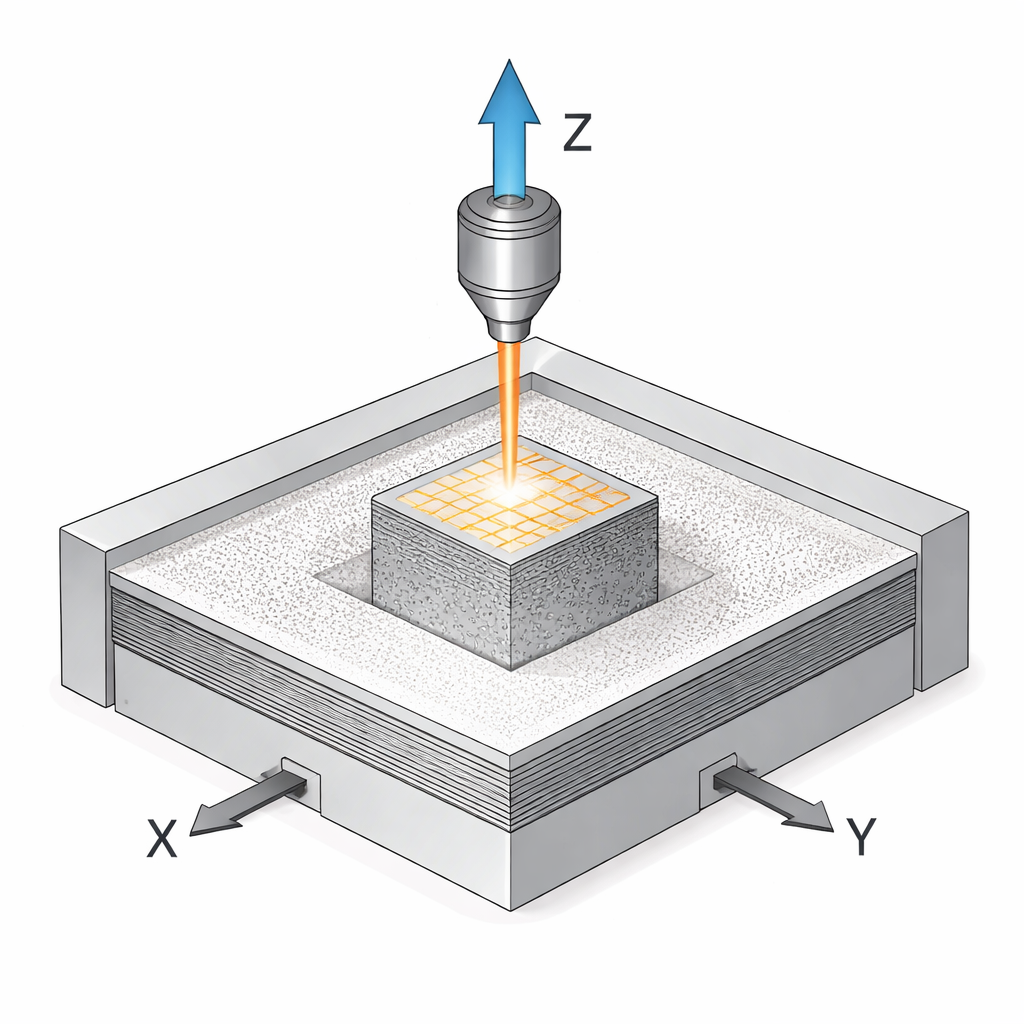
The researchers began with spherical Fe–45Ni powder produced by gas atomization, chosen for its good flow in the printer. They used a commercial laser powder bed fusion machine to build tiny 7×7×7 mm cubes in a chessboard scanning pattern, varying the laser power and scan speed while keeping layer thickness and hatch spacing fixed. After printing, they cut and polished the cubes and examined them using optical and electron microscopes to measure density and to locate pores and cracks. They also used X-ray diffraction to identify crystal structure, and more advanced microscopy to map grain shapes and orientations. Finally, they tested magnetic behavior along different directions and measured how much the alloy expanded when heated from room temperature up to 500 °C.
Finding the Sweet Spot in Printing Conditions
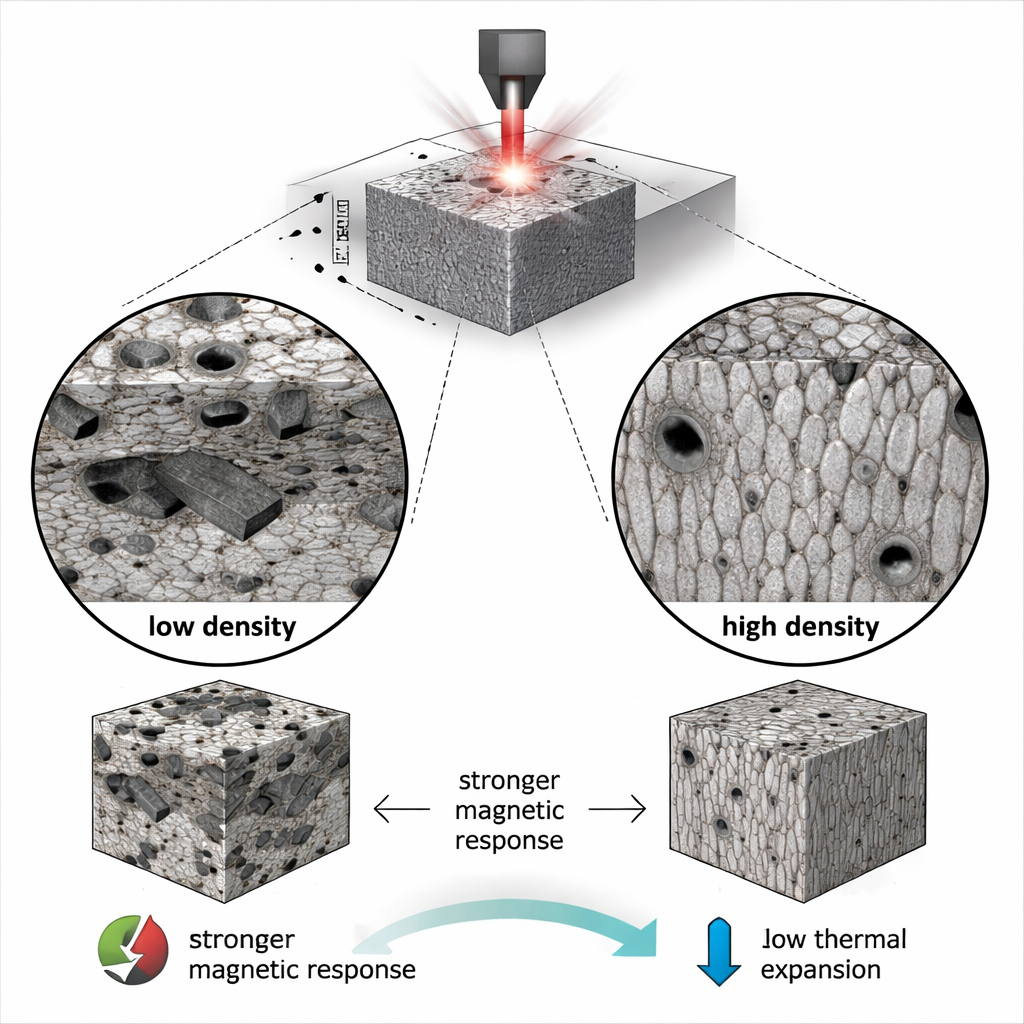
The study found that both too little and too much energy from the laser can damage the quality of the alloy. At low laser power or very high scan speed, the metal layers do not fully fuse, producing irregular voids and occasional hot cracks. At very high energy, gas trapped in the original powder or created during melting becomes sealed inside as round pores. By carefully balancing laser power and scan speed, the team achieved a very high relative density of about 99.3% at 85 W and 300 mm/s, leaving only fine, scattered pores. Under these best conditions, the internal structure consisted mainly of tightly packed, column-like grains growing along the build direction, interspersed with some smaller, more blocky grains. This textured grain pattern, set by the heat flow during solidification, turned out to be important for the alloy’s magnetic response.
Magnetic Strength and Heat Stability
When the team measured magnetism along and across the build direction, they found that the printed Fe–45Ni behaved as a soft magnet in both directions – it magnetizes easily and loses most of its magnetism when the field is removed. However, the response was not the same in all directions. Along the build direction, the material showed higher permeability (it magnetized more readily) and lower coercivity (less field was needed to flip the magnetization). Across the build, more field was required, likely because pores, grain boundaries, and residual stresses hinder the motion of magnetic domain walls. Despite these imperfections, the alloy’s maximum magnetization was high, aided by its relatively large iron content. Thermal tests showed that, between room temperature and about 400 °C, the alloy’s expansion remained very small and nearly the same in different directions, with a coefficient of roughly 6×10⁻⁶ per degree Celsius – close to so-called Invar behavior. Only above about 415 °C, near the Curie temperature where the magnetism fades, did the alloy begin to expand more rapidly.
What This Means for Real-World Uses
In simple terms, the authors show that Fe–45Ni can be 3D-printed into dense, crack-free parts that keep their size almost unchanged as they heat up and cool down, while still acting as strong, easily controlled magnets. By dialing in suitable laser settings, they minimize defects and shape the internal grain structure so that the build direction becomes the easiest path for magnetization. These traits make the printed alloy a strong candidate for precision components in aerospace and other high-tech fields where both magnetic performance and dimensional stability are critical.
Citation: Sim, N., Jung, H.Y. & Lee, KA. Characterization of the microstructural, magnetic, and thermal properties of Fe–45Ni fabricated by laser powder bed fusion. Sci Rep 16, 8049 (2026). https://doi.org/10.1038/s41598-026-37507-w
Keywords: Fe–Ni alloy, laser powder bed fusion, soft magnetic materials, low thermal expansion, additive manufacturing