Clear Sky Science · en
Effectiveness of probiotic supplementation on growth performance, gut microbiota, and Salmonella reduction in broiler chicks challenged with Salmonella Typhimurium
Why chicken gut health matters to your dinner plate
Chicken is one of the world’s most popular and affordable meats, but it also ranks among the top sources of food‑borne Salmonella infections in people. For decades, farmers have relied on low‑dose antibiotics to keep flocks healthy and growing fast, a practice now under fire for driving antibiotic resistance. This study asked a practical question with big public‑health implications: can carefully chosen probiotic bacteria help broiler chickens grow well, keep their guts healthy, and reduce dangerous Salmonella, without resorting to routine antibiotics?
Testing friendly bacteria in real farm conditions
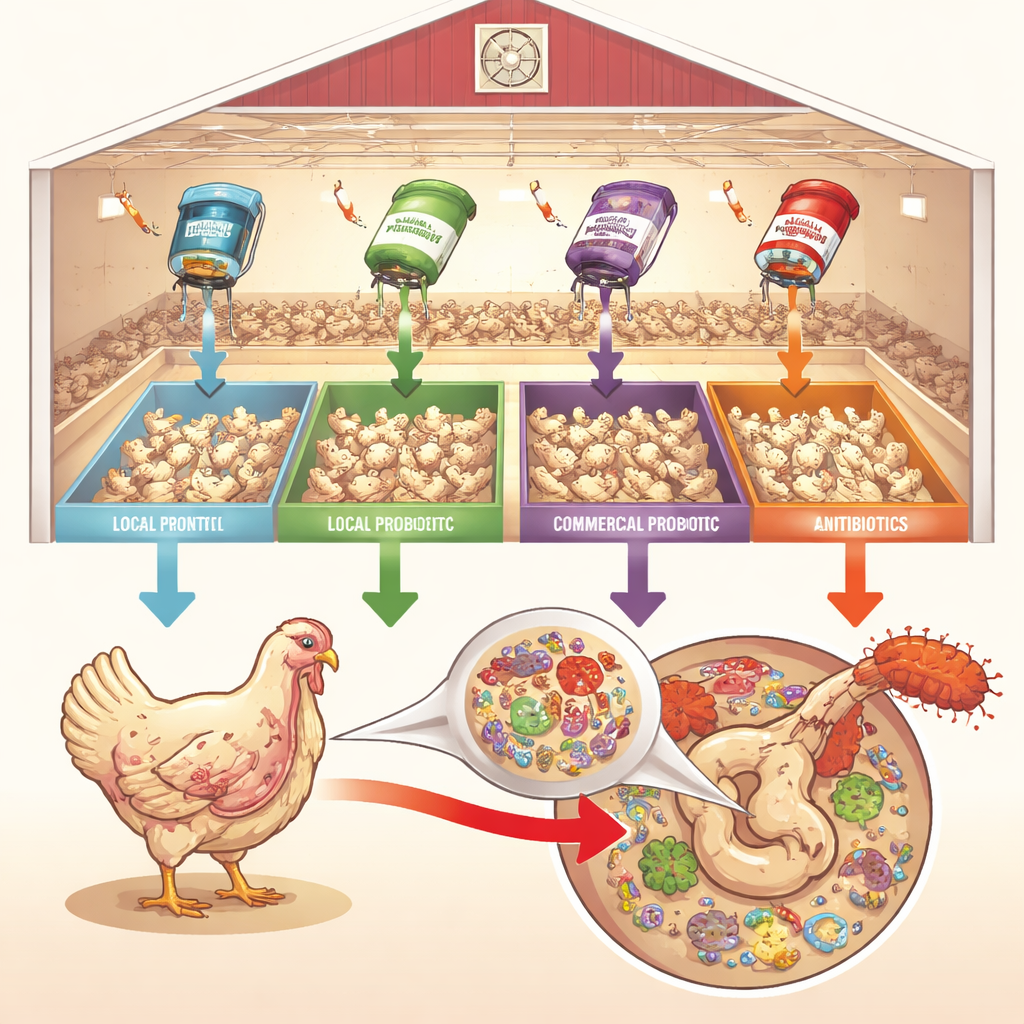
The researchers worked with nearly 200 meat‑type chicks and divided them into several groups. Some birds received no extra treatment, some were given a new blend of local lactic acid bacteria called ProCU, others received a commercial spore‑forming probiotic marketed as TOP GUT, and one group received a rotating course of common farm antibiotics. Half of these groups were later challenged with a strong strain of Salmonella Typhimurium, a leading cause of food poisoning in humans. Over four weeks, the team tracked how well the birds grew, examined the structure of their intestines under the microscope, counted Salmonella in the cecum (a major fermentation chamber in the chicken gut), and used shotgun DNA sequencing to profile the microbes and metabolic genes living there.
Growth, germs, and how the birds fared
Infected birds that received no protection showed poorer weight gain and feed efficiency after encountering Salmonella, confirming that the pathogen harms performance. Antibiotic‑treated birds largely kept growing as well as uninfected controls, but they still carried a high load of Salmonella in their ceca. Before infection, the local ProCU probiotic quietly reshaped the early gut community, boosting levels of lactic acid bacteria and genes for breaking down amino acids and carbohydrates, which are important for energy harvest. However, once Salmonella arrived, neither ProCU nor TOP GUT could fully prevent the temporary growth setback, underlining how disruptive this pathogen can be in young animals.
Inside the gut wall: damage and protection
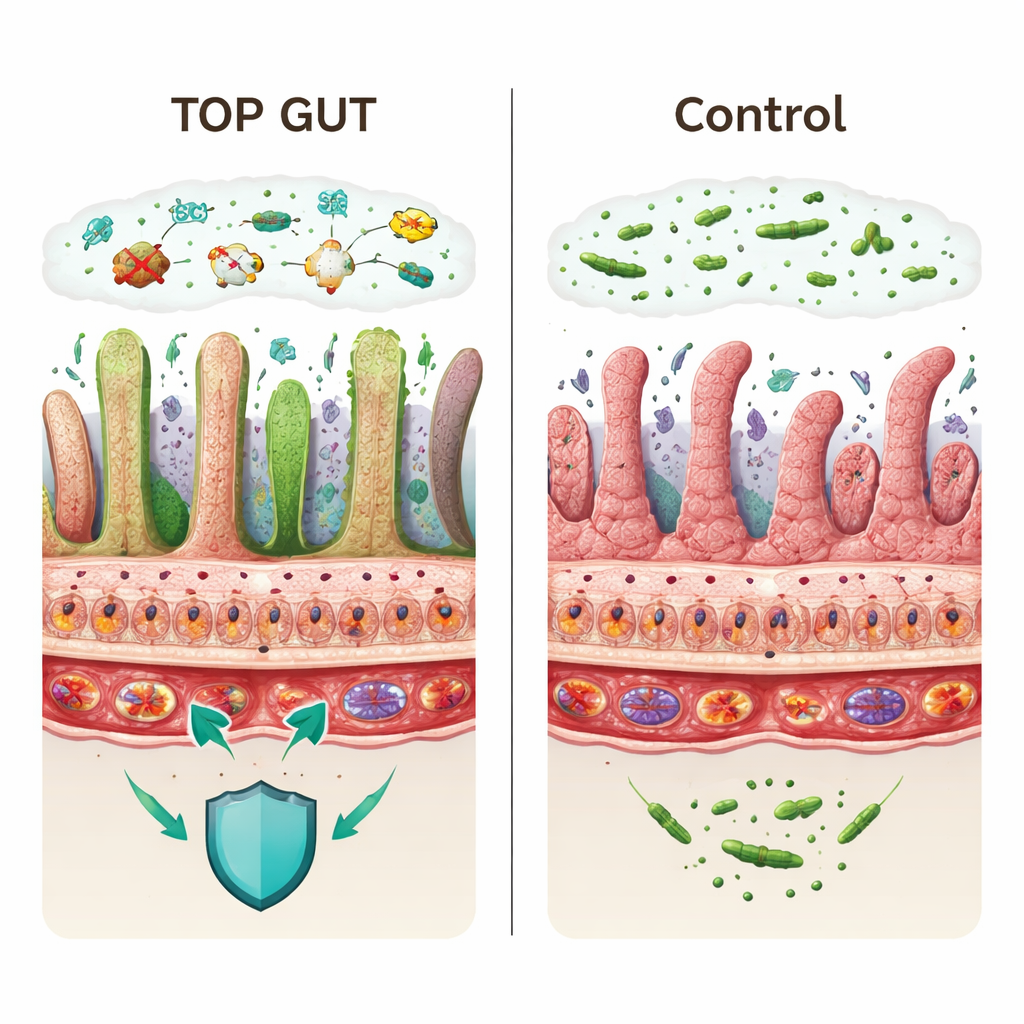
Looking directly at the intestinal lining revealed why the type of intervention matters. Unprotected, infected birds developed shortened villi (the tiny finger‑like projections that absorb nutrients), deepened crypts, and inflamed, distorted cecal tissue—changes that signal a leaky, less efficient gut. Both probiotic products helped preserve gut architecture, with TOP GUT in particular limiting cecal damage after infection. By seven days post‑challenge, birds receiving TOP GUT had markedly lower Salmonella levels than all other infected groups, even though they briefly showed higher counts right after exposure as the spore‑forming bacteria were still establishing themselves. In contrast, the antibiotic group showed some of the worst cecal lesions and retained high Salmonella burdens, suggesting that drug‑induced disruption of the normal microbiota can undermine long‑term protection.
A shifting community of microbes and their chemical tools
DNA sequencing of cecal contents showed that most gut bacteria belonged to a familiar cast—Firmicutes, Bacteroidetes, Actinobacteria, Proteobacteria, and Verrucomicrobia. In healthy birds, butyrate‑producing species that nourish the gut lining were common. After infection, the two probiotic treatments nudged the community in distinct ways. ProCU increased helpful Lactobacillus and the mucus‑associated species Akkermansia muciniphila, while TOP GUT enriched additional groups such as Parabacteroides and other Bacteroidetes known for breaking down complex carbohydrates. Both probiotics reduced the relative abundance of problem genera like Escherichia, Salmonella, Pseudomonas, and Campylobacter. Functionally, probiotic‑treated birds showed more genes involved in antioxidant defenses—such as catalases and superoxide‑reducing enzymes—and in pathways that generate short‑chain fatty acids from amino acids and sugars. These fatty acids fuel gut cells, lower pH to make life harder for pathogens, and support mineral absorption.
What this means for safer chicken and fewer antibiotics
For a general reader, the bottom line is that not all probiotics are created equal, but they can be powerful tools in the move toward more sustainable chicken production. In this study, the spore‑forming TOP GUT product best reduced Salmonella in the gut and protected intestinal tissues after infection, while the locally developed ProCU blend mainly improved gut structure, early microbial balance, and stress‑defense functions, with only modest effects on Salmonella counts. Both strategies outperformed routine antibiotics in terms of preserving a healthy microbial ecosystem. The authors conclude that choosing the right strains and supplying them continuously—especially hardy, spore‑forming types—could help poultry producers cut back on preventive antibiotics, maintain bird health and growth, and ultimately lower the risk of Salmonella reaching consumers’ kitchens.
Citation: Khurajog, B., Saenkankam, I., Apiwatsiri, P. et al. Effectiveness of probiotic supplementation on growth performance, gut microbiota, and Salmonella reduction in broiler chicks challenged with Salmonella Typhimurium. Sci Rep 16, 6983 (2026). https://doi.org/10.1038/s41598-026-37506-x
Keywords: poultry probiotics, Salmonella in chickens, gut microbiome, antibiotic alternatives, broiler health