Clear Sky Science · en
Potential of a cerium hexaboride electron gun as a monochromatic and high current beam via a virtual source mode
Sharper Views with a Better Electron Flashlight
Modern science often relies on beams of electrons the way everyday life relies on light: to see tiny structures, sculpt new materials, and write nanoscale circuits. This article explores a new way to build and operate an electron “flashlight” using a material called cerium hexaboride (CeB6), showing how a clever operating mode can make the beam both cleaner in energy and more stable, without demanding the ultra‑harsh vacuum conditions that many current tools require.
Why Electron Sources Matter
Electron microscopes, chip‑making tools, particle accelerators, and high‑precision machining systems all start with the same thing: an electron source. The quality of this source largely sets the limit on how sharp an image can be or how fine a pattern can be drawn. Engineers care about how bright the beam is, how tightly it can be focused, how narrow its energy spread is, and how steadily it runs over time. Today’s highest‑end sources often rely on “field emission,” where a sharp metal tip in an extremely strong electric field spits out electrons. These sources are bright and precise, but they demand ultra‑high vacuum and are sensitive to contamination, making them costly and finicky to operate.
A Different Kind of Glowing Tip
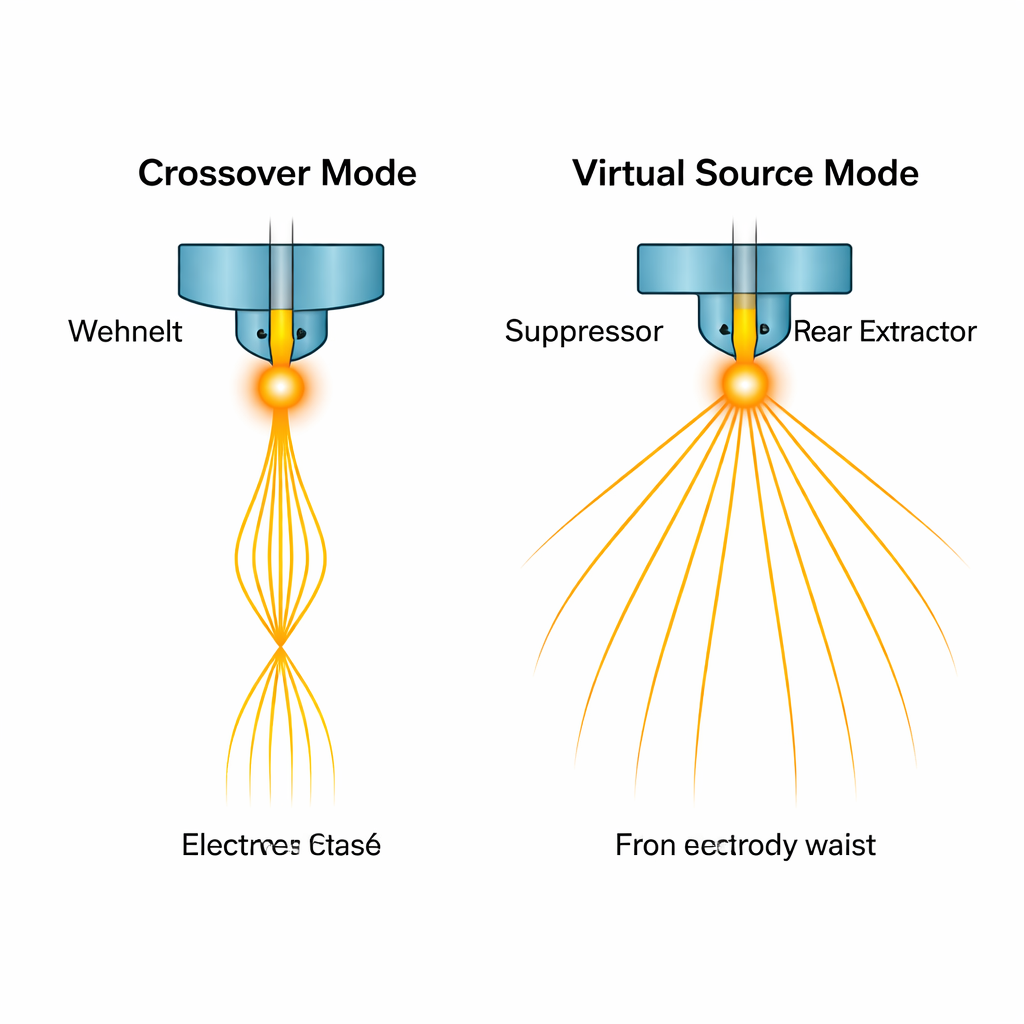
Cerium hexaboride belongs to a family of materials that emit electrons when heated, a process known as thermionic emission. Traditional heated sources, such as tungsten filaments, operate in a so‑called “crossover mode,” where a control electrode squeezes the electrons into a tight waist and then lets them spread out again. This setup yields plenty of current but at the cost of a large effective source size and a broad energy distribution, both of which blur images and patterns. CeB6 has long been known to outperform simple filaments in brightness and stability, yet it has not matched the very best field emitters. The authors of this study ask a simple question: can CeB6 be driven in a smarter way to unlock more of its potential?
The Virtual Source Idea
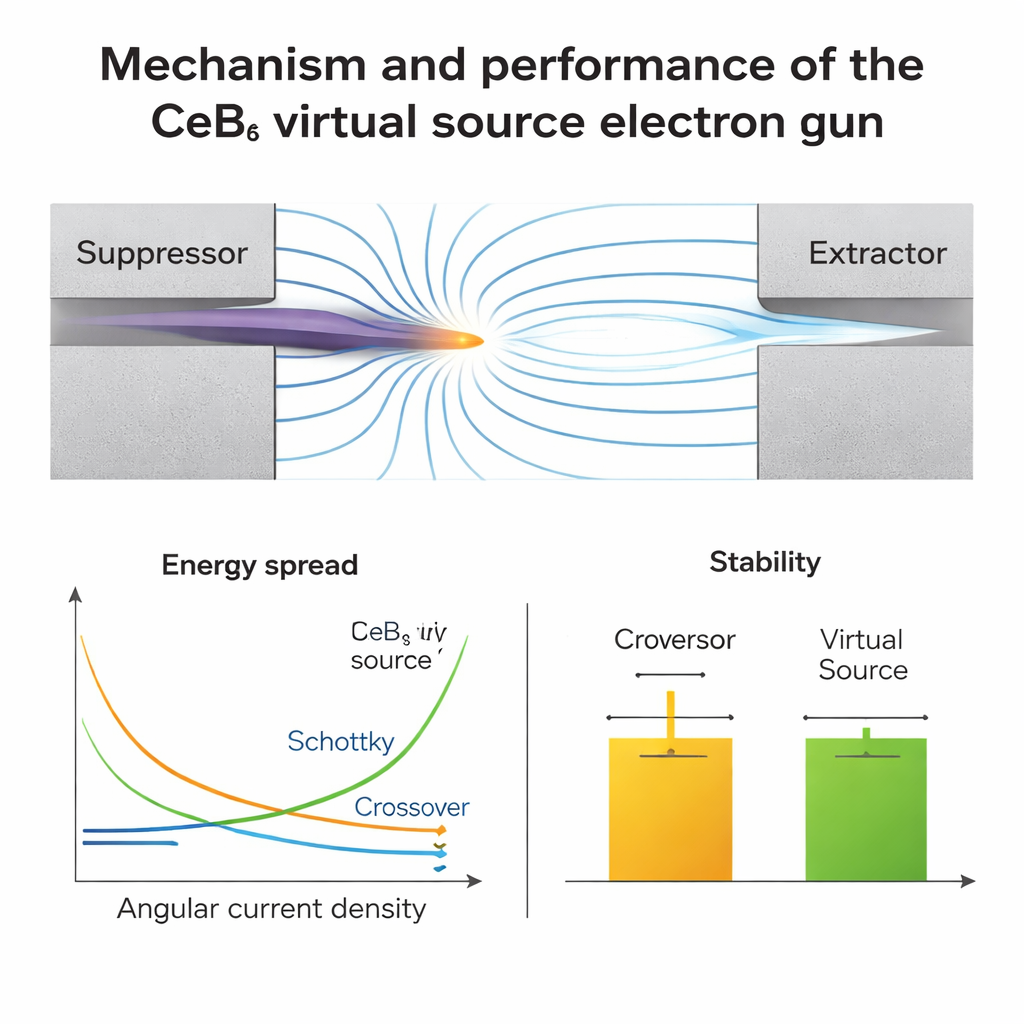
The team redesigned the small electrodes around a micrometer‑sized CeB6 tip so the electrons never form a real crossover inside the gun. Instead, in their “virtual source mode,” electrons appear—if their paths are traced backward—to come from a point just in front of the physical tip. This is achieved by moving the traditional Wehnelt electrode behind the tip to act as a suppressor, and adding a separate extractor electrode in front that pulls electrons out with a strong local electric field. Electrons then fan out smoothly rather than crowding together. This geometry reduces the jostling between electrons that would otherwise broaden their energies, and it lets the researchers apply electric fields strong enough to slightly lower the barrier that holds electrons in the material. As a result, the CeB6 source works in a hybrid regime, combining heating with field‑assisted emission.
Cleaner Beams, Higher Currents
Using a custom energy analyzer and detailed computer simulations, the researchers compared the virtual source mode with the conventional crossover mode and with a popular commercial Schottky source based on zirconium‑coated tungsten. In virtual source mode, the CeB6 tip delivered very high angular current densities—tens of milliamps per steradian—while maintaining an energy spread as low as about 0.32 electron volts, more than three times narrower than the Schottky reference under typical microscope conditions. Even as they increased the current, the energy broadening remained modest because electrons were not forced through a tight bottleneck. Just as important, the beam current was strikingly steady: fluctuations in virtual source mode were roughly five times smaller than in crossover mode, and the gun operated reliably in relatively relaxed high‑vacuum conditions that can be achieved with O‑ring‑sealed chambers.
Sharper Images with Simpler Hardware
To see what these beam improvements mean in practice, the team built a deliberately simple scanning electron microscope column and imaged tin particles on a carbon substrate at low accelerating voltage. With the same optics, simply switching from crossover to virtual source mode transformed the images: features became crisper, and the minimum resolvable spacing between neighboring particles shrank to about 52 nanometers. Because nothing else in the microscope was changed, this improvement reflects the smaller effective source size, narrower energy spread, and better stability of the virtual source mode. These traits help reduce blurring from lens imperfections and energy‑dependent focusing, which are major limits in high‑resolution, low‑voltage imaging.
What This Means for Future Tools
By re‑thinking how a heated CeB6 tip is driven, this work shows that thermionic sources do not have to be low‑performance workhorses. In virtual source mode, a CeB6 electron gun can generate bright, nearly monochromatic, and highly stable beams without the extreme vacuum demands of classic field emitters. For non‑specialists, the takeaway is that future electron microscopes, lithography tools, and beam‑based fabrication systems could become both sharper and easier to maintain. This could accelerate research in materials science, nanotechnology, and advanced manufacturing by making high‑precision electron tools more accessible to a wider range of laboratories and industries.
Citation: Lee, H.R., Haam, Y., Ogawa, T. et al. Potential of a cerium hexaboride electron gun as a monochromatic and high current beam via a virtual source mode. Sci Rep 16, 6860 (2026). https://doi.org/10.1038/s41598-026-37502-1
Keywords: electron microscopy, electron source, cerium hexaboride, nanofabrication, beam stability