Clear Sky Science · en
Estimating chemical oxygen demand in municipal landfill leachate using multilayer perceptron artificial neural networks based on seasonal monitoring data
Why Landfill Puddles Matter
Every modern city relies on landfills to hide its trash out of sight, but rainwater seeping through buried waste can turn into a powerful chemical cocktail called leachate. This liquid can pollute soil and water if not carefully controlled. The study described here shows how a type of computer model, inspired by the way brains work, can predict how dirty this leachate is—without having to run expensive lab tests every time. That knowledge can help communities keep waste sites safer and cut monitoring costs.
The Hidden Water Beneath Our Trash
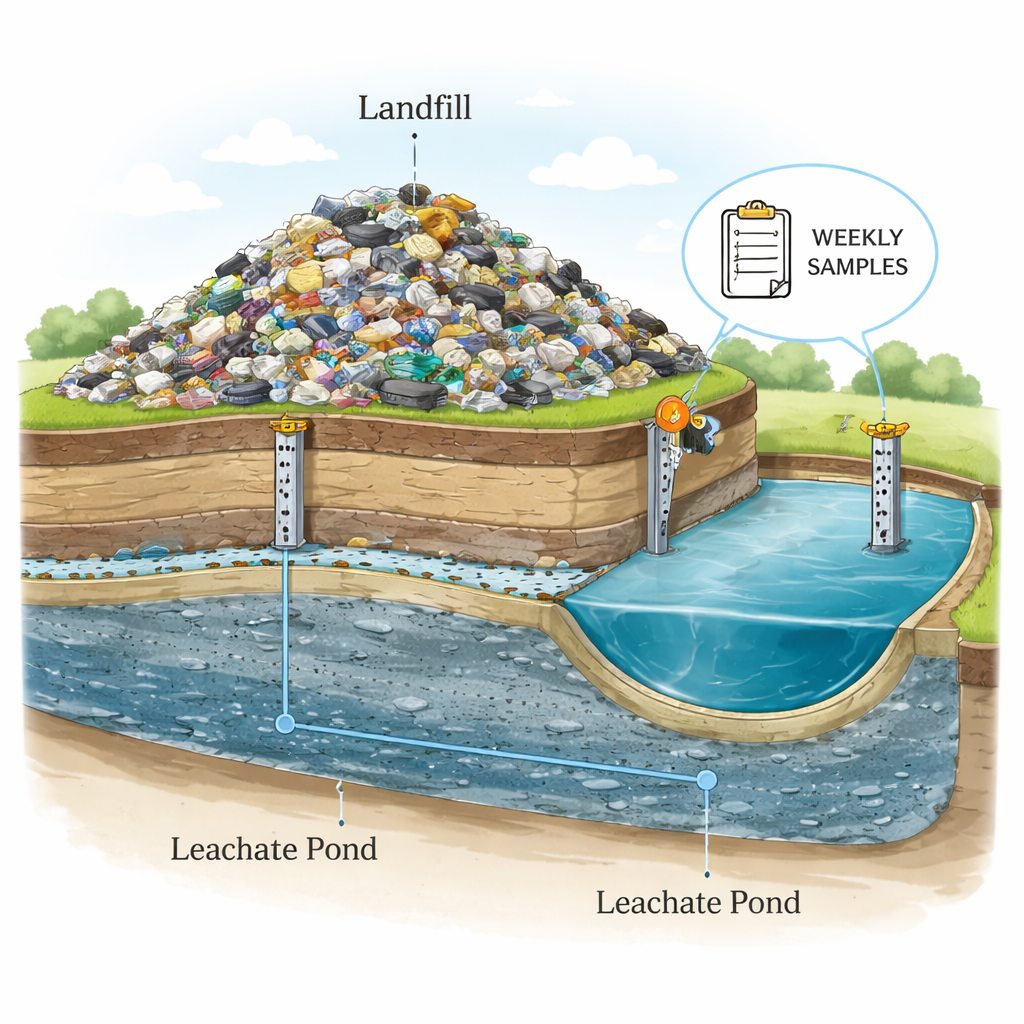
When rain falls on a landfill, it trickles through layers of old food scraps, paper, plastics, and other debris. Along the way it picks up dissolved organic matter, oils, salts, and traces of heavy metals such as arsenic, cobalt, and cadmium. The result is leachate, a dark, often foul-smelling liquid that has to be collected and treated. One key measure of how polluting this liquid is is called chemical oxygen demand, or COD. In simple terms, COD tells us how much oxygen would be needed to break down all the chemicals and organic material in the water; high COD means strong, potentially harmful pollution.
Watching a Landfill Through the Seasons
The researchers focused on a municipal landfill in Niğde, a semi‑arid region of central Türkiye. For a full year, from late 2022 to late 2023, they took weekly samples from the leachate pond where the liquid from the landfill is collected. They measured nine basic features of the leachate and its environment: temperature, pH (how acidic or alkaline it was), total solids, oil and grease, electrical conductivity (a sign of how salty it is), and the levels of arsenic, cobalt, and cadmium, along with COD. The COD values were extremely high—on average about 35 times higher than the country’s discharge limit—confirming that untreated landfill leachate can be a very strong pollutant.
Turning Many Measurements into a Few Smart Signals
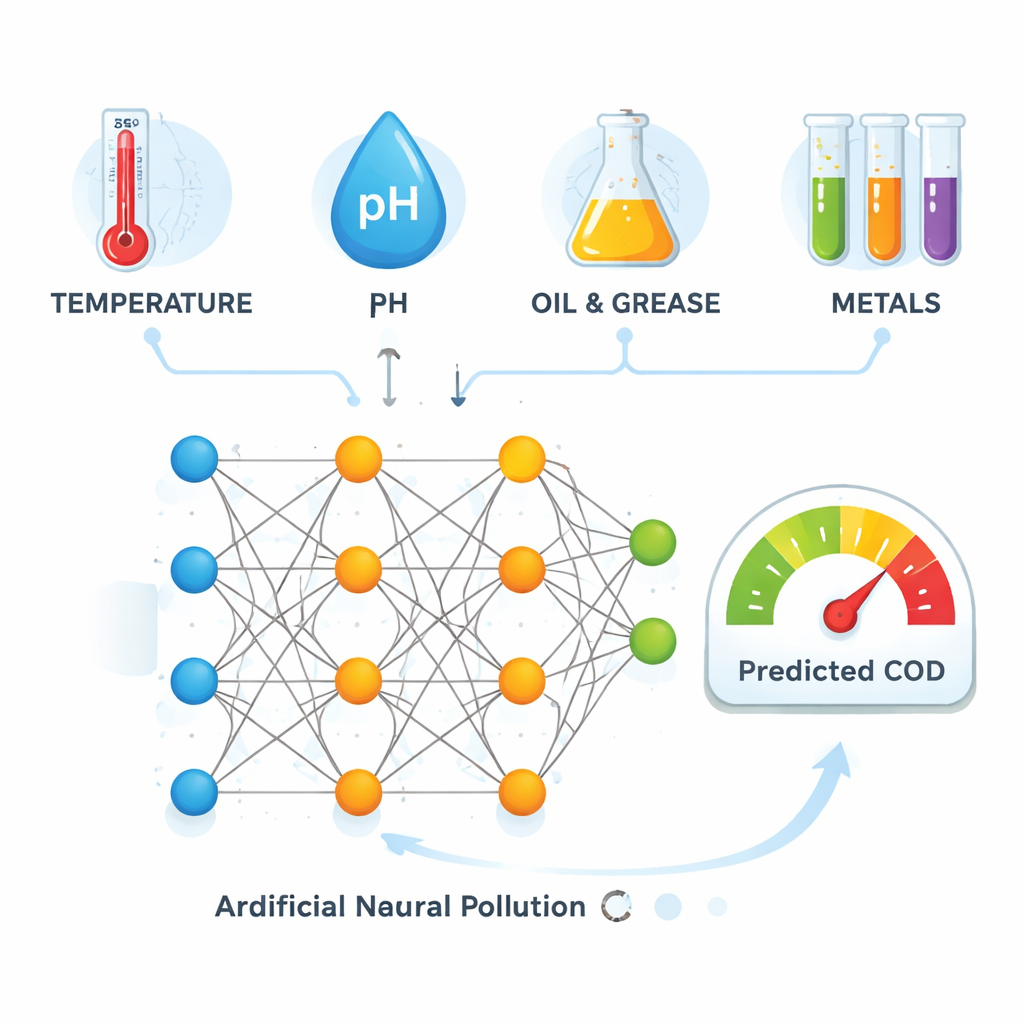
Because running full lab tests can be costly and slow, the team explored whether COD could be predicted from the other, easier‑to‑measure features. First they used a statistical tool called principal component analysis. Rather than looking at each variable separately, this method finds patterns—combinations of measurements that tend to rise and fall together. It helped highlight which factors carried the most information about leachate behavior: temperature, pH, oil and grease, and certain metals stood out. By reducing the number of inputs to just the most informative ones, the researchers hoped to build simpler, faster models that still captured the essentials.
Teaching a Digital ‘Brain’ to Read the Leachate
The heart of the study was a multilayer perceptron, a type of artificial neural network. This digital “brain” learns by being shown examples: measured inputs such as pH or temperature, paired with the actual COD values. The data set of 52 weekly samples was split by season into a training portion and a testing portion, so the model would be challenged with unseen conditions. The team tried four model designs, each using different sets of inputs, and relied on repeated cross‑validation—a method that trains and tests the model on many different splits of the data—to avoid fooling themselves with lucky coincidences. The best performer used just five variables chosen from the earlier pattern analysis and had a structure with one input layer, one hidden layer of 21 nodes, and one output node.
What the Model Can Tell Us
When this best model was tested on data it had never seen before, the predicted COD values lined up closely with the real measurements, with a correlation of 0.864. That means the model captured most of the ups and downs of the landfill’s pollution levels across seasons, even though the total number of samples was modest. Some errors remained, especially at lower COD levels, but the overall performance suggests that a handful of routine measurements can reliably stand in for a full chemical workup. For landfill operators and regulators, this approach offers a practical way to keep tabs on a hazardous liquid while saving time and money.
Cleaner Oversight for a Dirty Problem
In essence, this work shows that smart data analysis and machine learning can turn a complex, expensive testing problem into a manageable one. By training a neural network on a year of seasonal monitoring, the researchers built a tool that can estimate how polluted landfill leachate is from a small set of simpler tests. That does not replace treatment or detailed checks, but it gives decision‑makers a faster warning system and a more efficient way to plan. As similar models are refined and fed more data, they could become standard tools for making sure the liquids beneath our trash stay under control and out of our waterways.
Citation: Gök, G., Gürbüz, O.Ö. & Gürbüz, O.A. Estimating chemical oxygen demand in municipal landfill leachate using multilayer perceptron artificial neural networks based on seasonal monitoring data. Sci Rep 16, 7096 (2026). https://doi.org/10.1038/s41598-026-37497-9
Keywords: landfill leachate, water pollution, artificial neural networks, waste management, chemical oxygen demand