Clear Sky Science · en
Characterizing surface soil heavy metal contamination and source attribution in the Qinghai Lake Basin
Why soil around a remote lake matters
High on the northeastern edge of the Tibetan Plateau lies Qinghai Lake, a vast, sparsely populated basin that supplies grasslands for herders, habitat for wildlife, and a growing draw for tourists. Because heavy metals in soil can linger for thousands of years and move into crops, livestock, and drinking water, understanding even subtle contamination in such a fragile, high‑altitude region is important for anyone who cares about food safety, biodiversity, and how human activity reaches into Earth’s most remote landscapes.
Taking the pulse of a mountain basin
To see how clean the soils of the Qinghai Lake Basin really are, researchers collected 227 samples of surface soil from the top 10 centimeters across the basin, spacing sites roughly five kilometers apart and avoiding obvious human disturbance. They measured the levels of twelve heavy metals, including well‑known pollutants such as lead, chromium, copper, nickel, and zinc, then compared these findings with natural background levels from global rocks and soils, China as a whole, the province of Qinghai, and the nearly untouched Hoh Xil nature reserve. This broad comparison allowed them to distinguish what can be explained by natural geology from what might reflect human influence. 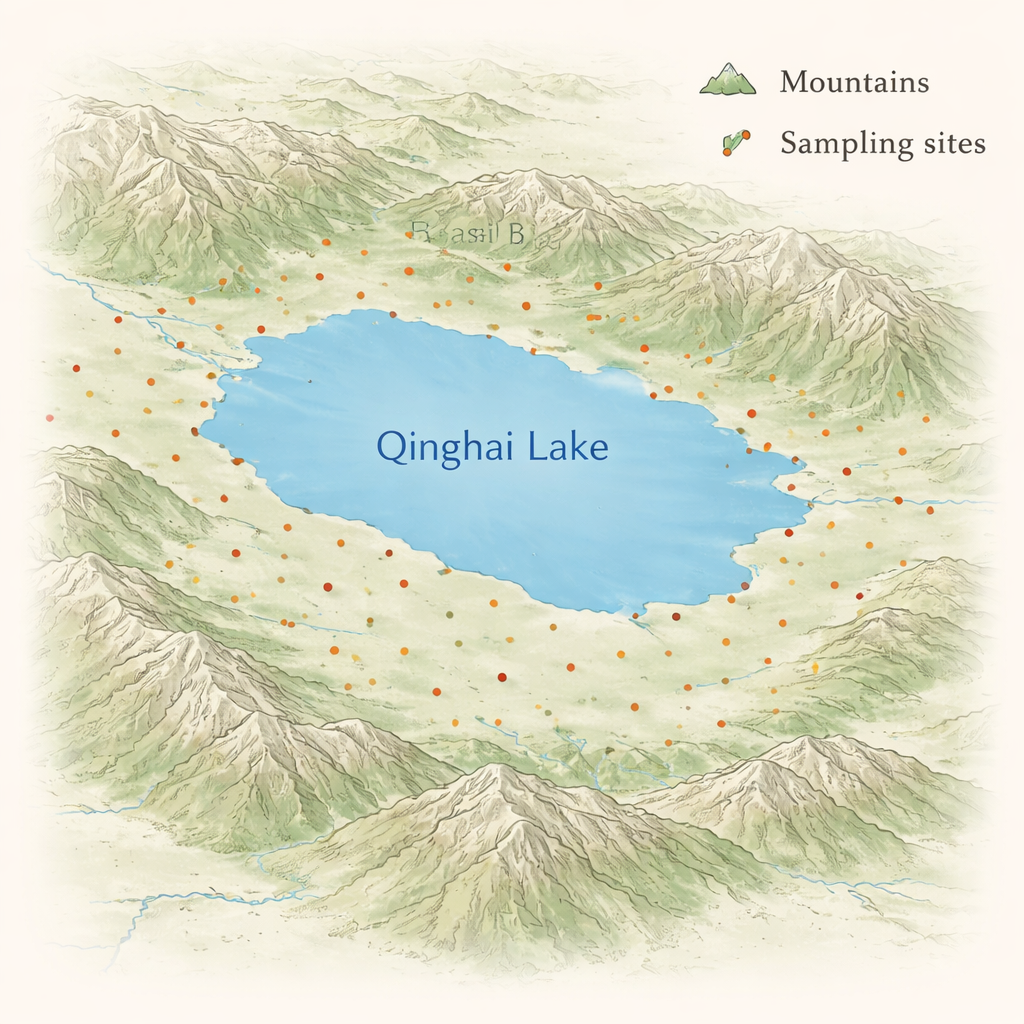
How much metal is too much?
The team used three common yardsticks for soil quality. An “enrichment factor” compares how much of a metal is present relative to a stable reference element; the “geo‑accumulation index” contrasts today’s levels with natural background; and the Nemero index rolls several pieces of information into a single pollution score. Across most of the basin, metal concentrations were close to natural levels found in crustal rocks and background soils. Chromium stood out as consistently somewhat higher than multiple reference values, and a handful of sampling sites showed elevated levels of elements like chromium, niobium, barium, and manganese, hinting at small, local hot spots rather than widespread contamination.
Spotting hidden patterns and likely sources
Because many metals tend to rise and fall together, the researchers applied statistical tools that look for such patterns and then link them to likely sources. Most of the metals—including arsenic, cobalt, copper, manganese, nickel, lead, zinc, vanadium, niobium, and zirconium—clustered in groups that match the composition of local rocks and soils. This points to natural weathering of parent material and wind‑blown dust as the main contributors across the basin. In contrast, chromium behaved differently: it did not closely track other metals and formed its own distinct pattern, especially near roads and settlements. That signature matches what is known from other regions, where particles from tire wear, brake pads, and other traffic‑related sources add chromium to roadside soils.
Local pressures in a mostly clean landscape
When the three pollution indices were mapped, nearly all locations fell into “unpolluted” or only slightly affected categories, and the geo‑accumulation index was below zero for the vast majority of samples—signaling that the basin as a whole has not yet suffered serious heavy‑metal buildup. The sites that did show higher scores were tied to specific human activities: busy roads serving as major corridors across the plateau and areas with concentrated livestock and herder settlements. Here, road traffic and animal husbandry appear to nudge metal levels upward in otherwise clean soils. The authors also note that certain scores, especially for niobium, may look worse than they are because global background values were used where local data are lacking, making some indices very sensitive to a few extreme measurements. 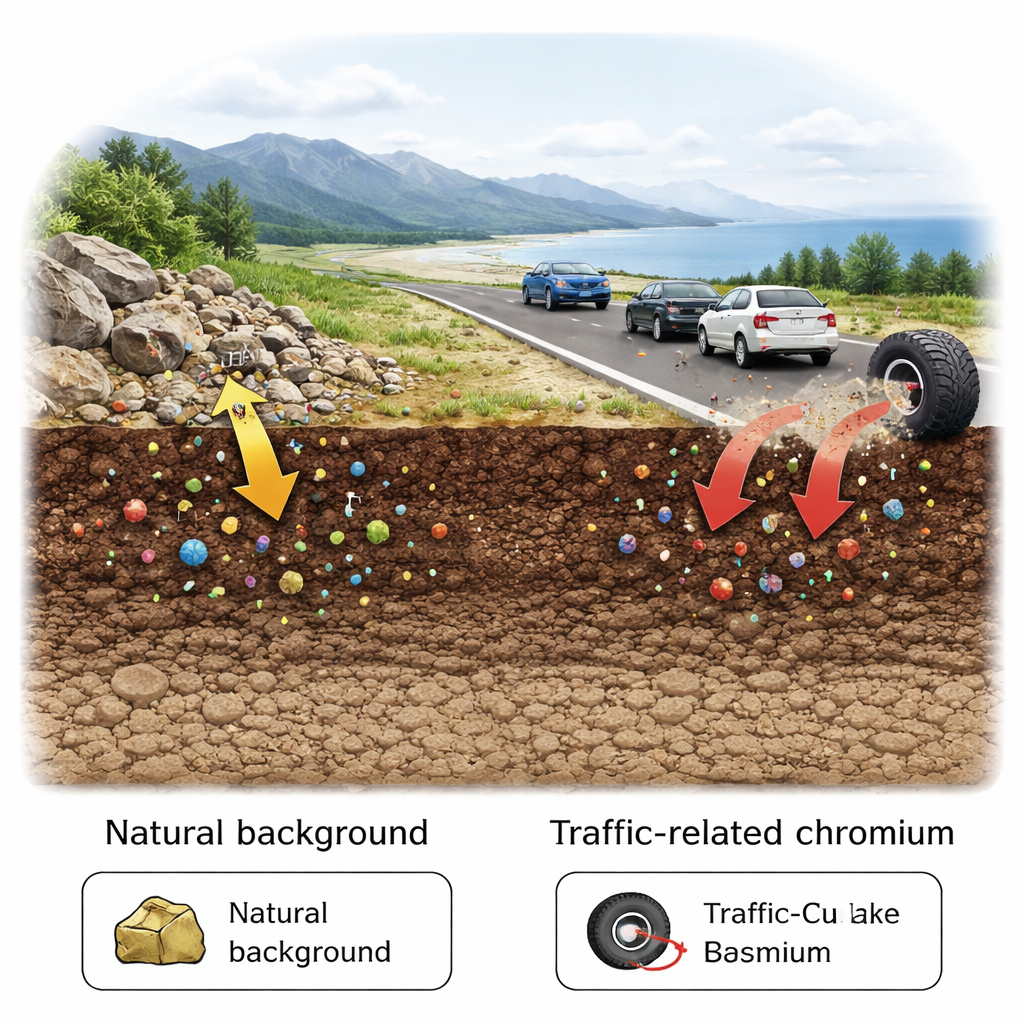
What this means for people and the plateau
For now, the message is reassuring: surface soils around Qinghai Lake are broadly clean, and most heavy metals remain near natural levels set by the region’s geology. Yet the study also offers an early warning. Even in a high‑altitude reserve with little industry and limited farming, road traffic and intensive grazing can create small pockets of elevated metals, especially chromium from tires. Because these elements persist for centuries and can interact with emerging pollutants like microplastics, the authors urge long‑term monitoring along major roads and in heavily grazed pastures, along with stronger ecological safeguards. In simple terms, the basin is in good condition today, but careful management is needed to keep this remote landscape from slowly accumulating a legacy of invisible metal pollution.
Citation: Chen, L., Wang, J., Ling, Z. et al. Characterizing surface soil heavy metal contamination and source attribution in the Qinghai Lake Basin. Sci Rep 16, 6417 (2026). https://doi.org/10.1038/s41598-026-37489-9
Keywords: Qinghai Lake Basin, soil heavy metals, traffic pollution, alpine ecosystems, environmental monitoring