Clear Sky Science · en
Nano packaging with carbon quantum dots and essential oil nanocapsules prolongs shelf life of fresh cut Kale
Why keeping cut greens fresh matters
Anyone who has bought a bag of salad knows how quickly leafy greens can wilt, yellow, and become slimy in the fridge. This study looks at new "smart" packaging ideas for kale that could keep cut leaves looking fresh and nutritious for more than a month, while also cutting food waste and relying less on conventional plastics and chemical preservatives.
Tiny helpers in food packages
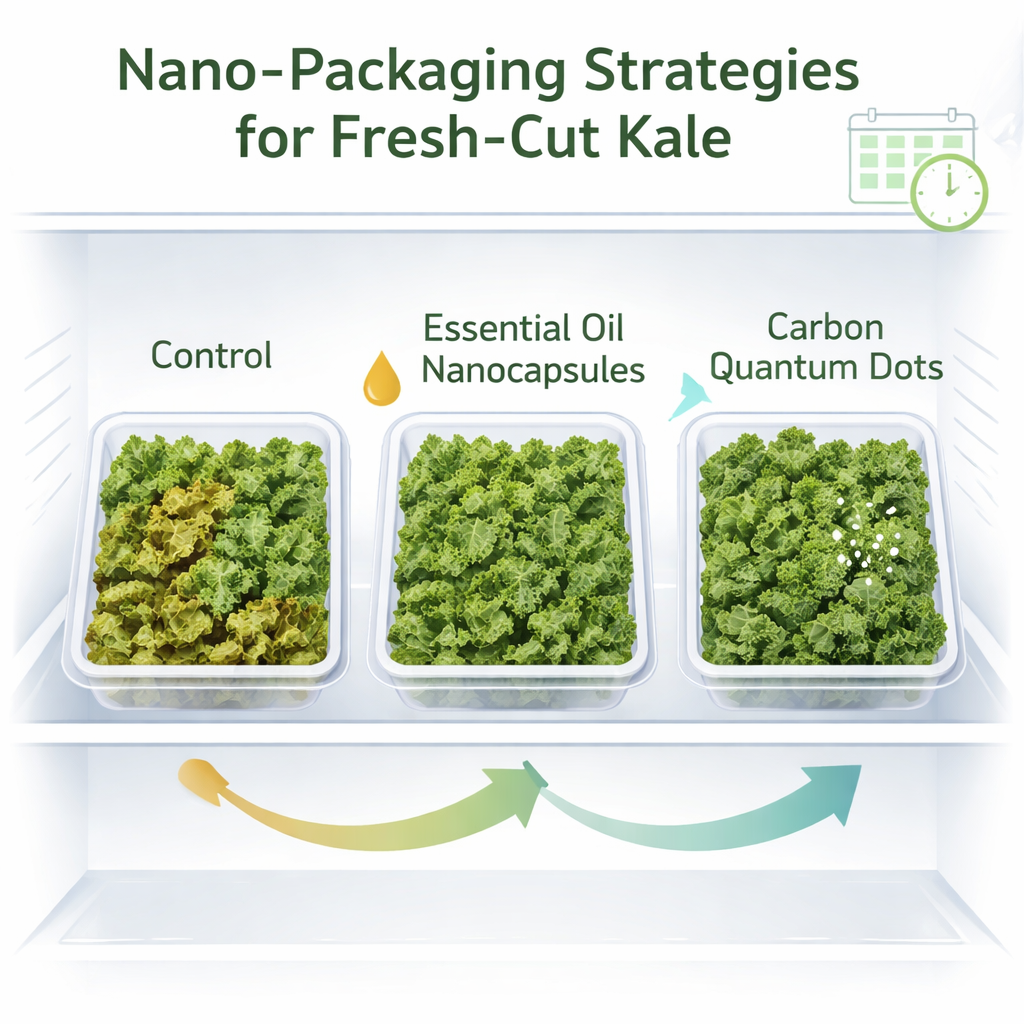
The researchers focused on fresh-cut kale, a nutrient-dense leafy green that spoils quickly after cutting. They tested two advanced packaging helpers placed on absorbent pads inside the container. One used essential oils from aromatic plants, trapped inside tiny capsules to release slowly over time. The other used carbon quantum dots, ultra-small particles made from simple carbon-based ingredients. Both were intended to act as invisible shields: slowing water loss, blocking oxygen, and limiting the growth of microbes that cause spoilage.
How the tests were done
To compare these approaches fairly, the team prepared equal-sized pieces of kale and stored them at standard refrigerator temperatures for up to 40 days. Some containers held untreated kale (the control), some had pads loaded with essential-oil nanocapsules, and others used pads containing carbon quantum dots. At several points during storage, they checked how much weight the leaves had lost, how green they remained, how much vitamin C and other nutrients they retained, how active browning-related enzymes were, and how many bacteria were present.
Freshness you can see and measure
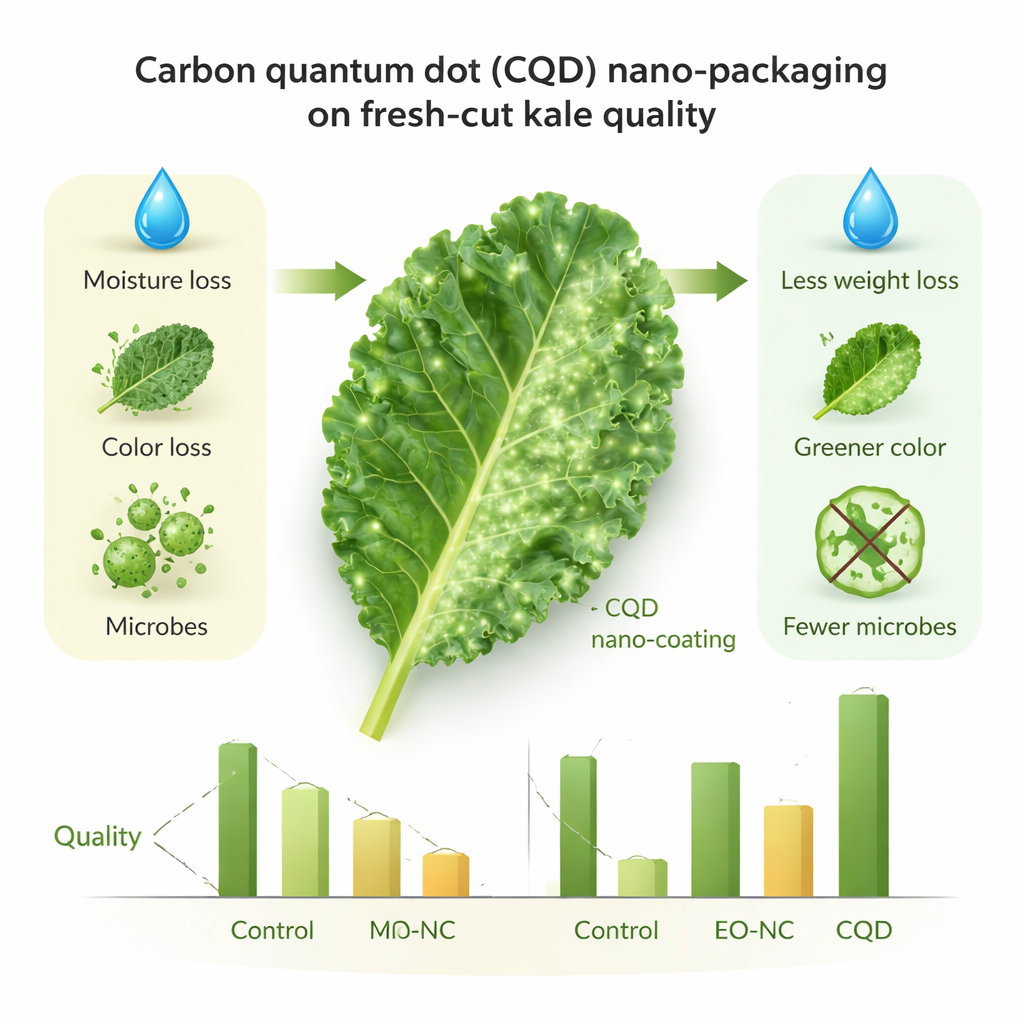
Visually, the differences were striking. After weeks in the fridge, the control kale had lost much of its water, turned yellow and dull, and showed signs of decay. Samples stored with essential-oil capsules kept their color better and dried out less, but the most dramatic improvement came from the carbon quantum dots. These leaves stayed the greenest, lost the least weight, and looked closest to freshly cut kale even after 40 days. Measurements backed up the images: carbon-dot packaging cut weight loss to about one-fifth of the control and preserved chlorophyll—the green pigment that signals freshness—at far higher levels.
Hidden nutrients and unseen microbes
Fresh appearance is only part of the story. The team also found that key nutrients stayed higher when kale was stored with the nano-packaging, especially with carbon dots. Vitamin C and natural antioxidant compounds fell sharply in the untreated samples but were much better preserved in the treated ones. At the same time, the activity of enzymes that drive browning and quality loss was lower under nano-packaging, suggesting that the leaves were under less stress. Microbial counts told a similar story: containers with carbon dots had far fewer bacteria than the control, indicating a strong built-in antimicrobial effect without adding traditional preservatives directly to the food.
What this could mean for your fridge
For everyday shoppers, the main takeaway is simple: carefully designed nano-scale materials in packaging could keep cut greens like kale fresher, safer, and more nutritious for much longer. In this study, carbon quantum dots clearly outperformed plant-based oil capsules, offering the greatest protection against drying, discoloration, nutrient loss, and microbial growth. The work is still at the laboratory stage, and questions about cost, large-scale production, and long-term safety must be answered. But if these hurdles are cleared, the technology could help reduce food waste, let retailers offer higher-quality ready-to-eat vegetables, and give consumers more time to enjoy their greens before they spoil.
Citation: Mirzajani, F., Ebrahimi, R., Weisany, W. et al. Nano packaging with carbon quantum dots and essential oil nanocapsules prolongs shelf life of fresh cut Kale. Sci Rep 16, 6741 (2026). https://doi.org/10.1038/s41598-026-37488-w
Keywords: fresh-cut kale, food packaging, nanotechnology, shelf life, food preservation