Clear Sky Science · en
Optimized scheduling of integrated energy systems considering waste-to-power plants and advanced adiabatic air compression energy storage machines
Turning Trash and Air into Cleaner Energy
Modern cities face two big challenges at once: growing mountains of garbage and the need to cut climate‑warming emissions. This study explores a way to tackle both by linking waste‑to‑energy plants with clever storage machines and fuel‑making units. Instead of letting heat and gases escape up the chimney, the proposed system recycles them into useful energy and cleaner fuels, while a smart control method keeps everything running at lowest cost and lowest pollution.
How the Energy Puzzle Pieces Fit Together
At the heart of the work is a city energy network that must supply electricity, heating, and gas around the clock. The authors start from a waste‑to‑power plant that burns household garbage to generate power and heat. They connect it to wind turbines, solar panels, gas‑fired combined heat and power units, and conventional coal stations. Pipes and cables link these devices so that electricity, heat, and fuel can be shifted where they are needed most. A central scheduling model decides, hour by hour, how much each device should produce so that homes stay warm and lights stay on at the lowest overall cost. 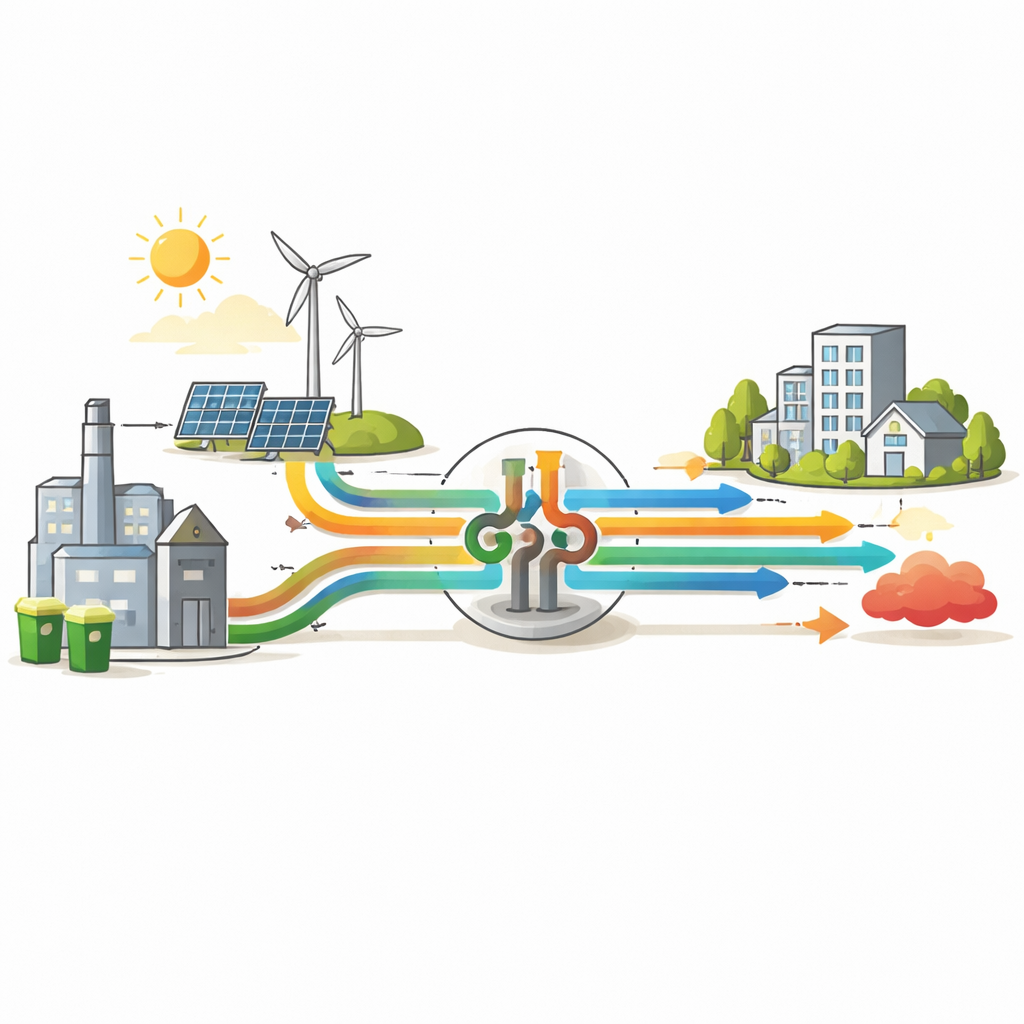
Making Useful Fuels from Stack Gases
Instead of simply cleaning flue gases and releasing them, the system captures two important ingredients: carbon dioxide and nitrogen. Using electricity and water, an electrolyzer produces hydrogen. That hydrogen reacts with the captured carbon dioxide in a reactor to make methane, a gas that can fuel efficient combined heat and power units. At the same time, nitrogen from the flue gas teams up with hydrogen in another reactor to make ammonia. Part of this ammonia is burned alongside coal in a power unit, cutting coal use and emissions; the rest can be sold as a product, adding new income. Heat that would normally be wasted during these chemical steps is recovered by a waste heat boiler and fed back into the heating network, improving overall efficiency.
Storing Energy in Squeezed Air and Hot Tanks
The study also brings in an advanced compressed‑air energy storage system. When there is plenty of wind and sun, surplus electricity drives air compressors. Squeezing the air generates large amounts of heat, which is stored in insulated tanks, while the compressed air itself is held in a cavern‑like reservoir. Later, when electricity or heat is in short supply, the process is reversed: stored heat warms the air as it expands through turbines to generate power, and heat can also be sent directly to buildings. By shifting energy from hours of surplus to hours of need, this device helps the waste‑to‑power plant and renewables work together smoothly across the day. 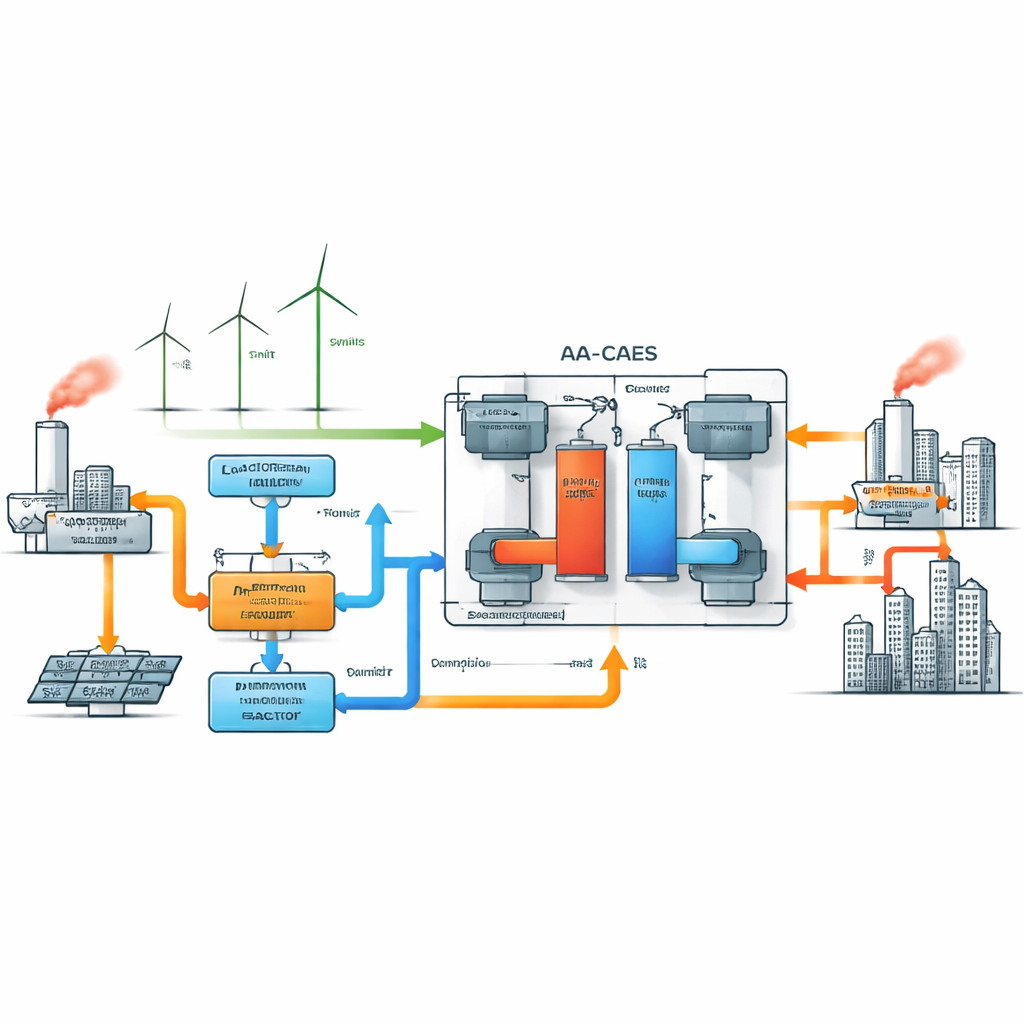
Testing Different Build‑Out Choices
To see which combination of technologies pays off, the authors model four scenarios. The simplest uses only the link between the waste plant and methane production. Successive cases then add waste‑heat recovery, ammonia production, and finally the compressed‑air storage system. The most advanced configuration delivers the best results: it uses all the available wind and solar energy, eliminates the need to buy outside heat, cuts coal use, and lowers carbon emissions by about one‑seventh compared with the basic case. Despite higher upfront equipment costs, savings in fuel purchases and carbon charges, along with revenue from selling ammonia, bring the total operating cost down by about one‑fifth.
A Smarter Way to Run the System
Coordinating this many devices is a complex mathematical task, so the team refines a popular search method known as particle swarm optimization. By adjusting its internal parameters on the fly and adding a local fine‑tuning step, their improved version finds cheaper, more stable operating plans than standard approaches. They also show that raising the temperature of the air going into the compressors increases both the heat available for buildings and the useful storage capacity, further reducing overall costs and emissions.
What This Means for Everyday Life
Put simply, the study suggests that tomorrow’s low‑carbon cities could turn trash, air, and surplus renewable electricity into a flexible web of power, heat, and clean fuels. By recovering waste heat, making synthetic gas and ammonia, and storing energy in compressed air and hot tanks, city energy systems can cut fuel bills, curb greenhouse gases, and put renewable power to full use. With smarter scheduling, these technologies work together as a coordinated whole, pointing to a practical path for cleaner, more efficient urban energy.
Citation: Wang, W., Liu, M., Zhao, H. et al. Optimized scheduling of integrated energy systems considering waste-to-power plants and advanced adiabatic air compression energy storage machines. Sci Rep 16, 8041 (2026). https://doi.org/10.1038/s41598-026-37485-z
Keywords: waste-to-energy, energy storage, low-carbon power, synthetic fuels, integrated energy systems