Clear Sky Science · en
Optimizing agricultural production for economic sustainability of sunflower across climatic zones
Why smarter sunflower farming matters
Sunflower oil is a staple in many kitchens, and Türkiye is one of the world’s leading producers—yet it still has to import large amounts of sunflower seed. At the same time, farmers are facing hotter summers, shifting rains, and rising costs for water and fertilizer. This study asks a practical question that matters to anyone concerned with food prices and sustainability: if we fine‑tune when and how we grow sunflowers in different parts of Türkiye, can we earn more from each field while using scarce water and fertilizers more wisely?
Harvesting insight from virtual fields
Instead of testing every possible farming strategy in real fields—which would be expensive and take decades—the researchers turned to an advanced crop simulation tool called DSSAT. They fed the model 30 years of daily weather records, detailed soil information, and the traits of a popular sunflower variety. Then they created 1,000 different “what‑if” scenarios that combined planting dates, irrigation rules, and nitrogen fertilizer doses for three contrasting regions: rainy, temperate Edirne in Thrace; warm, fertile Adana on the Mediterranean coast; and dry, high‑plain Konya in Central Anatolia. For each virtual season, the model calculated how the plants would grow, what yield they might produce, how much water and fertilizer they would use, and—crucially—how much profit a farmer could make at current market prices. 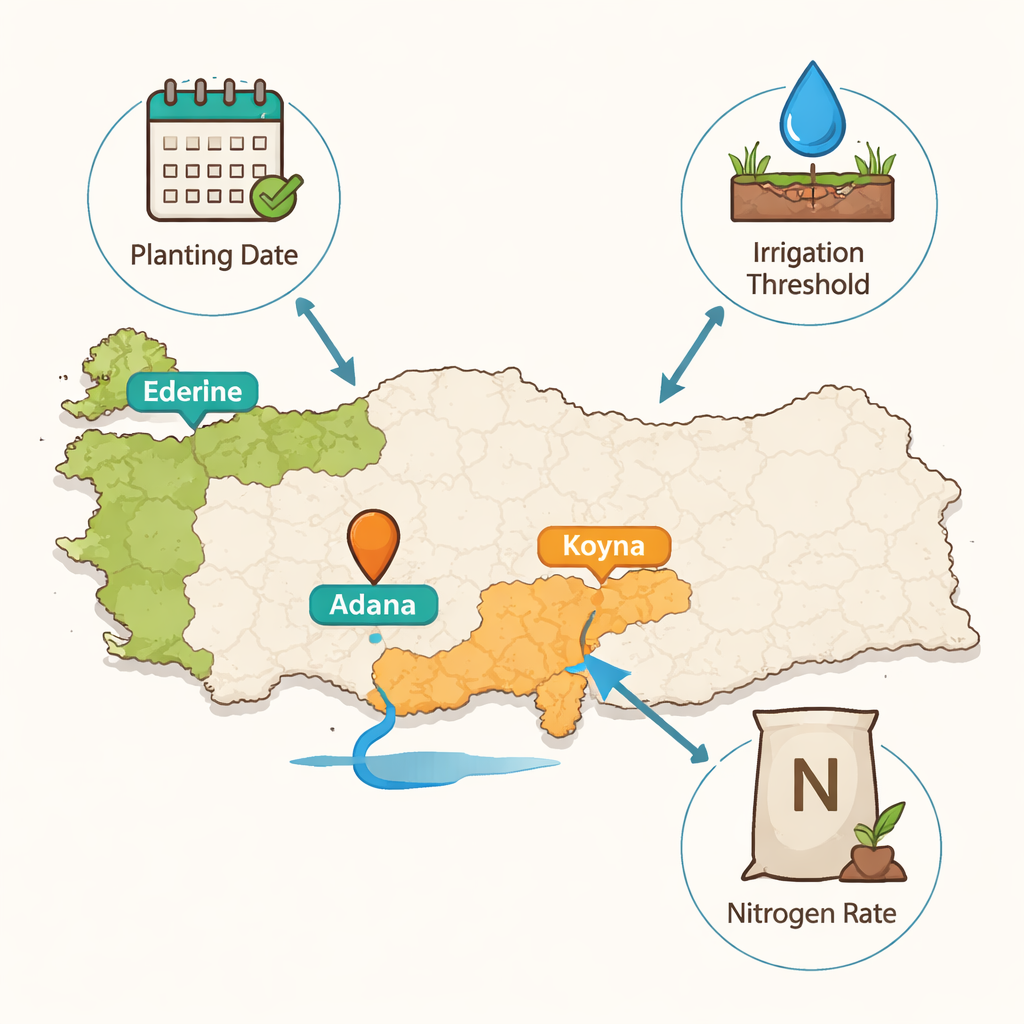
Timing the seed to the season
One of the clearest results concerned planting dates. The most profitable time to sow was not the same everywhere, and it did not always match traditional practice. In Edirne, the model pointed to late March as the sweet spot, earlier than the usual April planting. Long‑term records show that damaging frosts have become rare in this window, so farmers can safely take advantage of cooler, moist spring weather before summer heat arrives. In Adana, the best date clustered around the end of April, while Konya’s chillier, semi‑arid climate favored sowing in early May, when soils have finally warmed but the hottest days are still ahead. By aligning planting with local temperature and frost patterns, the simulations showed that farmers could boost yields and profits without changing the crop itself.
Getting more from every drop of water
Water strategy was just as important. The study tested irrigation rules based on how much usable water remained in the top part of the soil. Rather than keeping fields near “full” all season, the most profitable approach turned out to be a form of controlled thirst. In Edirne and Adana, profits peaked when irrigation was triggered once the soil had dried to about two‑fifths of its usable water; in Konya, the optimal trigger was about half. Irrigating more often did increase raw yield, but the extra water and pumping costs ate into net income. Under these optimized rules, sunflower fields produced more grain per unit of water, and in Konya and Adana the switch from purely rain‑dependent farming to smart supplemental irrigation turned average losses into strong gains over the 30‑year period.
Balancing fertilizer use and farm income
Nitrogen fertilizer brought another trade‑off. When the team looked purely at efficiency—how many kilograms of seed came from each kilogram of nitrogen—the lowest fertilizer doses won. But farmers are paid for total tonnes, not efficiency ratios. When economic returns were calculated, higher nitrogen rates proved more attractive: roughly 250 kilograms per hectare in Edirne and 300 in Adana and Konya. At these levels, each extra unit of fertilizer still added enough grain to outweigh its cost, even though efficiency per unit declined. The authors caution, however, that very high nitrogen can reduce oil quality, increase the risk of plants toppling over, and raise environmental concerns. They argue that 300 kilograms per hectare should be treated as a sensible upper limit until more is known about long‑term soil and water impacts. 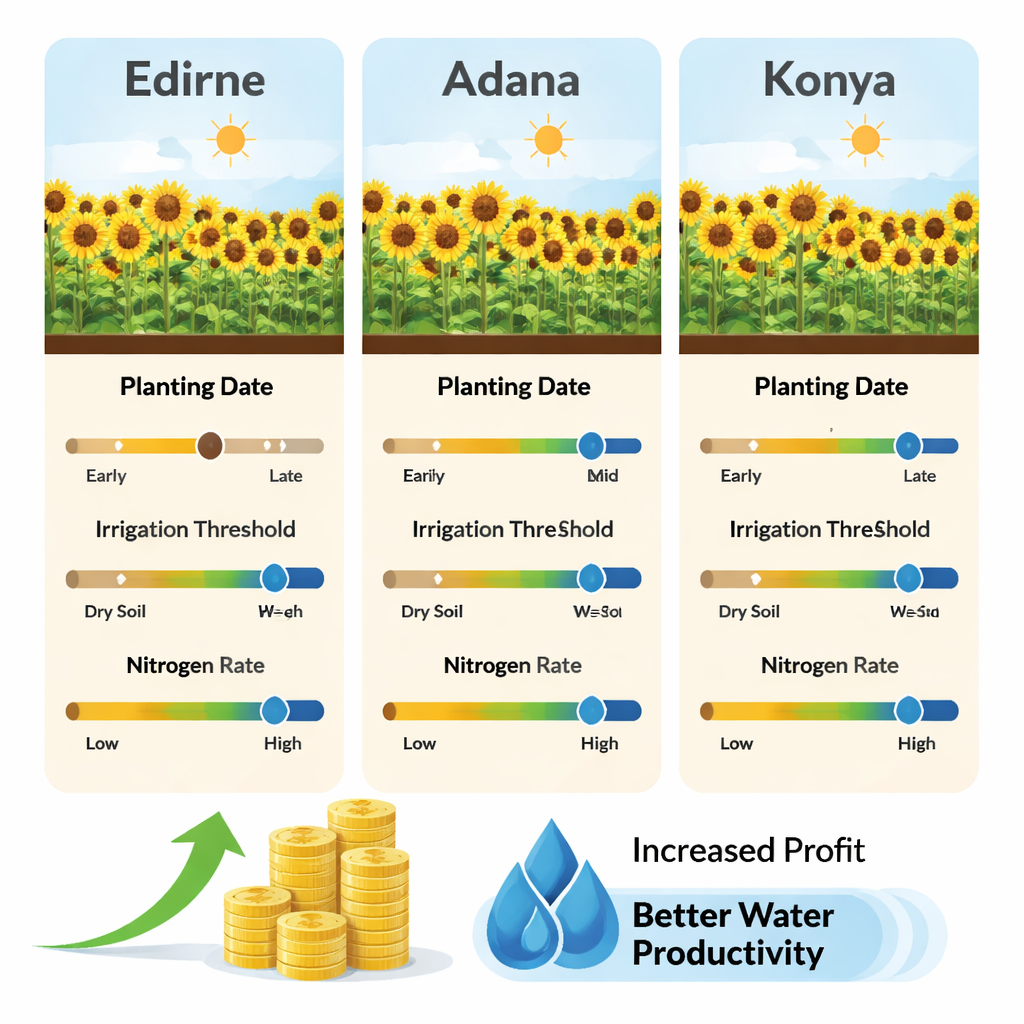
What this means for food and farmers
Put simply, the study shows that small shifts in when farmers plant, how strictly they ration irrigation, and how much fertilizer they apply can make sunflower production both more profitable and more resilient to climate swings. Across thousands of simulated seasons, the best combinations for each region consistently delivered positive returns, even in bad weather years. While the results are based on computer models and one sunflower variety, and still need on‑farm testing in some areas, they offer a clear message for growers and policymakers: using data‑driven planning tools like DSSAT, countries can design region‑specific “recipes” for crops that stretch limited water and fertilizers further, strengthen farm incomes, and reduce the need for imports without expanding farmland.
Citation: Gürkan, H., Bulut, H. & Hoogenboom, G. Optimizing agricultural production for economic sustainability of sunflower across climatic zones. Sci Rep 16, 6437 (2026). https://doi.org/10.1038/s41598-026-37479-x
Keywords: sunflower farming, irrigation management, fertilizer use, climate-smart agriculture, crop modeling