Clear Sky Science · en
Evaluation of heavy metal contamination in coastal aquifer groundwater of Alappuzha district (Kerala, India) using OSPRC framework
Why this coastal water story matters
For many families in Kerala’s Alappuzha district, the water drawn from a backyard well is the main source of drinking and cooking water. This study asks a simple but vital question: how safe is that groundwater when it is exposed to tourism, farming, waste, and the rising pressures of climate change? By tracking tiny amounts of metals such as arsenic, iron, and aluminum in shallow wells, the research shows where the problems are emerging, why they occur, and how a structured risk framework can help protect public health in this fragile coastal setting.
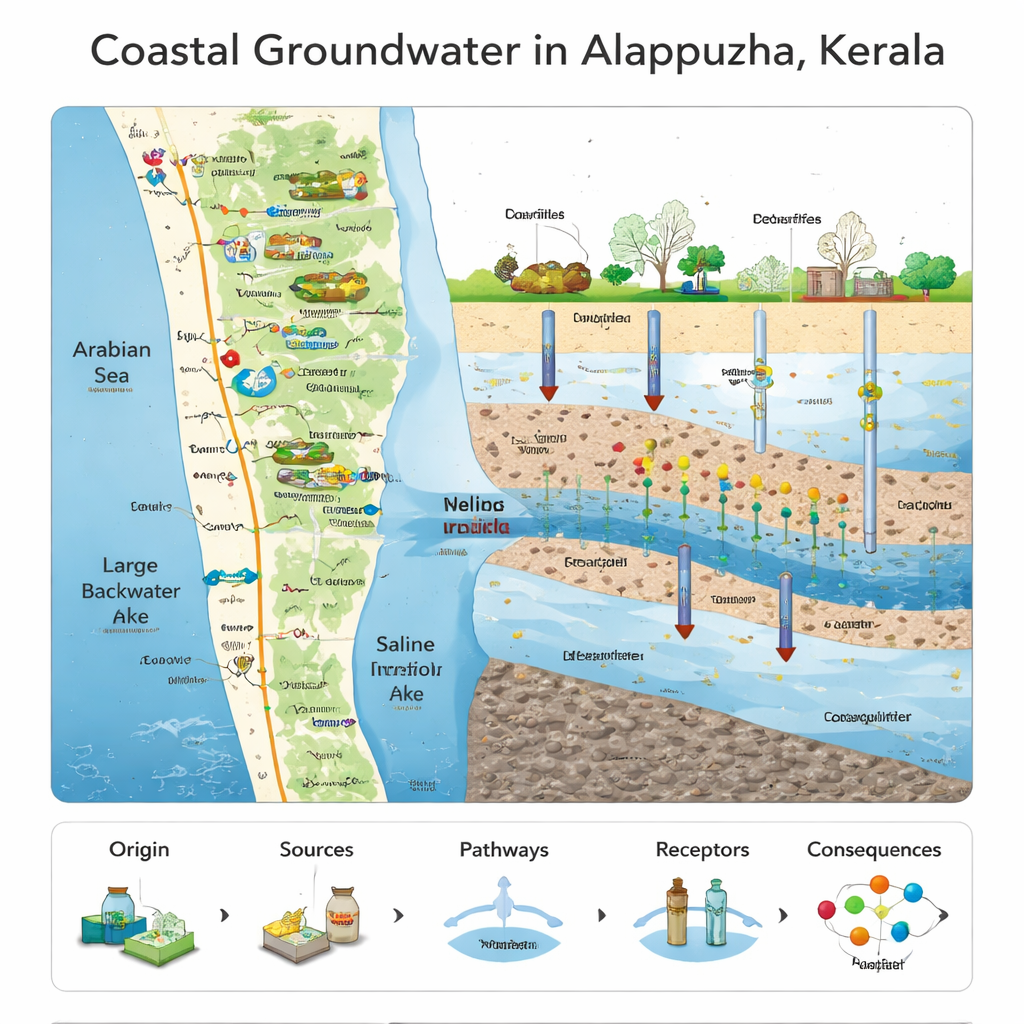
A coastal landscape under pressure
Alappuzha, often called the “Venice of the East,” lies between the Arabian Sea and Vembanad Lake, a vast backwater system and Ramsar wetland. Despite abundant rivers and canals, many residents depend on shallow groundwater just one to four meters below the surface. These aquifers are easily influenced by salty water from the sea, pollution from coir and brick industries, and runoff from intensely farmed paddy fields. Rapid growth in tourism, urban areas, and agriculture has increased the chances that harmful substances, including heavy metals, can seep underground and reach household wells.
How the team checked the wells
To understand the scale of the issue, the researchers collected 50 groundwater samples from open and bore wells across the district during two seasons: pre-monsoon (June 2021) and post-monsoon (January 2022). They tested each sample for 12 trace metals, including arsenic (As), lead (Pb), cadmium (Cd), chromium (Cr), nickel (Ni), copper (Cu), iron (Fe), aluminum (Al), manganese (Mn), barium (Ba), strontium (Sr), and cobalt (Co), and compared the results with World Health Organization (WHO) drinking-water guidelines. Using geographic information systems (GIS), they created maps showing where each metal was higher or lower, and applied several pollution indices to summarize how seriously each area was affected.
What was found in the water
The good news is that most trace metals stayed within the recommended limits. However, three metals stood out as concerns: arsenic, aluminum, and iron. Arsenic exceeded WHO limits in about 8–10% of samples, especially near coastal paddy fields and areas of intense agriculture, likely linked to certain pesticides and to natural chemical changes in the sediments. Aluminum was too high in about 8% of samples, particularly near coastal belts and urbanized zones that receive industrial and domestic waste. Iron, mostly from natural rock and soil, rose above the guideline in 4–8% of wells, more often after the monsoon when heavy rains enhance leaching from iron-rich lateritic rocks. When the researchers combined all metals into a Heavy Metal Pollution Index, roughly one-third of the wells in both seasons fell into a “medium to high” pollution category, marking clear hotspots around Ambalapuzha, Alappuzha town, and nearby villages.
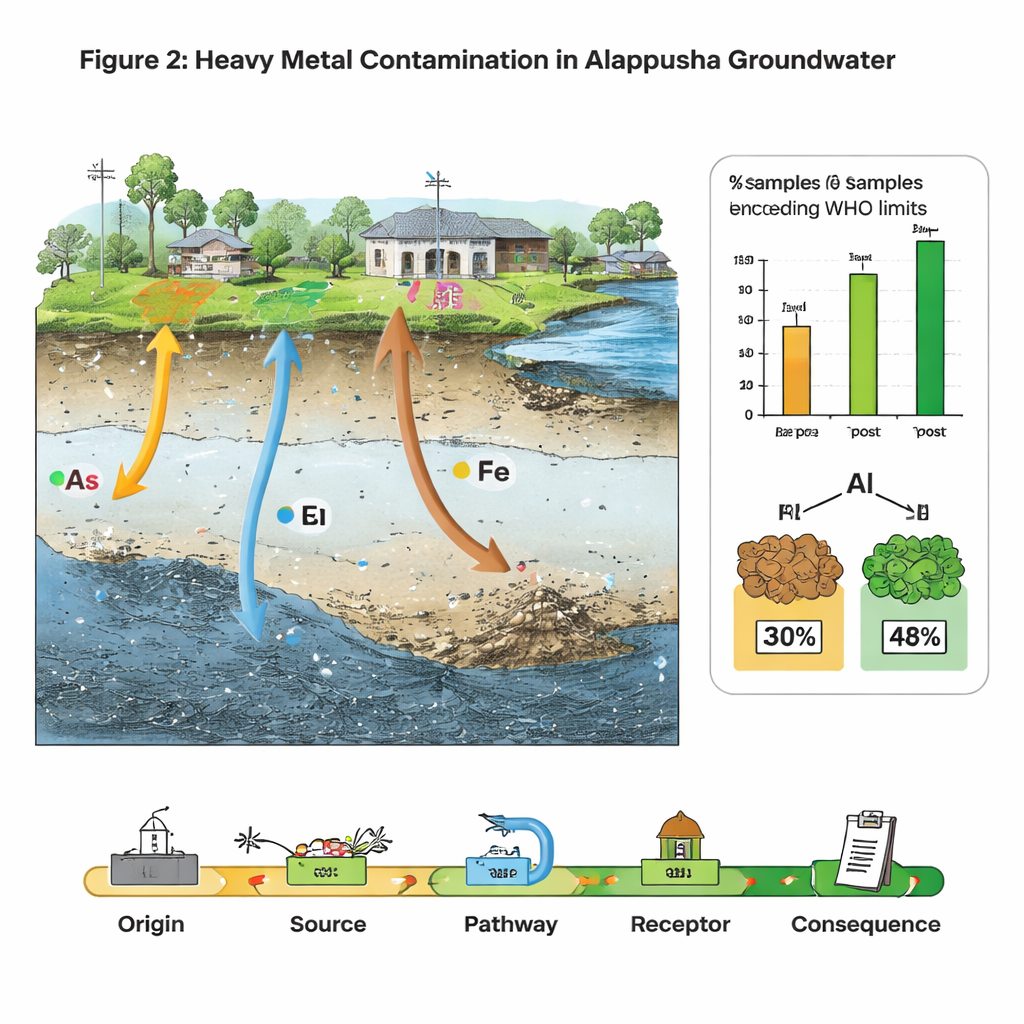
Following the journey of contaminants
To go beyond simple measurement, the team used an Origin–Source–Pathway–Receptor–Consequence (OSPRC) framework. “Origin” distinguishes whether metals come from natural geology or human activities. “Source” pinpoints particular contributors, such as fertilizers, sewage, or industrial effluent. “Pathway” tracks how metals move—via agricultural runoff, leaking waste sites, or groundwater flow in sandy aquifers that lie just below the surface. “Receptors” are the people, plants, and ecosystems that ultimately receive the contamination, while “Consequences” capture health and social impacts, from skin disorders due to arsenic to possible neurological effects of long-term aluminum exposure. Applied to Alappuzha, this framework shows how monsoon rains, backwater flooding, and shallow water tables work together to mobilize metals into wells used by households, especially in low-lying coastal and tourist areas.
Steps toward safer wells
For a lay reader, the central message is that most wells in Alappuzha are still usable, but a worrying minority now carry arsenic, aluminum, or iron at levels that should not be ignored. The study suggests practical responses: targeted treatment methods (such as iron-based filters for arsenic or simple coagulation–filtration for iron and aluminum), protection of recharge zones from farm chemicals and sewage, stricter controls on waste from nearby towns and industries, and long-term monitoring that reflects seasonal and climate-driven changes. By combining precise measurements with the OSPRC risk framework, the work offers a template that local authorities, health officials, and communities can use to identify problem areas early and to design affordable, sustainable solutions that keep well water safe in this vulnerable coastal region.
Citation: Sekar, S., Nath, A.V., Kamaraj, J. et al. Evaluation of heavy metal contamination in coastal aquifer groundwater of Alappuzha district (Kerala, India) using OSPRC framework. Sci Rep 16, 6838 (2026). https://doi.org/10.1038/s41598-026-37477-z
Keywords: groundwater contamination, heavy metals, coastal aquifer, Kerala India, arsenic in drinking water