Clear Sky Science · en
A new method for predicting the shear strength of loess based on moisture content and large and medium pore volume
Why this fragile soil matters
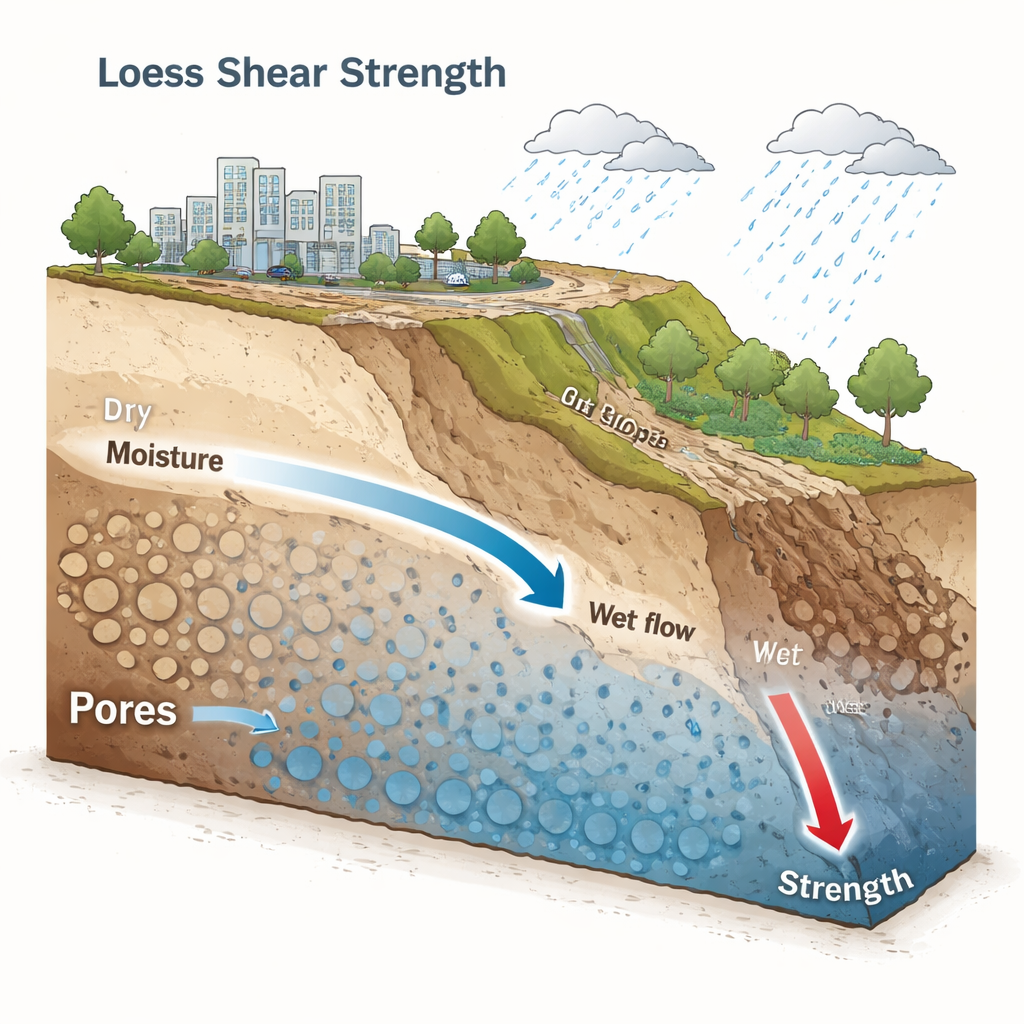
Across northern China’s Loess Plateau, towns, roads, and dams are built on a deceptively soft, powdery soil called loess. This soil can stand tall and strong in dry weather, yet suddenly weaken and collapse after heavy rain, triggering landslides and building damage. The study summarized here looks inside this soil at the tiny voids between grains and shows how two simple factors—how wet the soil is and how many larger pores it contains—can be used to predict how strong, or how fragile, loess will be.
Hidden structure inside a common soil
Loess is not an ordinary dirt. It is a wind-blown deposit made of fine silt, with a “metastable” structure: grains are lightly glued together by salts and clays, and held apart by a network of relatively large pores. This open framework can carry buildings and slopes safely when it is dry, but it is highly sensitive to water. Traditional engineering formulas for soil strength often require hard-to-measure quantities, such as detailed water–pressure relationships, which are especially unreliable for such fragile materials. The authors propose a different route: focus on two things that are easier to measure—moisture content and the share of pore space occupied by large and medium-sized pores (they call this share PLM)—and ask whether these alone can reliably predict how loess will behave under load.
How the team probed strength and pores
The researchers collected intact blocks of loess from construction sites near Xi’an on the Loess Plateau and carefully shaped them into cylindrical specimens without disturbing their natural layering. They then adjusted each specimen to one of several target moisture levels, ranging from very dry (5%) to quite wet (25%), representing conditions from drought to intense rainfall. Using a triaxial testing machine—essentially a press that squeezes the soil while controlling surrounding pressure—they measured how much shear stress each specimen could resist before failing. In parallel, they used mercury intrusion tests to map out the sizes and volumes of pores inside the soil, allowing them to calculate PLM, the percentage of total pore volume made up by larger and medium pores that form the open framework.
What happens as water and pressure change
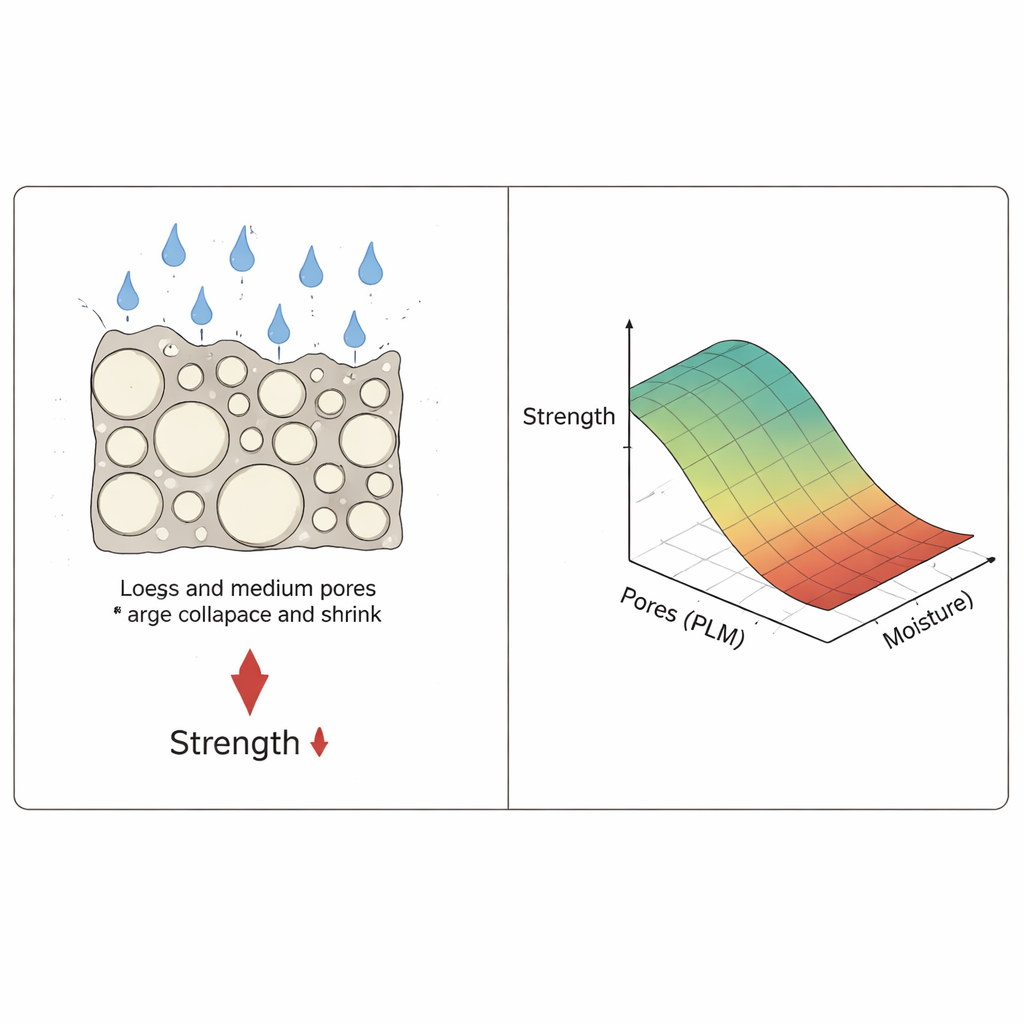
The tests revealed clear patterns that link everyday conditions—rainfall and overlying weight—to microscopic shifts inside the soil. At low moisture, loess samples showed high strength but failed in a brittle fashion, splitting along sharp cracks when pushed. As moisture rose, the salts and weak bonds at pore walls dissolved, and water lubricated the contacts between grains. The large and medium pores began to collapse, the soil compacted, and its strength dropped, especially under lower surrounding pressures like those near the ground surface. Detailed pore measurements showed that the total volume of large and medium pores shrank markedly after shearing, while smaller pores changed much less. Statistically, changes in these larger pore classes were tightly linked to the loss of shear strength, whereas changes in tiny pores were not. The PLM index therefore captured the part of the pore system that truly controls whether loess stands firm or gives way.
A simple model with two practical knobs
Armed with hundreds of measurements, the authors built a mathematical surface that relates shear strength to just two inputs: water content and PLM. In this model, increasing moisture and increasing PLM both push strength downward, because more water speeds up bond dissolution and a larger fraction of big pores means more “empty space” ready to collapse. Even though the equation was fitted from data, its shape reflects the physical picture: water weakens bonds and suction, while PLM measures how much of the skeleton is made of vulnerable, open pores. When they tested the model on new samples, the predicted strengths matched measured values within about 1.6 percent—good enough for most real-world design decisions.
What this means for safety on the Loess Plateau
For engineers and planners working in loess regions, this study offers a practical way to anticipate where slopes, embankments, or foundations may be at risk. Instead of relying on complex, hard-to-calibrate theories, they can measure moisture and use lab or future field methods to estimate PLM, then feed these into a two-variable model to estimate shear strength. In everyday terms, the work shows that how wet the soil becomes, and how much of it is made of larger voids, together control whether loess behaves like a solid or like a collapsing sponge. By quantifying this relationship, the new method can help guide safer designs, better drainage measures, and more reliable hazard assessments in landscapes built on this delicate soil.
Citation: Zhang, Y., Zhou, C., Bian, M. et al. A new method for predicting the shear strength of loess based on moisture content and large and medium pore volume. Sci Rep 16, 6602 (2026). https://doi.org/10.1038/s41598-026-37476-0
Keywords: loess, slope stability, soil microstructure, shear strength, unsaturated soil