Clear Sky Science · en
Active optical boundary recognition with boron powder injection in a magnetic confinement device
Why the Edge of a Fusion Plasma Matters
Nuclear fusion aims to power the future by recreating the reactions that light up the Sun, but doing this on Earth means trapping an ultra‑hot, electrically charged gas—plasma—inside powerful magnetic fields so it never touches the reactor wall. The exact location of the plasma’s outer edge is critical: it determines how safely and efficiently a fusion device can run, and how close we are to practical fusion power. This paper introduces a new way to “draw” that invisible edge in real time by sprinkling in tiny grains of boron and watching where they light up.
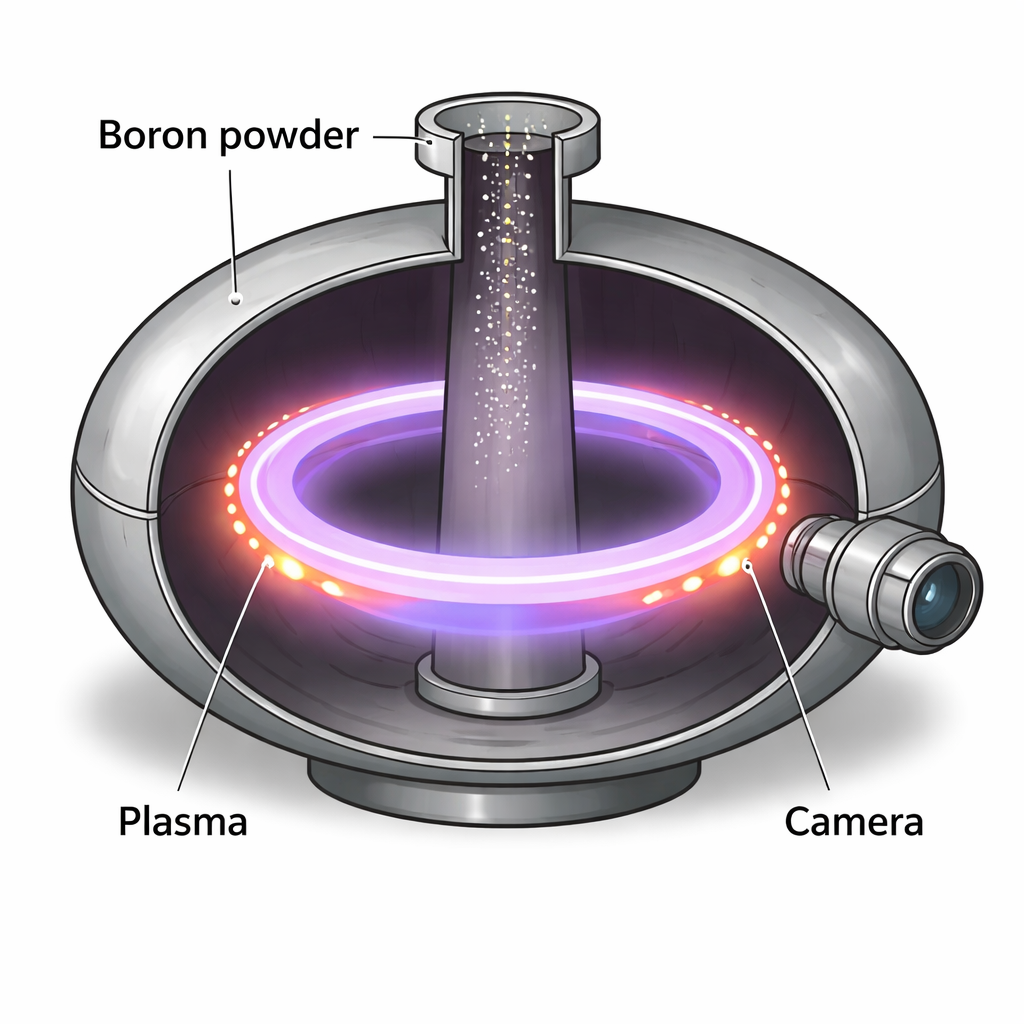
Finding the Invisible Edge
In a doughnut‑shaped fusion device called a tokamak, the plasma is confined by carefully shaped magnetic fields. The boundary of the well‑confined region, known as the last closed flux surface, acts like an invisible fence: inside it, particles circle around; outside it, they escape and hit the walls. Traditional methods infer this boundary indirectly from magnetic sensors or from the faint light naturally emitted near the edge. These techniques work well under steady, bright conditions, but they can drift over long operation times or become unreliable when the plasma changes quickly or glows only weakly. As fusion machines move toward long‑lasting, reactor‑like operation, engineers need boundary measurements that are faster, more precise, and less dependent on complex computer models.
Sprinkling Boron as a Tracer
The authors tested a simple yet clever idea on the EXL‑50U spherical tokamak: use tiny boron powder grains as active tracers. Boron is already employed in fusion devices to coat walls and improve performance, so introducing a small extra amount is acceptable. In this experiment, boron particles were dropped from the top of the machine so they fell straight down under gravity. At first they moved through empty vacuum, but when they reached the plasma’s hot edge they rapidly heated and “ablated,” turning into a bright cloud of glowing boron ions. This glow appears in a specific red region of visible light, which makes it easy to isolate with cameras and optical filters. Where the boron lights up marks where the plasma’s magnetic fence meets the falling particles.
Turning Light Spots into a Measured Boundary
To convert these bright spots into a precise boundary measurement, the team used carefully calibrated visible‑light cameras viewing the plasma from known positions. When a boron cloud flared up, they identified its image location on the camera sensor and traced a line from the camera’s lens through that point into a 3D model of the reactor. Because they also knew the plane in which the boron was injected, they could compute exactly where in space the ablation occurred. Repeating this during a discharge produced a series of marker points lying right at the plasma edge. The researchers compared these active markers with boundaries reconstructed from more conventional optical images of hydrogen emission. In regions where the standard method is reliable, the boron‑based markers agreed well. Importantly, near the divertor—the bottom region where exhaust heat and particles are handled—background light often overwhelms passive signals, but the boron flashes remained clear and gave a more trustworthy reference.
Building a Practical Diagnostic System
Beyond proof‑of‑principle, the authors outlined how to turn this idea into a practical tool for future fusion devices. They designed a system with multiple boron injectors along a U‑shaped flange on top of the reactor and an array of fast light detectors equipped with a narrow filter that only passes the distinctive boron light near 703 nanometers. As boron grains fall and ignite at the edge, each detector sees a sharp peak in brightness along its line of sight. By combining information from many injectors and detectors, the system can reconstruct how the boundary shifts in three dimensions over time, with modest computing power. Tests with different injection amounts showed that, when kept within a few milligrams per second, the added boron hardly disturbed key plasma conditions such as current, density, and core temperature.
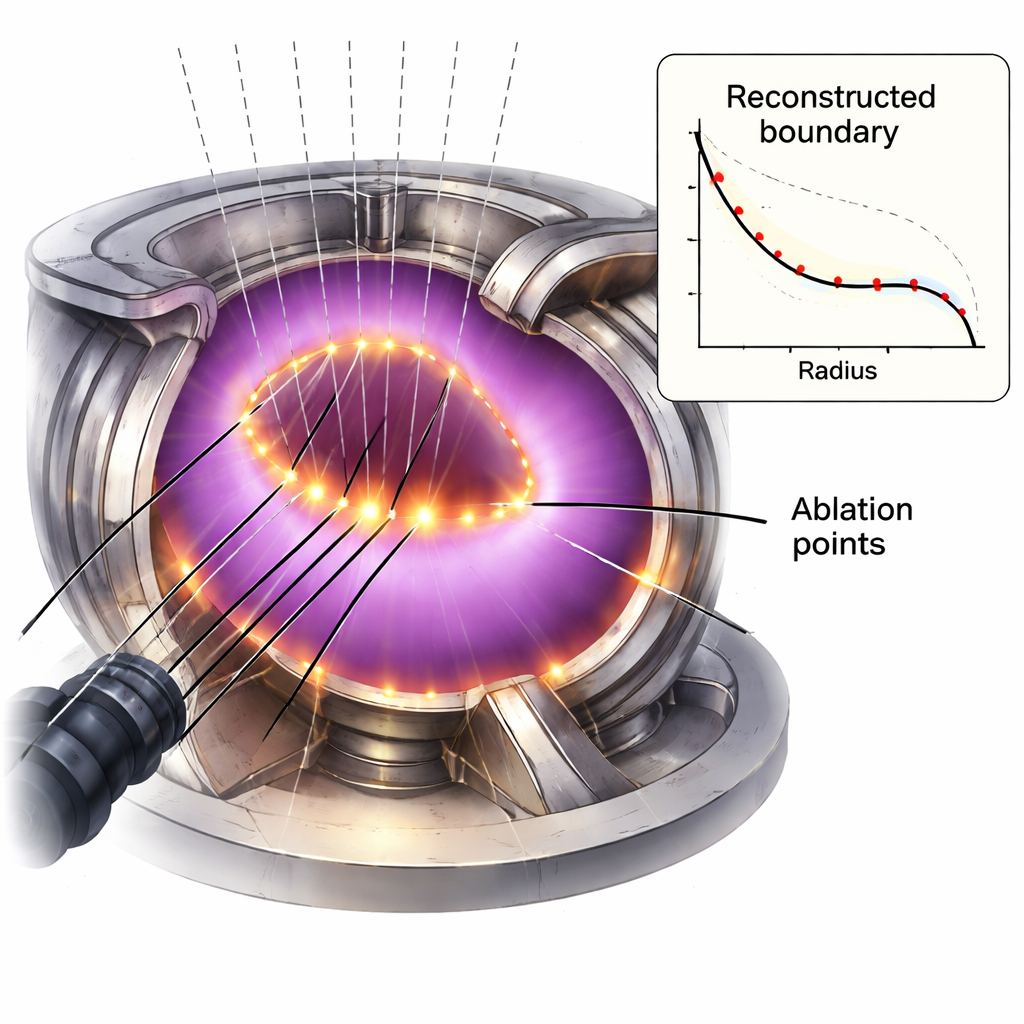
Implications for Future Fusion Reactors
This active boron marking method gives fusion researchers a new, relatively simple way to watch the plasma edge in real time, even in visually cluttered regions where traditional cameras struggle. Because it depends mainly on geometry and camera calibration rather than on detailed plasma models, it offers a more direct and potentially more reliable measurement of the boundary. In future, using several cameras and faster detectors could turn these glowing tracer grains into a powerful control tool, helping operators keep the plasma well centered and stable during long pulses. In plain terms, the study shows that a carefully aimed sprinkle of boron dust can act like a high‑tech highlighter pen, tracing the outline of the plasma’s invisible magnetic cage and bringing us a step closer to practical fusion energy.
Citation: Guo, D., Shi, Y., Xie, Q. et al. Active optical boundary recognition with boron powder injection in a magnetic confinement device. Sci Rep 16, 6326 (2026). https://doi.org/10.1038/s41598-026-37469-z
Keywords: fusion plasma boundary, tokamak diagnostics, boron powder injection, optical imaging, plasma control