Clear Sky Science · en
Performance enhancement of perovskite solar cells through plasmonic titanium nitride nanoparticles
Why better solar cells matter to everyday life
Solar panels are getting cheaper and more common on rooftops, in fields, and even on backpacks. But today’s panels still waste a lot of the Sun’s energy, especially the red and near‑infrared light our eyes can’t see. This study explores a clever way to squeeze much more electricity out of that wasted light using a new class of high‑performance solar materials called perovskites, boosted by tiny metallic particles made from titanium nitride.
Turning more sunlight into useful power
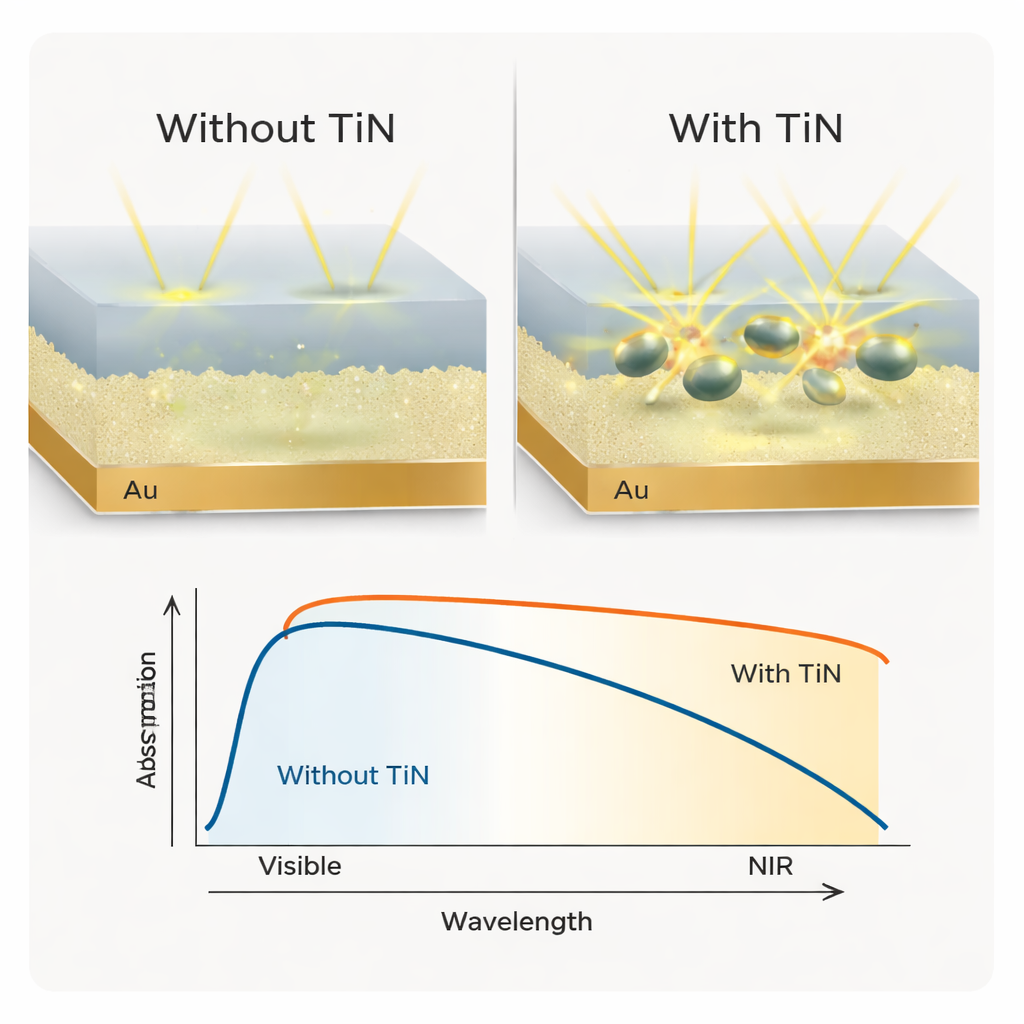
Perovskite solar cells have risen to prominence because they can capture sunlight very efficiently while being relatively simple and inexpensive to make. A popular perovskite material, known by the formula CH3NH3PbI3, already absorbs visible light very well. Its weakness is in the near‑infrared region, beyond about 750 nanometers in wavelength, where its ability to soak up light drops sharply. That means a large slice of the Sun’s energy passes straight through the cell instead of being converted into electricity. The authors asked whether carefully designed nanoparticles could act like tiny antennas for light, redirecting and concentrating this otherwise lost energy back into the perovskite layer.
Tiny antennas made of tough metal
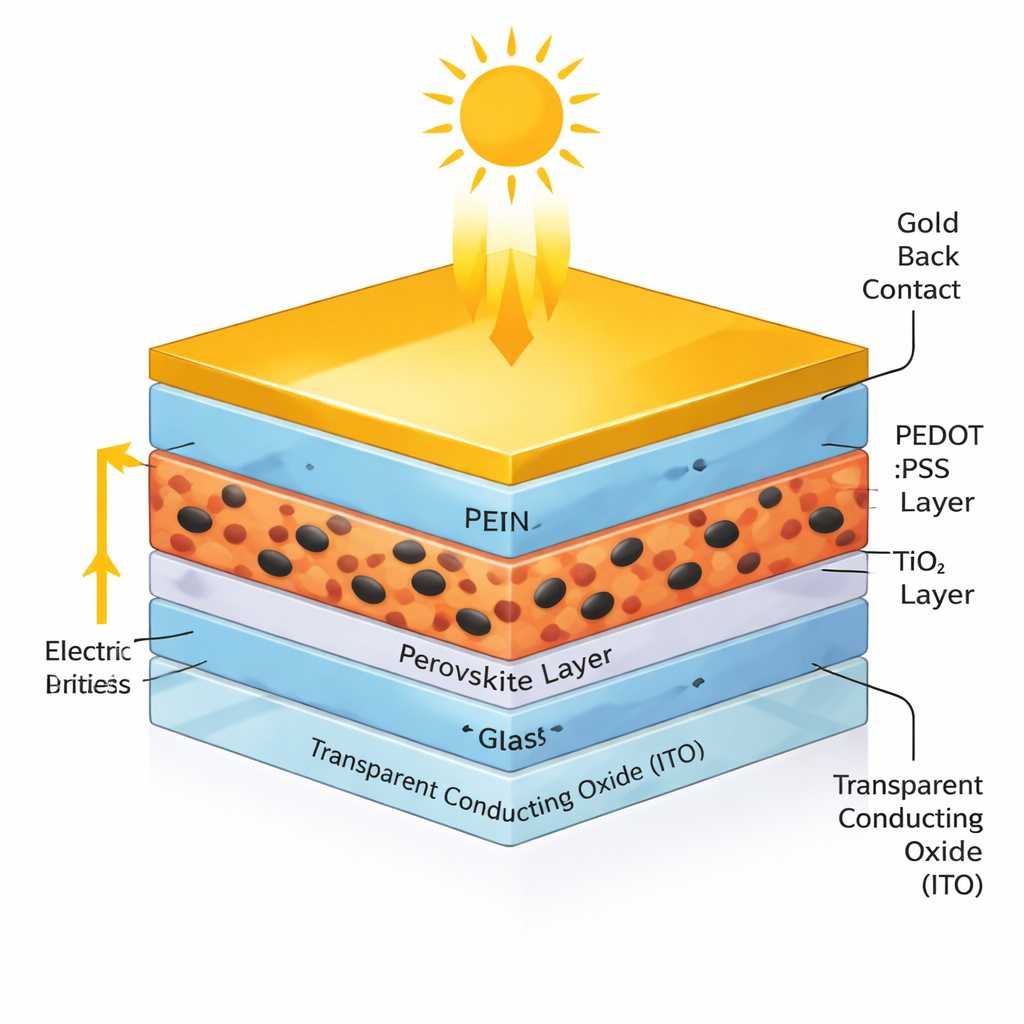
The team focused on nanoparticles made of titanium nitride, a hard, heat‑resistant compound that behaves like a metal for light. Unlike gold and silver—the usual choices in light‑manipulating “plasmonic” devices—titanium is common in Earth’s crust and far cheaper. The researchers shaped these nanoparticles as stretched ellipsoids and arranged them in a hexagonal pattern inside the perovskite layer of a model solar cell stack: a glass front, a transparent conducting layer, a thin titanium dioxide layer to guide electrons, the perovskite absorber containing the nanoparticles, an organic layer to collect holes, and a gold back contact to reflect light. Because titanium nitride strongly interacts with a wide band of wavelengths, especially when shaped and packed carefully, the nanoparticles can trap and concentrate both visible and near‑infrared light in and around the perovskite.
Simulating light and electricity inside the cell
Rather than building devices in the lab, the authors used advanced computer simulations to follow what happens to light and electric charges inside the solar cell. A method called finite‑difference time‑domain tracked how incoming sunlight bounced, scattered, and was absorbed within the layered structure and around the nanoparticles. From these optical patterns they calculated how many charge‑carrying electrons and holes would be created at each depth inside the cell. They then fed this information into another tool, SCAPS‑1D, which models how those charges move, recombine, and ultimately contribute to current and voltage at the cell’s terminals. This combined approach let them test many design choices—particle material, shape, size, spacing, and array pattern—without fabricating each option.
Capturing almost all useful sunlight
The optimized design, with titanium nitride ellipsoids arranged in a dense hexagonal lattice, transformed the perovskite layer’s behavior. Simulations showed more than 90 percent of light absorbed across a broad band from 400 to 1200 nanometers, stretching well into the near‑infrared. In contrast, a similar cell without nanoparticles stayed highly absorbing only up to about 750 nanometers, then dropped to roughly one quarter of that performance. Maps of the electric field inside the device revealed intense bright regions around the nanoparticles—evidence that they were acting as tiny antennas that grab and re‑emit light, greatly boosting the chance it will be absorbed by the surrounding perovskite.
Near‑theoretical efficiency on paper
When these optical gains were translated into electrical output, the simulated cell performed strikingly well. The short‑circuit current density, which measures how much current flows under full sunlight, rose from about 26 to nearly 47 milliamps per square centimeter—an increase of around 80 percent. The overall power conversion efficiency climbed from 18.2 percent to 31.8 percent, approaching the fundamental theoretical limit for a single‑junction solar cell. While the authors stress that these values come from idealized simulations and that real devices will face losses from imperfections and manufacturing limits, the results highlight how titanium nitride nanoparticles could push perovskite solar cells toward record‑level performance using a material that is robust, heat‑tolerant, and relatively inexpensive.
What this means for future solar panels
For a non‑specialist, the core message is that adding carefully designed, tough, and affordable nanoparticles inside a perovskite solar cell could allow future panels to harvest not just visible sunlight but also a large fraction of the invisible near‑infrared. If these designs can be realized in practice, they promise lighter, more efficient, and potentially cheaper solar modules, helping to make renewable electricity more competitive and widespread in the push to reduce greenhouse‑gas emissions.
Citation: El-Mallah, M.N., El-Aasser, M. & Gad, N. Performance enhancement of perovskite solar cells through plasmonic titanium nitride nanoparticles. Sci Rep 16, 7182 (2026). https://doi.org/10.1038/s41598-026-37468-0
Keywords: perovskite solar cells, titanium nitride nanoparticles, plasmonic photovoltaics, light absorption enhancement, solar energy efficiency