Clear Sky Science · en
MiniPromoters Ple384 (TH) and Ple388 (PITX3) for targeting midbrain dopaminergic neurons in mice and monkeys
Why this research matters for brain health
The brain’s dopamine-producing cells help us move, learn from rewards, and stay motivated. They are also the cells that die in Parkinson’s disease. Scientists and doctors would like to deliver helpful genes or molecular tools specifically to these vulnerable neurons, in both lab animals and, one day, in people. But guiding gene therapy so that it turns on only in the right cells, and not everywhere in the brain, has been a major roadblock. This study describes two new, compact DNA “switches” that can reliably turn on genes almost only in midbrain dopamine neurons of mice and monkeys, opening a path to more precise and potentially safer treatments.
Small genetic switches with a big job
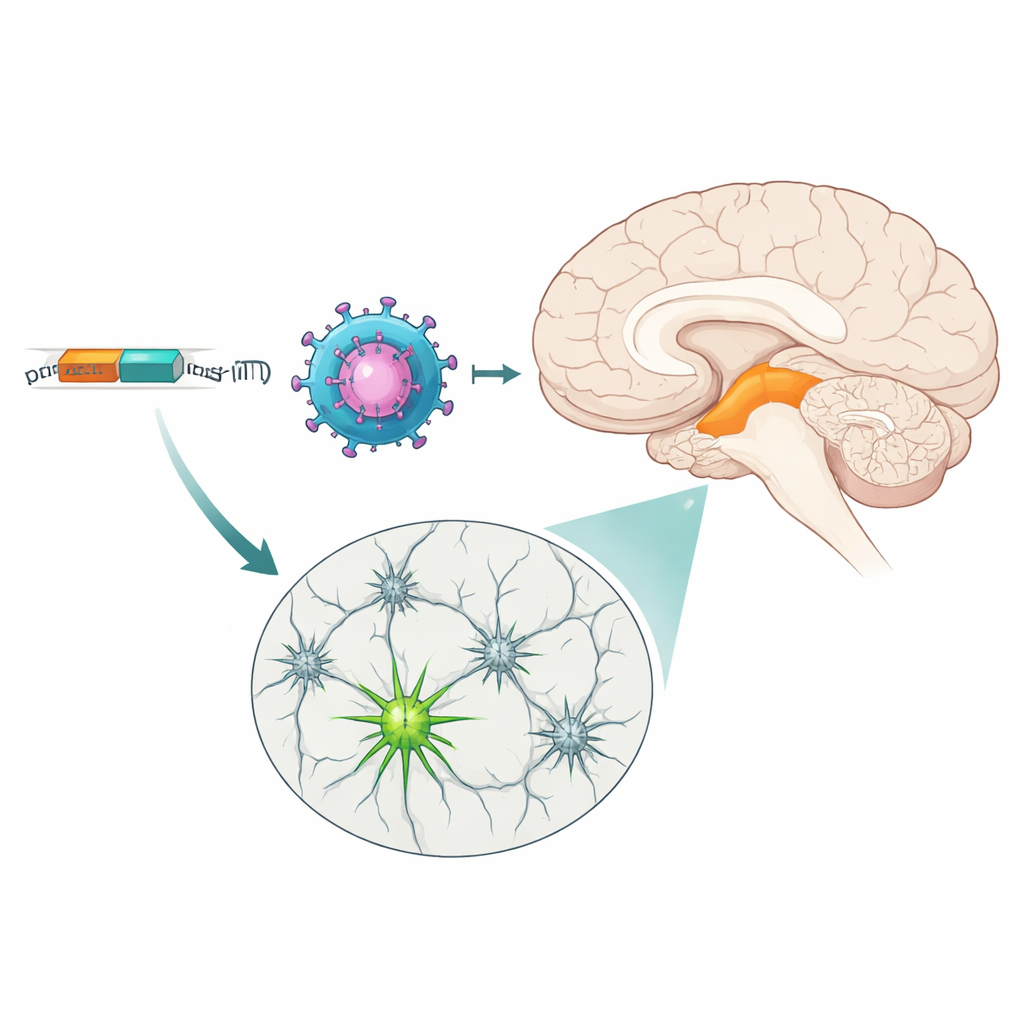
To get a therapeutic gene into brain cells, researchers often use adeno-associated viruses (AAVs), harmless delivery vehicles that can carry only a limited amount of DNA. Inside each virus, a short promoter sequence acts like an on–off switch, deciding where that gene will be active. Many natural promoters are too large or too blunt, turning genes on in too many cell types. The team used bioinformatics to design eight very compact “MiniPromoters” from human DNA—short combinations of control elements taken from genes known to mark dopamine-making neurons. Their goal was a set of switches that fit inside AAVs yet still drive strong, cell-type-focused expression.
Finding the right targets in the mouse brain
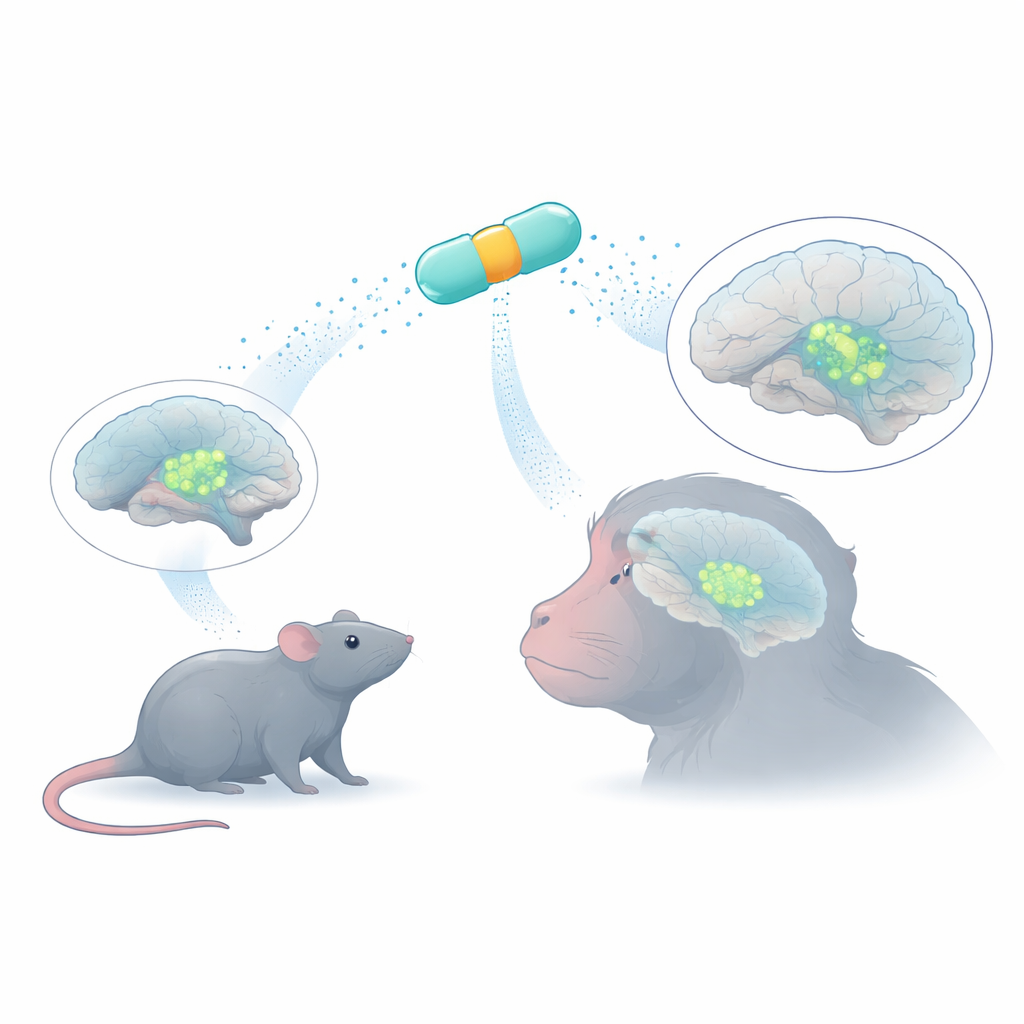
The eight candidate MiniPromoters were first tested in mice. Each promoter was placed in an AAV carrying a green fluorescent protein, allowing the scientists to see where the switch was active. They delivered the viruses either into the bloodstream or directly into the fluid-filled spaces of the brain. Most MiniPromoters failed to be selective: some lit up many non-dopamine cells, others barely worked at all. Two stood out. One, called Ple384, was built from control regions of the gene for tyrosine hydroxylase, the key enzyme used by all catecholamine-producing neurons. The other, Ple388, came from PITX3, a gene critical for a subset of midbrain dopamine neurons. Both Ple384 and Ple388 produced bright, tightly confined signals in the substantia nigra compacta and ventral tegmental area—the midbrain hubs of dopamine neurons—with over 90% of labeled cells also carrying dopamine’s hallmark molecule.
From mice to monkeys without drilling deep into the brain
Any gene therapy aimed at human disease must eventually work in primates, whose brains are larger and more complex. Directly injecting the substantia nigra is technically demanding and can damage this small, deep structure. Instead, the researchers tested whether the same MiniPromoters could be delivered into the cerebrospinal fluid of rhesus macaque monkeys via a single injection into a lateral ventricle. Using an AAV capsid variant known to spread widely from the fluid spaces, they found that both Ple384 and Ple388 drove robust expression in midbrain dopamine neurons of the substantia nigra and ventral tegmental area, while largely sparing other dopamine-rich regions such as the hypothalamus and the locus coeruleus. Most labeled cells in the target region were dopamine neurons, confirming that the switches kept their selectivity across species.
Two tools with different strengths
Although both MiniPromoters hit their targets, they did so with different patterns. Ple384, based on the broader tyrosine hydroxylase gene, lit up more neurons overall and covered both the ventral and dorsal layers of the substantia nigra as well as a larger portion of the ventral tegmental area. Ple388, reflecting the more restricted PITX3 gene, primarily labeled a subset of ventral tier neurons and produced weaker fluorescence. Off-target expression was seen mainly near the injection sites and in some peripheral organs after bloodstream delivery, but careful controls showed that the viral vectors were capable of reaching many brain regions; it was the MiniPromoters themselves that limited expression mostly to midbrain dopamine neurons. This tunable strength—one more powerful and broad, one more selective and moderate—means researchers can choose the switch that best matches their needs, from gentle modulation to wide-scale intervention.
What this means for future therapies
To a non-specialist, the key message is that the authors have created two compact genetic switches that act like precise, programmable light switches for dopamine neurons in both mice and monkeys. Ple384 offers strong, widespread access to these cells, while Ple388 focuses on a narrower, particularly vulnerable subset. Because the switches are small enough to fit comfortably inside commonly used viral vectors, they leave room for therapeutic genes and may help reduce side effects by avoiding unwanted brain regions. As gene therapy for Parkinson’s disease and related conditions advances, such targeted control elements will be essential ingredients for treatments that are powerful yet precise.
Citation: Galvan, A., Choi, D., Korecki, A.J. et al. MiniPromoters Ple384 (TH) and Ple388 (PITX3) for targeting midbrain dopaminergic neurons in mice and monkeys. Sci Rep 16, 9277 (2026). https://doi.org/10.1038/s41598-026-37466-2
Keywords: dopamine neurons, gene therapy, Parkinson’s disease, AAV vectors, cell-specific promoters