Clear Sky Science · en
Study on the mechanism and prevention techniques of dynamic disaster in nearly vertical extra-thick coal seams
Why deep coal mining can suddenly turn dangerous
As the world continues to rely on coal for energy and industry, mining companies are forced to dig ever deeper and into more difficult geology. In parts of western China, some of the thickest coal seams stand almost upright, like books on a shelf. Mining these near-vertical seams has led to violent underground “dynamic disasters” – sudden rock failures and rock bursts that can damage equipment and threaten miners’ lives. This study looks inside one such mine, Wudong Coal Mine in Xinjiang, to understand why these disasters occur and how they can be prevented.
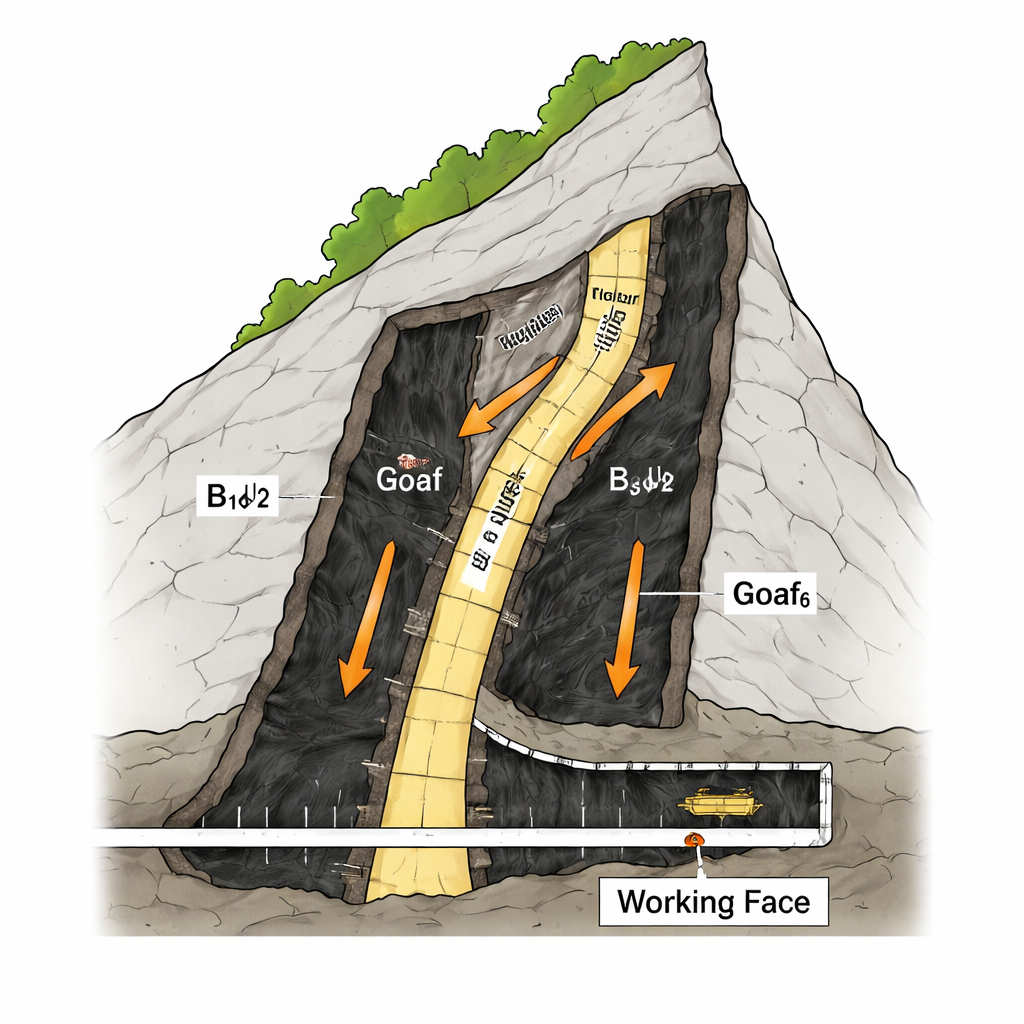
Coal seams standing on edge
In most people’s minds, coal beds lie roughly flat underground. At Wudong, however, the main seams are 28 and 40 meters thick and tilt at about 85–87 degrees, nearly vertical. Between them sits a massive wall of rock called a rock pillar. As miners carve out horizontal slices of coal on different levels, large empty spaces (goafs) are left behind. In such steep seams, gravity acts sideways as well as downward, putting unusual stress on the roofs, floors, and the central rock pillar. Past accidents in this area – several high‑energy rock bursts linked to the pillar and roof – showed that these structures can store and suddenly release huge amounts of energy.
How rock pillars and roofs store hidden energy
The researchers combined mathematical modeling, lab tests on rock samples, underground measurements, and scaled physical models to track how the rock mass deforms as mining advances. They found that once the coal is removed from around the pillar, it behaves like a giant cantilever beam, slowly bending toward one of the mined-out voids. This bending and rotation squeezes and pries on the coal left on each side, building up strain energy inside both the pillar and the coal. Calculations showed that the first cracking of the pillar begins when about 150 meters are exposed, and large-scale failure develops when the unsupported height reaches around 350 meters. Micro-seismic monitoring – essentially underground “listening” for tiny rockquakes – confirmed intense damage and high‑energy events in the pillar at these depths.
Toppling roofs, sliding floors, and violent collapse
The overlying rock layers above the coal behave just as critically. Because the seams are nearly vertical, the roof is not pressed straight down in the usual way; instead, it tends to tilt toward the empty spaces. The team’s models and a large laboratory simulation showed that the immediate roof can hang unsupported for more than 40 meters before failing. When it does fail, the upper layers mainly topple – like rows of books falling – while lower layers may also slump or slide. Broken blocks then tumble and rotate into the goaf, sometimes forming temporary triangular supports that later collapse again. The floor beneath the lower seam is also loaded and then suddenly unloaded as mining progresses, making it prone to shearing and sliding. Together, bending pillars, overhanging roofs, and weakened floors create powerful static stresses and, when they finally break, strong dynamic impacts that can trigger rock bursts.
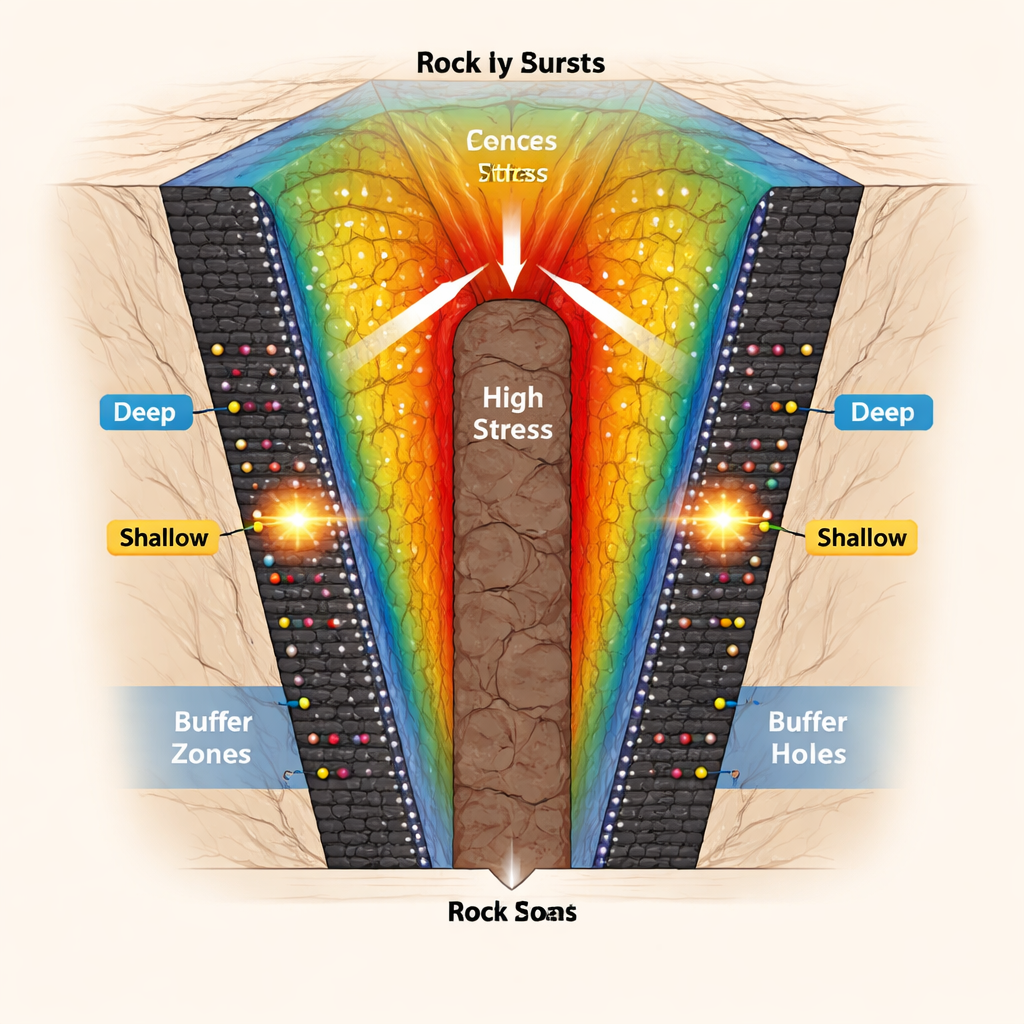
From understanding the hazard to changing the rock
Knowing that disasters arise from a combination of high static stress and sudden dynamic disturbance, the authors focused on ways to drain off energy before it can do harm. Their solution is to deliberately weaken selected rock zones using blasting. They drill two sets of boreholes – shallow and deep – into both the roof and floor ahead of the mining face, then fire controlled explosive charges. This creates a three‑dimensional “buffer zone” of cracked rock that redirects and softens the horizontal stresses coming from the pillar and surrounding strata. Computer simulations showed that, compared with no blasting, these measures can cut horizontal stress in front of the coal face by up to about one fifth, with shallow-hole blasting alone performing best in their scenarios.
Measuring whether the protection really works
To test the technique underground, the team used two kinds of monitoring. First, they tracked electromagnetic radiation naturally emitted when coal and rock crack. After blasting, radiation levels in the treated zone dropped by nearly 30 percent in rock and about 13 percent in coal, indicating that stresses had been reduced. Second, they examined micro-seismic data from a month before and after blasting. Immediately after the blasts, the number and energy of micro-seismic events rose as fractures opened and stored stress was released. Over time, both frequency and energy then declined, suggesting that the rock mass had become more stable and less likely to fail violently.
Making deep, steep coal mining safer
For a non-specialist, the main message is that the most dangerous forces in steep, extra‑thick coal seams are largely invisible: slow bending and hanging of massive rock slabs that quietly stockpile energy until something gives. This study shows that by understanding where and how that energy builds up – mainly in the central rock pillar and overhanging roofs – engineers can step in early and carefully weaken the rock in chosen zones. Done correctly, this controlled damage provides a safety valve, lowering stress, reducing the size of sudden releases, and making rock bursts less likely. The approach offers a practical path toward safer mining in some of the world’s most challenging coal deposits.
Citation: Zhang, Y., Li, Q., Li, L. et al. Study on the mechanism and prevention techniques of dynamic disaster in nearly vertical extra-thick coal seams. Sci Rep 16, 6520 (2026). https://doi.org/10.1038/s41598-026-37461-7
Keywords: rock burst, coal mining safety, steep coal seams, stress relief blasting, rock pillar failure