Clear Sky Science · en
Spatiotemporal evolution and configurational pathways of synergistic green development in the Yangtze river economic belt
Why this river basin matters to everyday life
The Yangtze River Economic Belt is home to hundreds of millions of people and powers a large share of China’s economy. Yet it also bears heavy pollution, high carbon emissions, and mounting climate risks. This study asks a simple but pressing question: can such a vast region grow richer while cutting pollution and protecting nature at the same time? By tracing more than a decade of data, the authors show how different parts of the Yangtze basin are learning to develop in a cleaner, more coordinated way—and what that reveals about managing green transitions in any large, unequal region.
A new way to think about "green" progress
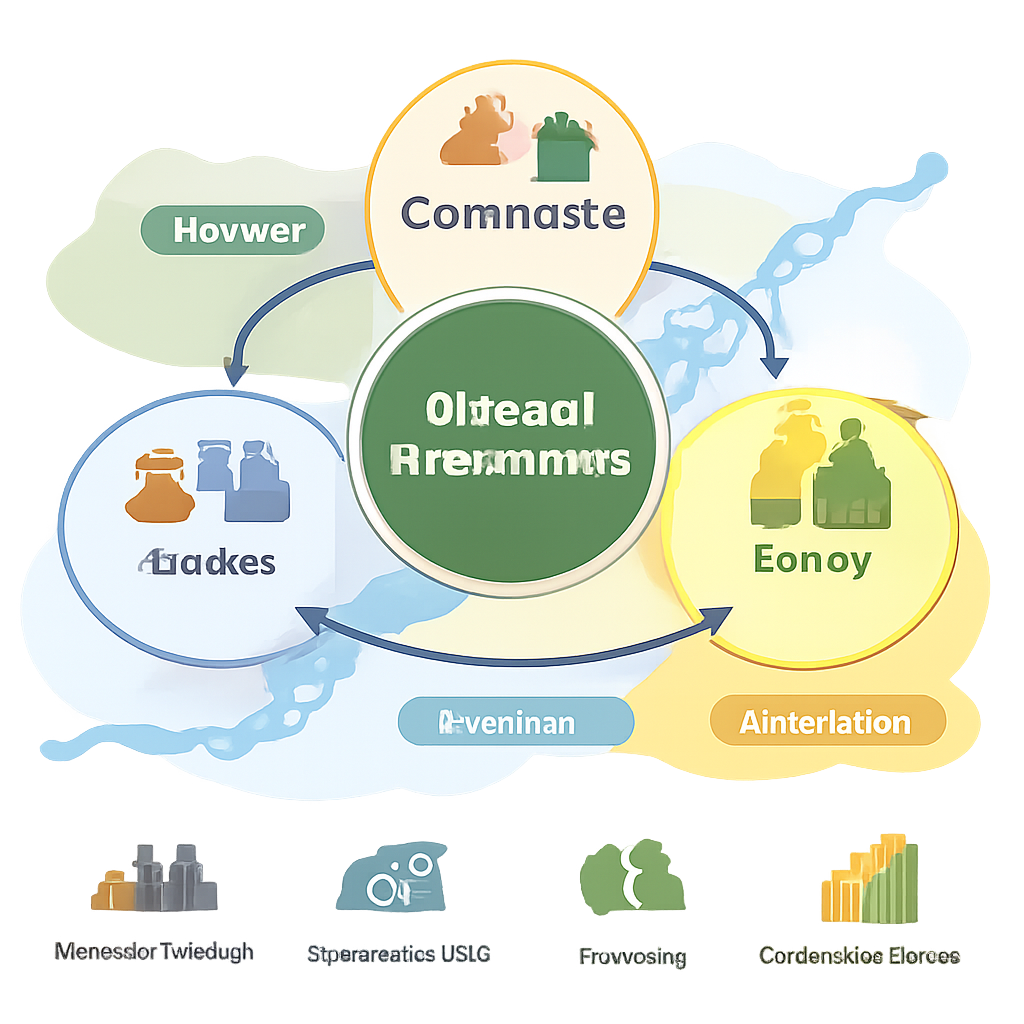
Instead of treating the environment and the economy as rivals, the researchers use the idea of “synergistic green development.” They track four goals together: reducing traditional pollution, cutting carbon emissions, expanding green spaces such as forests and parks, and sustaining economic growth. Using detailed data for 101 cities from 2011 to 2024, they build an index that combines air pollution, energy use, land greening, income, innovation and more. Then they apply several tools—from inequality measures to network analysis—to see how this combined green score changes over time and space along the river.
How the Yangtze’s green journey is unfolding
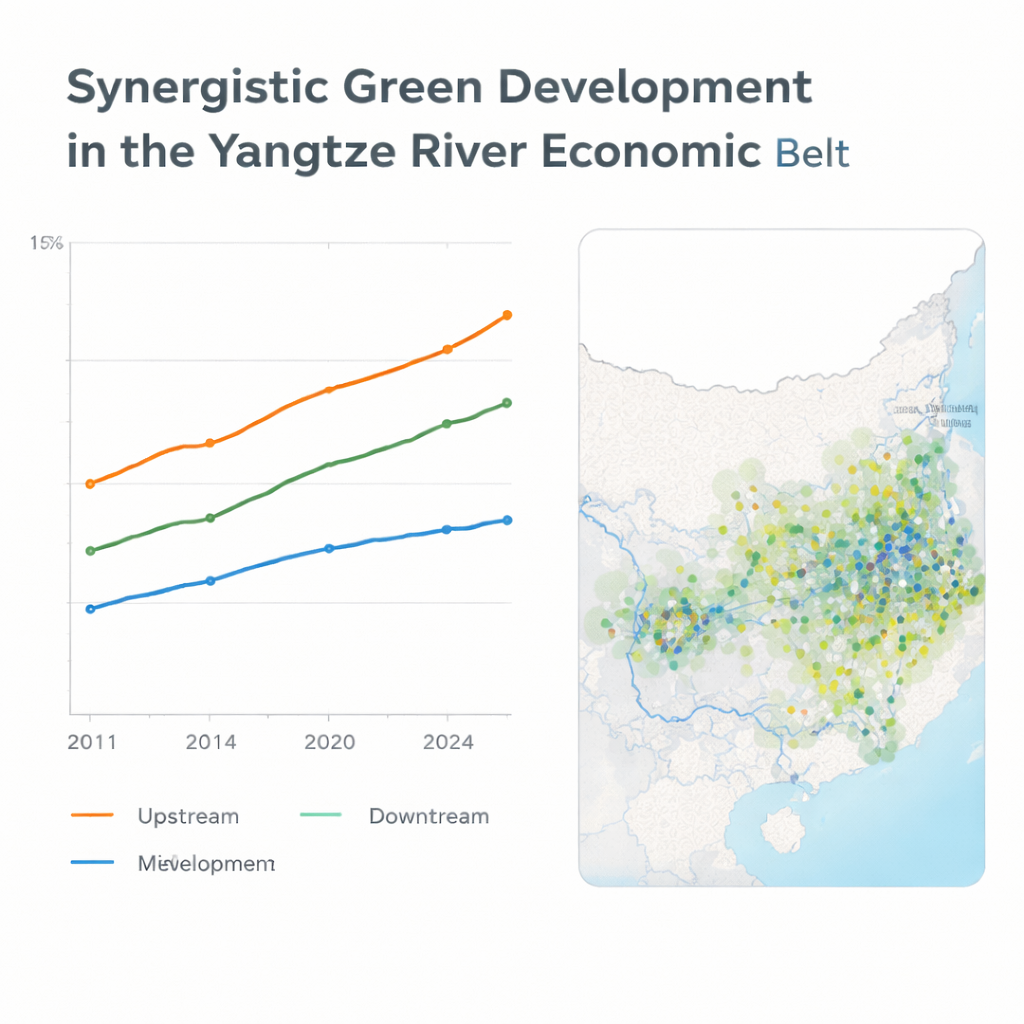
The overall story is encouraging: on average, cities along the Yangtze have steadily improved their green performance. Downstream cities near the river’s mouth, such as those in the Yangtze River Delta, started out ahead and remain leaders. Upstream areas in the west, once seen mainly as resource frontiers, have caught up surprisingly fast by leaning into an “ecology first” strategy and shifting away from heavy, dirty industry. The middle reaches, however, lag behind both ends of the river. When the authors plot how cities are distributed along the green index, they find that a single peak has split into two over time: a cluster of high-performing cities and a separate cluster of laggards. In other words, the region is getting greener on average, but the gap between leaders and followers is becoming more pronounced.
From a single center to a web of connections
Economic and environmental change rarely stop at city borders, so the authors also treat the Yangtze as a living network. Using a gravity-style model, they estimate how strongly each city’s green development is linked to others, and then map this as a web of ties. Early in the period, the network is sharply tilted: dense connections in the prosperous east, sparse ones in the west. Over time, links multiply and thicken across the whole basin. Coastal hubs like Shanghai remain important, but inland cities such as Chongqing, Chengdu and Wuhan emerge as new anchors that both absorb know‑how and spread it to their neighbors. The network gradually shifts from a rigid, top‑down hierarchy into a more “grid-like” pattern with multiple centers, making the overall system less fragile and more cooperative.
What actually drives cleaner growth
To understand why some city–years achieve high green scores while others do not, the study looks at combinations of driving forces rather than single causes. It groups them into three broad players: government (rules and pollution-control spending), markets (market openness, size and green finance) and society (education levels and public involvement in environmental affairs). Using a method called qualitative comparative analysis, the authors identify several “recipes” that can all lead to strong green performance. In some cases, deep markets and well‑educated citizens allow cities to rely less on heavy-handed regulation. Elsewhere, strong rules and large public investments compensate for weaker markets or lower public awareness. In resource-poor western cities, pollution-control spending acts as a crucial lifeline; in advanced eastern hubs, human capital and social participation become the main engines, with government playing a lighter, coordinating role.
What this means for people and policy
For a lay reader, the takeaway is that there is no one-size-fits-all path to a green future. The Yangtze story shows that poorer, more polluting areas may first need strong government push and targeted funding just to break old habits, while richer, more innovative cities can lean more on markets and civic pressure. Over time, the whole basin has moved from a model where government at the top tried to fix everything toward one where many actors—cities, firms, banks, communities—jointly sustain progress. The study argues that tailoring green strategies to local strengths and weaknesses, while keeping the river basin connected as a single system, offers a practical route for large regions worldwide to cut pollution, curb carbon and keep economies thriving.
Citation: Zheng, L., Yang, X., Yu, W. et al. Spatiotemporal evolution and configurational pathways of synergistic green development in the Yangtze river economic belt. Sci Rep 16, 7262 (2026). https://doi.org/10.1038/s41598-026-37460-8
Keywords: Yangtze River Economic Belt, green development, pollution and carbon reduction, regional inequality, environmental governance