Clear Sky Science · en
Optimizing a dynamic infrared emitter by tailoring titanium carbide MXene surface chemistry
Why controlling heat without power matters
From smartphones to spacecraft, almost every modern device struggles with one basic issue: how to get rid of excess heat, or hold on to warmth, without wasting energy. One promising strategy is to control how much invisible infrared light a surface gives off. This paper explores a new way to build a thin, flexible coating that can change how strongly it glows in the infrared, using clever chemistry at the surface of a new material called MXene. The goal is simple: create smart skins that passively manage heat, tag objects in infrared, or help harvest solar energy, all while working at temperatures close to everyday conditions.
A thin sandwich that manages heat
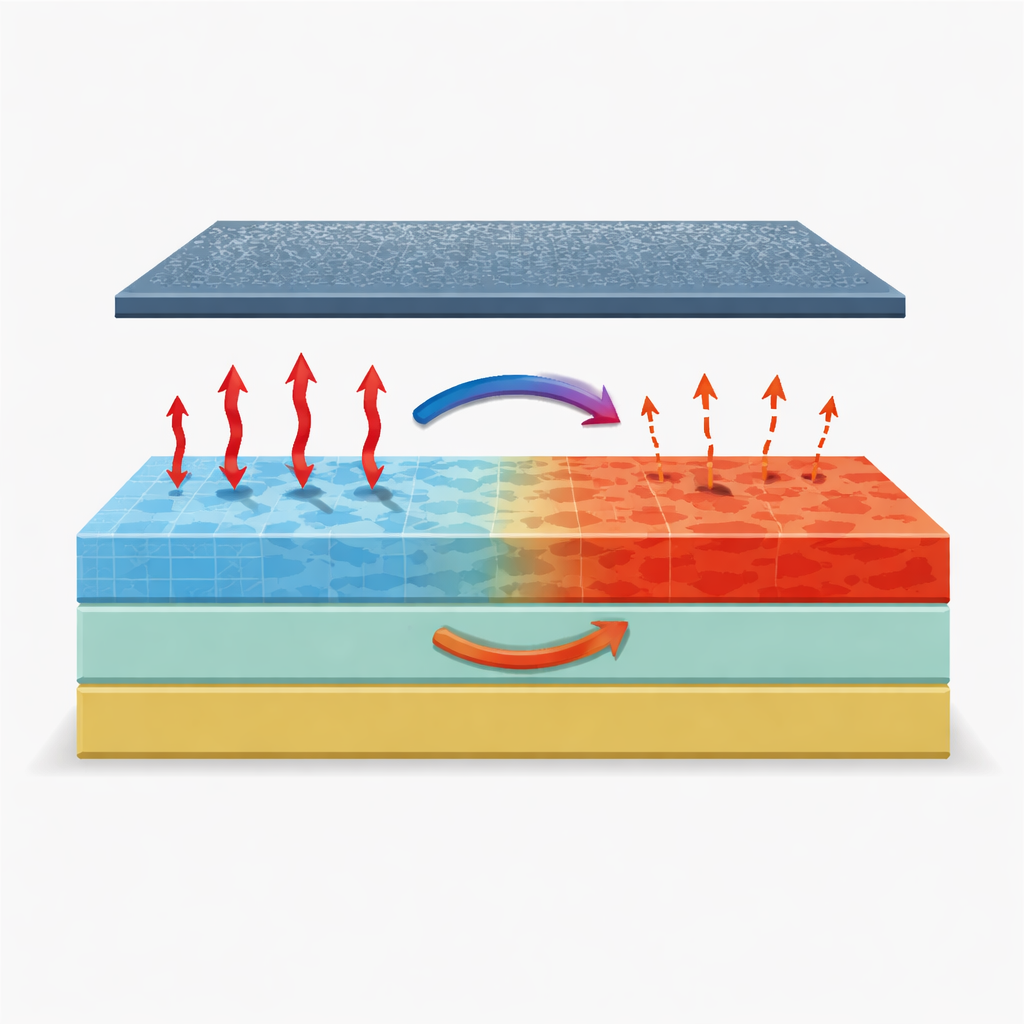
The researchers design a flat, layered structure that acts like a controllable infrared “dimmer switch.” It is built as a stack: at the bottom is a thin titanium carbide MXene film, in the middle is a glass-like layer of silicon dioxide, and on top sits a special form of vanadium dioxide that has been slightly modified with tungsten. This top layer can switch between acting like a semiconductor and acting like a metal when its temperature changes by only a few tens of degrees around room temperature. Because the layers are flat and continuous, the device can be made using relatively simple thin-film methods, avoiding the complicated patterns and high costs often seen in advanced optical coatings.
Tuning heat with tiny chemical endings
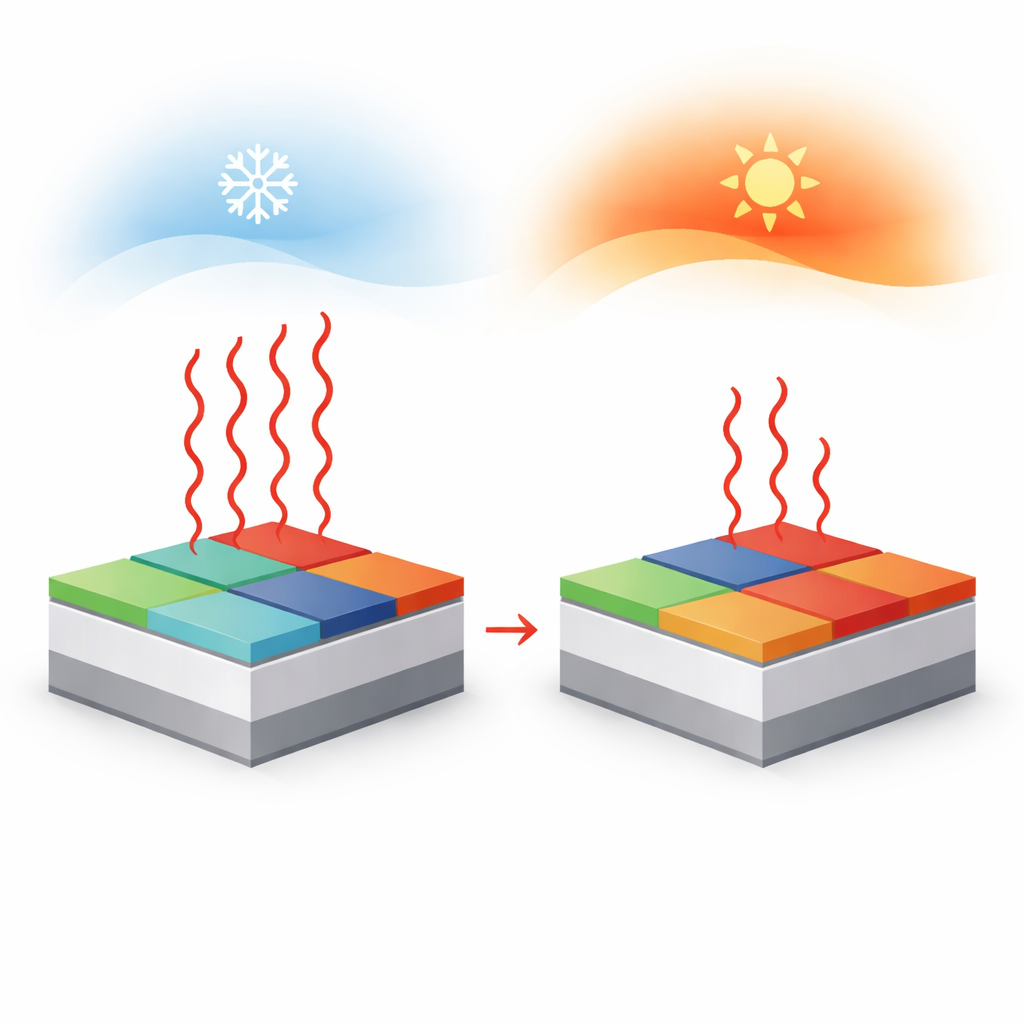
A key idea in this work is that the MXene layer is not just a simple metal-like sheet. Its surface is covered with small chemical groups, and changing these groups subtly alters how it interacts with light. The team compares four cases: MXene with no added groups, and MXene whose surface ends in fluorine, oxygen, or hydroxyl (an oxygen plus hydrogen). These endings change the optical response of the MXene, which in turn reshapes how the whole stack absorbs and emits infrared radiation between 2 and 20 micrometers in wavelength. While the temperature at which the top vanadium dioxide layer switches state stays nearly the same for all four cases, the strength of the emissivity change—how much the device’s glow drops when it heats up—varies a lot across the different surface chemistries.
Switching from glowing to hiding
When the structure is cool and the vanadium dioxide behaves as a semiconductor, the stack absorbs—and therefore emits—infrared strongly. As it heats and the vanadium dioxide turns metallic, the device becomes more reflective and its infrared emission drops. This produces what the authors call negative differential emissivity: emissivity is higher at low temperature and lower at high temperature, the opposite of what one might expect from a glowing hot object. Among all surface chemistries, the MXene terminated with hydroxyl groups delivers the largest change, with a strong drop in average emissivity between the cool and hot states, while the oxygen-terminated version shows the weakest contrast. Simulations of electric fields and temperature inside the stack reveal how these different surface endings reshape the light distribution and how quickly the phase change is triggered.
Fast response and design flexibility
The study also examines “partial” switching, in which only part of the vanadium dioxide layer heats into the metallic state, as well as the effect of changing the thickness of each layer. These variations alter how efficiently the device can emit or reflect heat, giving designers a toolkit to fine-tune performance. The transition itself happens on nanosecond timescales when driven by light, meaning the emissivity could be switched extremely quickly. Importantly, the temperature window over which the switching occurs remains narrow and stable near 315 K (about 42 °C), which is attractive for applications that require precise thermal control without running at very high temperatures.
What this means for future smart surfaces
To a non-specialist, the takeaway is that by changing only the tiny chemical decorations on the surface of a thin MXene film, the authors can strongly adjust how a layered coating glows in the infrared as it heats and cools. This allows a simple, flat device to act as a controllable thermal “valve” at modest temperatures, with the hydroxyl-terminated MXene giving the largest on–off contrast. Such coatings could one day help spacecraft keep temperature steady without heavy mechanical systems, hide objects from infrared cameras, encode information that is visible only in infrared, or improve how buildings and devices handle heat from the sun. The work shows that smart control of surface chemistry can be as powerful as reshaping the material itself when it comes to managing invisible thermal light.
Citation: Daliran, N., Oveisi, A.R. & Wang, Z. Optimizing a dynamic infrared emitter by tailoring titanium carbide MXene surface chemistry. Sci Rep 16, 9770 (2026). https://doi.org/10.1038/s41598-026-37457-3
Keywords: infrared emissivity, MXene coatings, thermal management, phase-change materials, infrared camouflage