Clear Sky Science · en
Sensitive and quantitative biosensing technique based on NV centres-doped nanodiamonds applied to lateral flow assays
Why a new kind of rapid test matters
Lateral flow tests — the familiar strip tests used for COVID-19 and pregnancy — are cheap, fast and easy to use, but they struggle to measure very small amounts of disease markers and to give precise, numerical results. This paper presents a new way to read such tests using tiny diamonds that glow in a special way, turning simple paper strips into far more sensitive and quantitative diagnostic tools that could work in clinics, ambulances or even remote areas.
From simple strips to smarter sensing
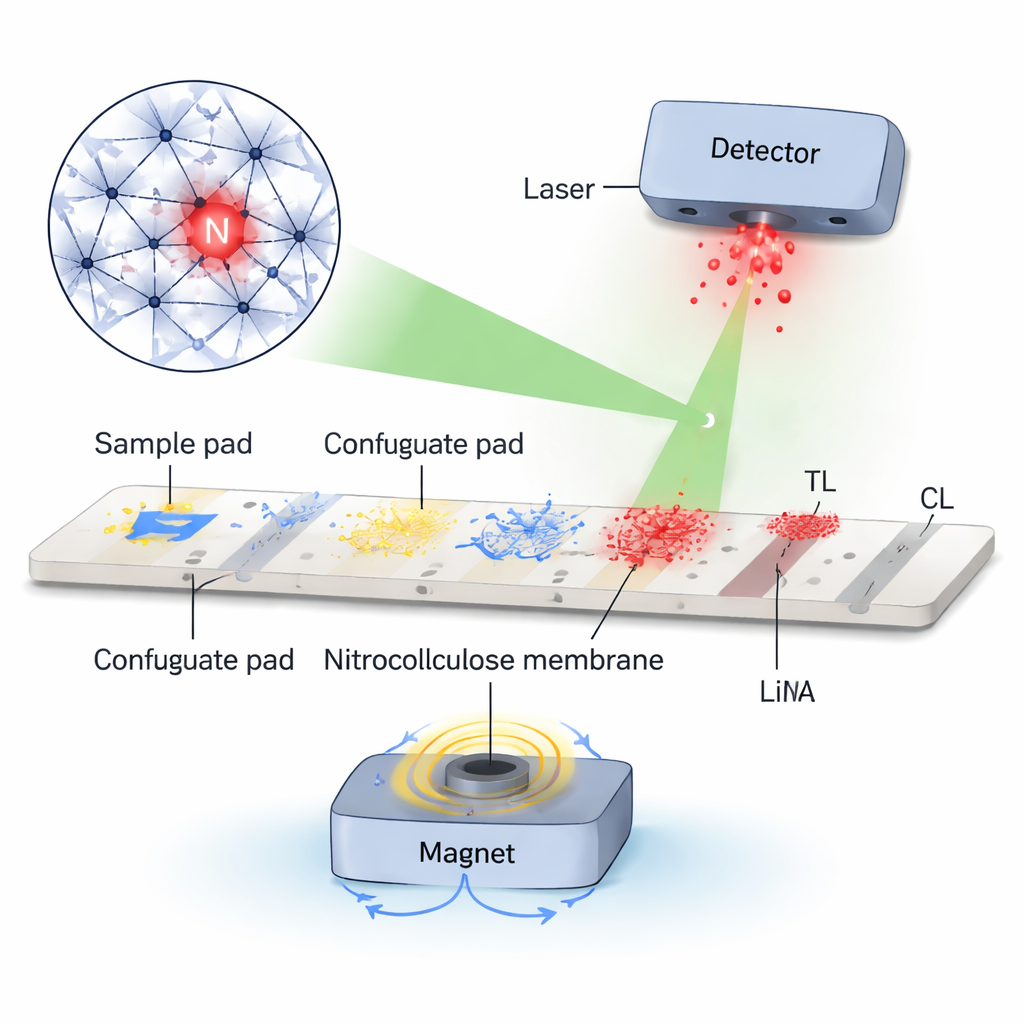
Standard lateral flow assays rely on colored particles, often made of gold or latex, that stick to a target molecule and form a visible line on a strip. While this is convenient, the color change is crude: faint lines are hard to interpret, and background light and materials in the strip can hide weak signals. The authors explore a different label: nanodiamonds containing nitrogen-vacancy (NV) centers, tiny defects in the diamond crystal that fluoresce strongly when illuminated by green light. These NV-doped nanodiamonds can be coated with antibodies so they latch onto specific biomarkers just like existing labels, but their optical behavior allows for much more precise detection.
Making diamond labels stand out from the noise
In a typical strip test, useful light from the labels is mixed with unwanted fluorescence and scattering from the plastic, paper and biological material. The innovation here is to make the nanodiamond signal “blink” in a controlled way using a small oscillating magnetic field. NV centers emit red light around 650 nm under green laser illumination, and their brightness drops slightly when a modest magnetic field is applied. By switching this field on and off at 60 Hz, the nanodiamond fluorescence flickers at a known frequency, while the background light stays essentially constant. A lock-in detection scheme then isolates just this flickering component, dramatically boosting the signal-to-noise ratio and turning a noisy glow into a clean, quantitative measurement along the strip.
Proving the concept with cancer markers
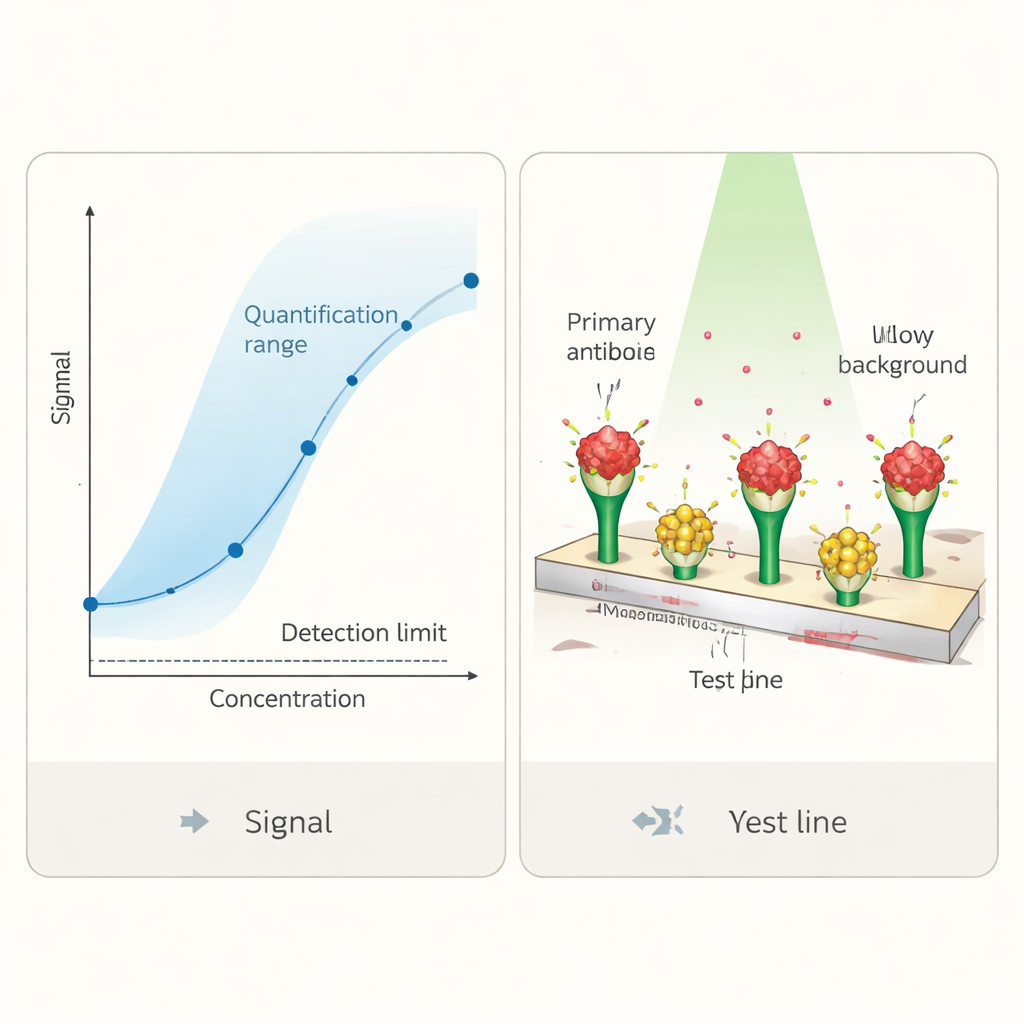
To show that this approach works in realistic conditions, the researchers built an NV-based reader and applied it to detect carcinoembryonic antigen (CEA), a blood marker used in the diagnosis and monitoring of certain cancers. They optimized the strip materials, buffer chemistry, nanodiamond size and antibody coating to maximize specific binding on the test line while minimizing stray sticking elsewhere. With this setup, they measured the nanodiamond fluorescence at the test line for CEA concentrations spanning from picograms to micrograms per milliliter. The resulting calibration curve followed the expected medical-diagnostics behavior and yielded a limit of detection around 0.2 nanograms per milliliter and a quantification range stretching over more than two orders of magnitude, all without changing test conditions. This demonstrates that the diamond labels can support both very low detection thresholds and accurate numerical readouts.
How diamonds compare to common labels
Beyond a single cancer marker, the team asked whether nanodiamonds could outperform the labels already used in commercial or advanced tests. In collaboration with an industrial partner, they carried out a head-to-head comparison on a fish protein (VHS/G57) using several standard labels: latex particles, cellulose particles, europium-based fluorescent nanoparticles and carbon nanotubes carrying fluorescent dyes. All tests shared the same strip format, membranes, antibodies and running conditions, and each label was used under its own optimized settings. Nanodiamonds achieved the lowest detection limit (about 80 nanograms per milliliter) and the broadest quantification range, outclassing both traditional color labels and state-of-the-art europium fluorescent particles under these matched conditions. Simple physical calculations of how many useful photons each label can produce support the experimental finding that NV centers can be intrinsically more sensitive, potentially by up to a thousandfold relative to europium in ideal scenarios.
Practical advantages and future uses
Beyond raw sensitivity, NV-doped nanodiamonds offer practical benefits. Their fluorescence is stable, does not bleach under light and is relatively insensitive to temperature, making the readout robust outside controlled laboratory environments. Diamond nanoparticles can be synthesized in the lab in a range of sizes, with surfaces that are easy to chemically modify for different targets, and they do not require attaching a separate fluorophore. The authors have begun engineering a compact, push-button reader that combines a low-power laser, a detector, an electromagnet and a strip scanner into a device whose projected cost is similar to existing quantitative rapid-test readers. Although further work is needed — including faster nanodiamond migration on strips, larger statistical studies and trials on more clinically relevant biomarkers — this study suggests that glowing nanodiamonds could turn everyday lateral flow tests into powerful, precise diagnostic tools for cancer, infectious diseases and environmental monitoring.
Citation: Vindolet, B., Sallem, F., Perré, A. et al. Sensitive and quantitative biosensing technique based on NV centres-doped nanodiamonds applied to lateral flow assays. Sci Rep 16, 7125 (2026). https://doi.org/10.1038/s41598-026-37454-6
Keywords: lateral flow assay, nanodiamond, biosensor, cancer biomarker, fluorescence detection