Clear Sky Science · en
Synthesis of 2D nickel MOF nanosheets incorporated in thin film nanocomposite membranes for efficient reverse osmosis desalination
Turning Salty Water into a Reliable Resource
As droughts, booming populations, and industrial growth strain freshwater supplies, many regions are looking to the sea for drinking water. Reverse osmosis, the leading technology for turning seawater into fresh water, already serves millions of people. Yet its filters can be slow, energy-hungry, and prone to gumming up with dirt and biological film. This study explores a new way to make these filters faster, longer lasting, and just as effective at blocking salt—using ultra-thin crystalline flakes built from metal and carbon-based building blocks.
A New Kind of Building Block for Filters
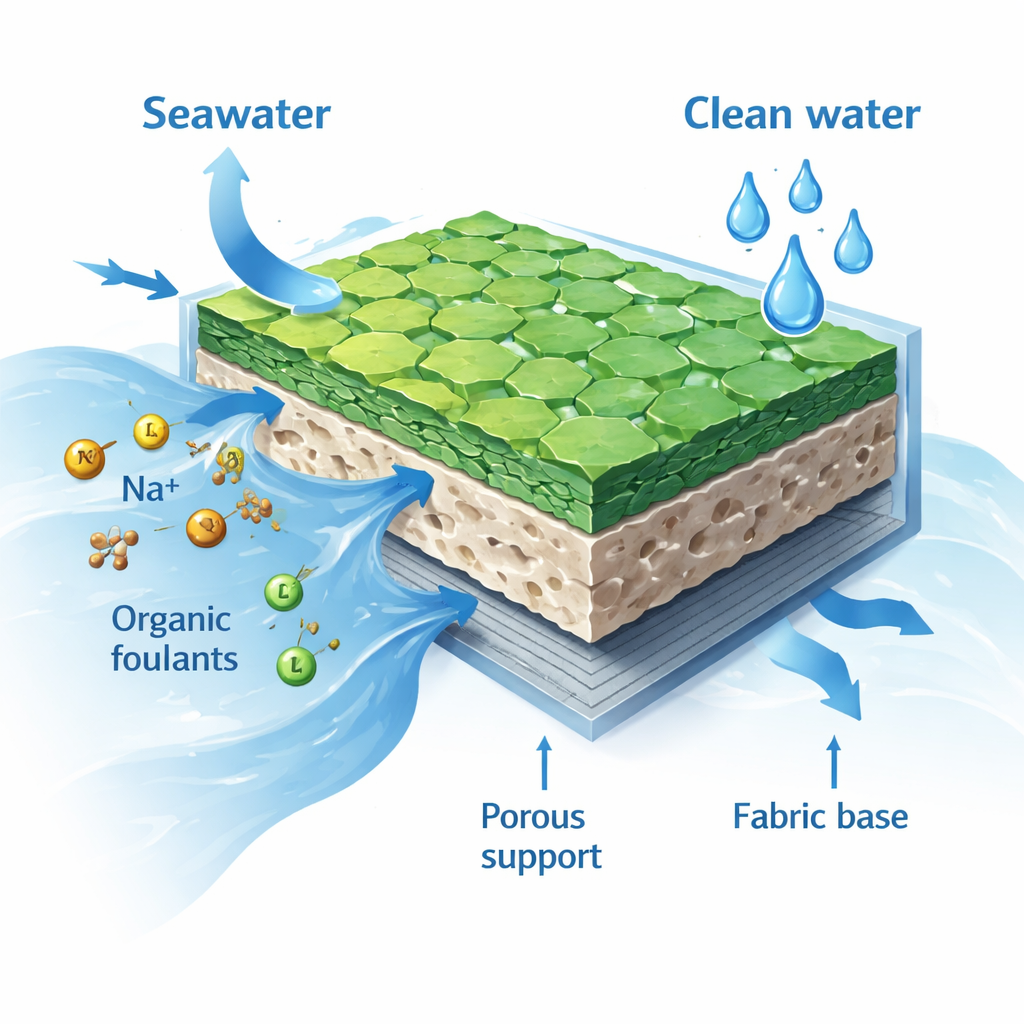
Conventional reverse osmosis membranes are like multi-layered sieves. A tough fabric base supports a spongy plastic layer, topped by an ultra-thin “skin” that actually does the salt removal. Engineers have tried mixing tiny particles such as zeolites, metal oxides, and carbon nanotubes into that top skin to let more water through without letting salt slip by. A promising family of additives is metal–organic frameworks, or MOFs—crystal-like materials full of well-defined pores. Earlier work usually used bulky, three-dimensional MOF crystals that can clump together, creating defects that hurt performance. The authors instead turned to sheet-like, two-dimensional MOFs made with nickel, which are only a few dozen nanometers thick and offer a high surface area and plenty of water-friendly chemical groups.
Peeling 3D Crystals into 2D Nanosheets
To create these nanosheets, the team first synthesized a three-dimensional nickel MOF, where flat layers are held apart by organic “pillars.” They then soaked the crystals in water and used sound waves to gently shake them apart. Water molecules slipped in and replaced the original pillars, allowing the stacked layers to peel into separate sheets. A suite of techniques—X-ray diffraction, infrared spectroscopy, electron microscopy, and surface analysis—confirmed that the pillars were removed, the material kept its overall framework, and the sheets were only about 27 nanometers thick. The nanosheets remained stable up to a few hundred degrees Celsius and showed pores in the nanometer range, indicating that they could offer additional pathways for water molecules.
Weaving Nanosheets into Desalination Membranes
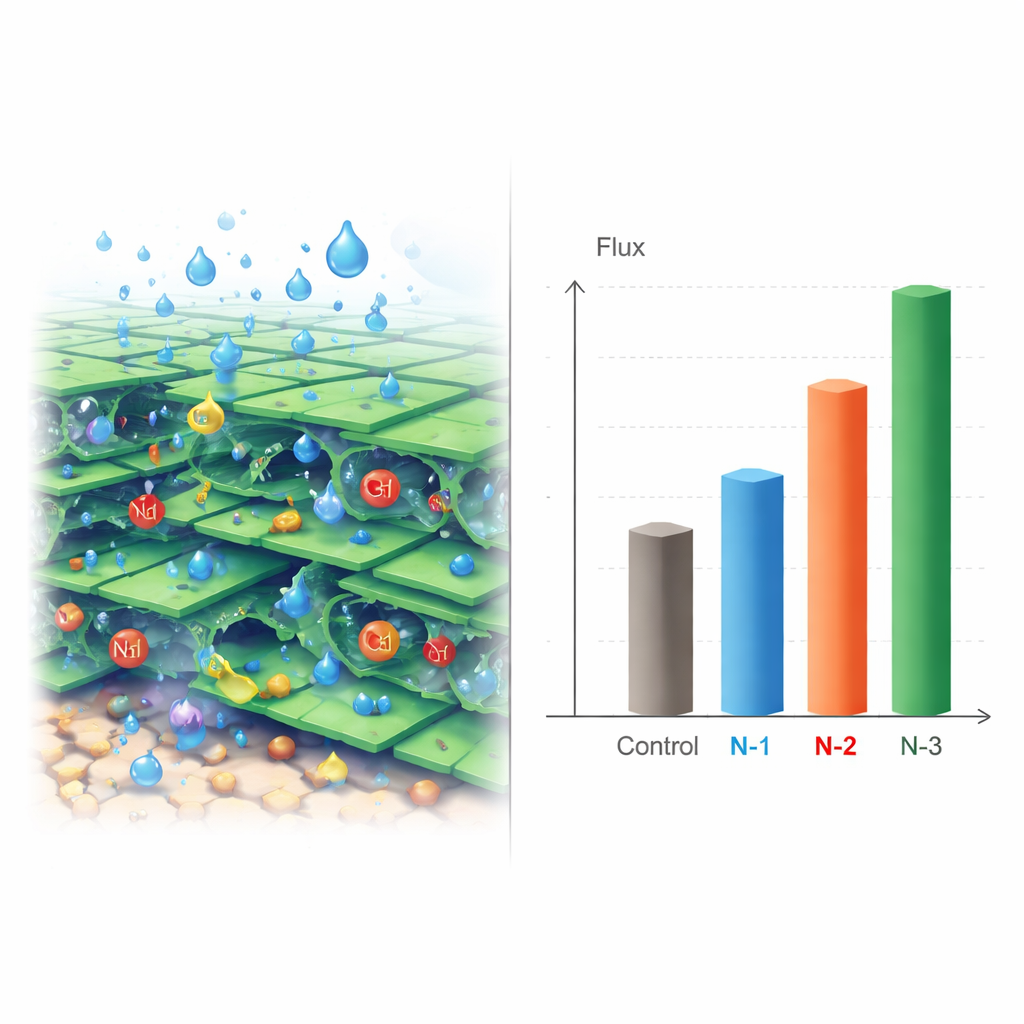
The researchers then blended tiny amounts of these nickel nanosheets into the water-based solution used to form the membrane’s selective top skin. As this solution met an oil-based solution containing another ingredient, a fast reaction formed a thin polyamide layer with the nanosheets embedded inside. Three modified membranes were produced, containing rising nanosheet loadings and labeled N-1, N-2, and N-3, and compared with an unmodified control. Microscopy showed that the new membranes had a slightly rougher yet smoother-looking surface at the microscopic scale, with fewer sharp bumps where dirt can lodge. Contact-angle tests revealed that their surfaces became more welcoming to water, a sign that they would wet easily and resist fouling.
More Water, Less Salt, and Reduced Gumming Up
Performance tests told a clear story. Under the same pressure, the membrane with the highest nanosheet content (N-3) allowed roughly 80 percent more pure water to pass through compared with the original membrane, while still rejecting above 97 percent of common salts such as sodium chloride, calcium chloride, and magnesium sulfate. In other words, the filter became both faster and at least as selective—a rare combination. The authors attribute this to the porous nanosheets offering extra “express lanes” for water, while tightening up any loose pathways that salt ions might otherwise exploit. When challenged with a protein solution that mimics real-world fouling, the modified membranes recovered more of their original water flow after a simple rinse, indicating that unwanted material stuck less firmly. Long, 48-hour tests under high pressure showed that the upgraded filters maintained high salt rejection and stable output, suggesting they could be durable in real desalination plants.
What This Means for Future Drinking Water
For non-specialists, the key message is that the authors have shown a practical way to upgrade existing seawater filters by sprinkling in tiny, sheet-like crystals. These additives help water move more easily through the membrane, keep salt ions out, and make it harder for grime to build up, all without major changes to current manufacturing methods. While challenges remain—such as ensuring long-term stability of nickel-based materials and preventing particle clumping—the approach points toward more efficient, robust desalination systems. If scaled up and further refined, such membranes could help produce more fresh water from the same amount of energy, making desalination a more sustainable part of the global response to water scarcity.
Citation: Dauda, A., Falath, W., Waheed, A. et al. Synthesis of 2D nickel MOF nanosheets incorporated in thin film nanocomposite membranes for efficient reverse osmosis desalination. Sci Rep 16, 6499 (2026). https://doi.org/10.1038/s41598-026-37452-8
Keywords: desalination, reverse osmosis membranes, metal-organic frameworks, water treatment, nanocomposite materials