Clear Sky Science · en
Advanced electrical diagnostics for monitoring soil contamination: a laboratory-based assessment approach
Why tracking hidden pollution matters
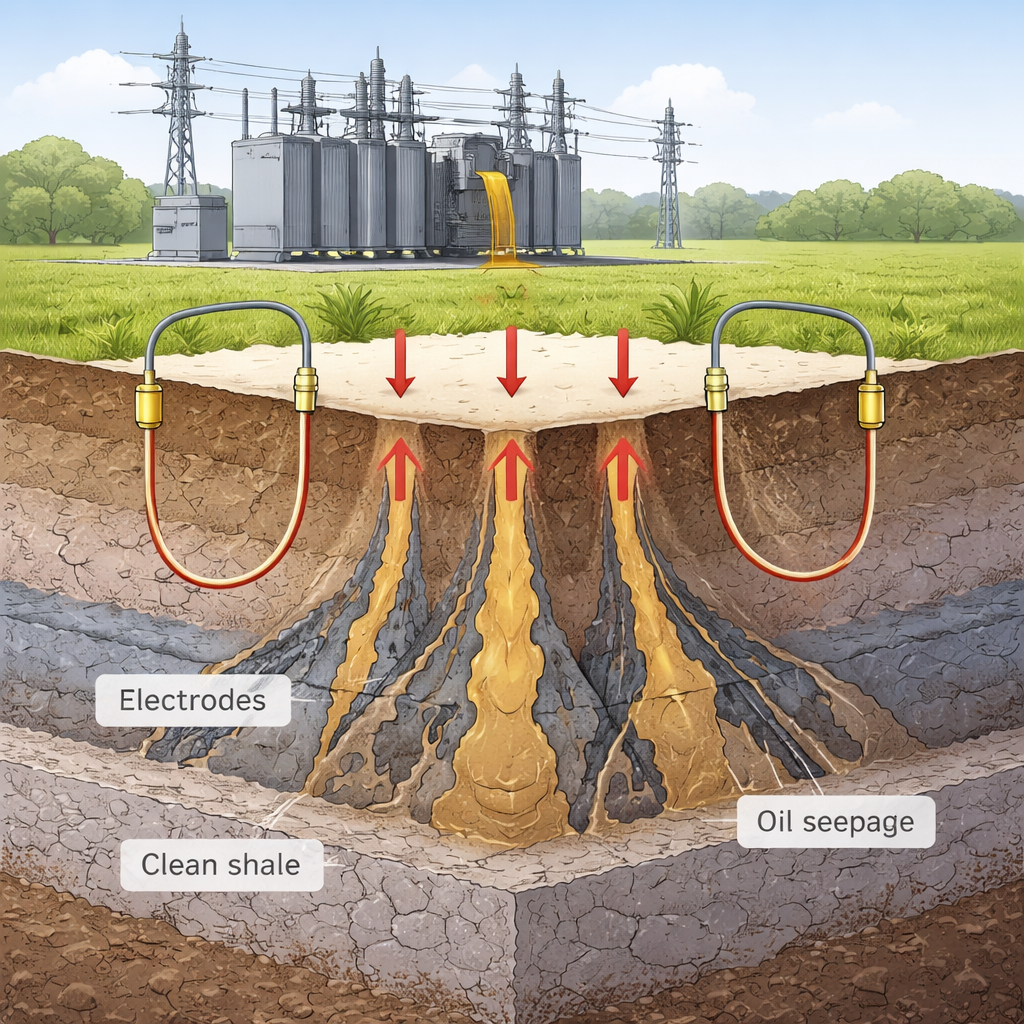
Oil leaks from old electrical transformers do not just stain the ground; they can release invisible poisons called PCBs that linger for decades, seep into groundwater, and build up in the food chain. Digging up large areas to look for this contamination is expensive and disruptive. This study explores whether we can instead "listen" to the soil using gentle electrical signals to spot where oil and PCBs have spread, offering a fast, non-invasive way to protect water resources, farmland, and nearby communities.
Turning the ground into an electrical circuit
Soil and rock are not just dirt and stone; they act like complex electrical materials. Some parts conduct electricity reasonably well, while others behave more like insulation. The researchers focused on shale, a fine-grained rock common in many regions and often rich in organic matter. They worked with shale from a site in Egypt where transformer oil containing PCBs could potentially leak into the ground. In carefully controlled laboratory tests, they treated clean shale samples with different amounts of this oil and then measured how easily electrical signals passed through the rock over a wide range of very low to moderate frequencies.
Building real-world samples in the lab
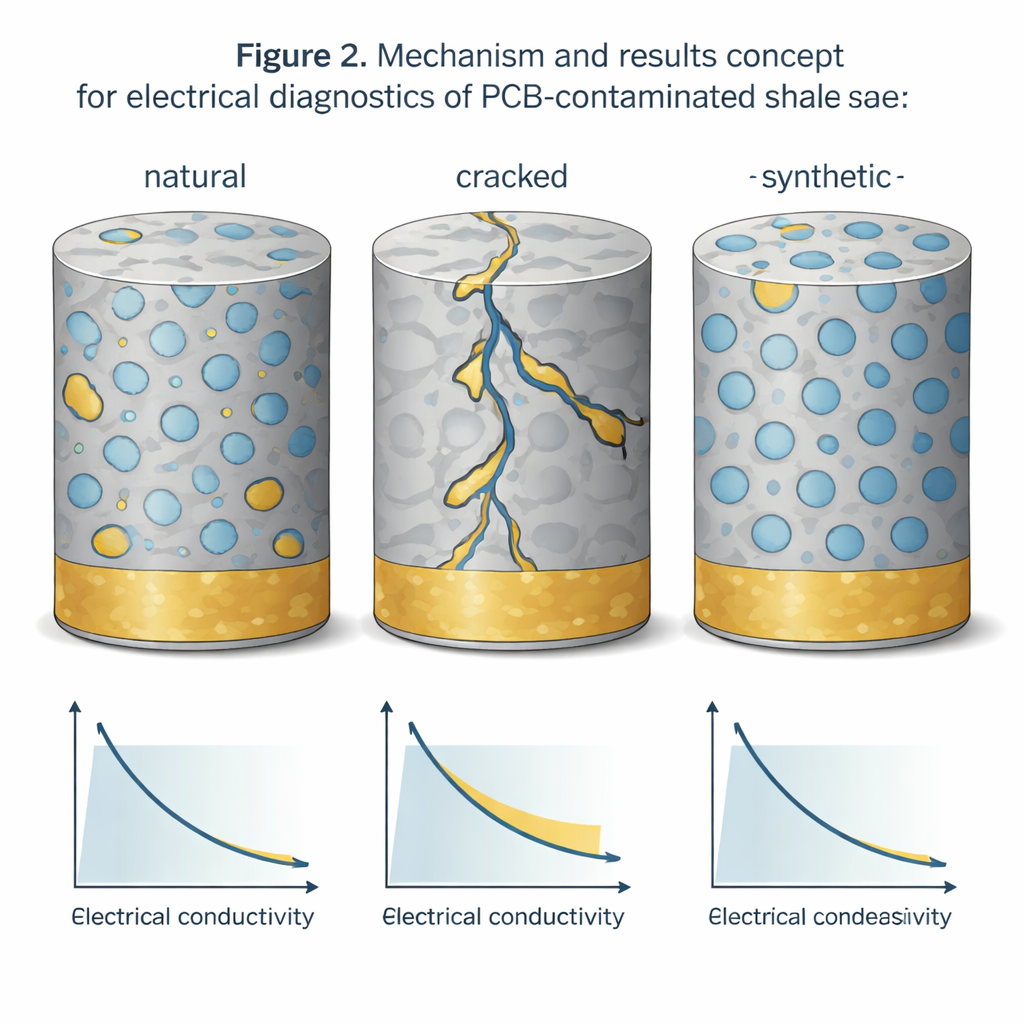
To mimic different types of ground, the team prepared three kinds of shale samples: intact cores ("natural"), cores with visible fractures ("cracked"), and a powdered-and-repacked version ("synthetic") that behaves like very fine, uniform soil. Each type has different pore spaces and pathways for fluids to move. They gradually increased the oil saturation from dry to fully soaked, weighing the samples to know exactly how much oil had entered. Using a specialized instrument called an impedance analyzer and a four-electrode setup to avoid measurement distortions, they recorded key electrical properties: how well the samples conducted current, how much electrical energy they could store (the dielectric constant), and how they resisted and delayed current flow across frequencies.
What happens when oil invades the pores
The results were strikingly consistent for most cases. As more oil filled the pores of the shale, both electrical conductivity and dielectric constant dropped sharply. In simple terms, the rock became more like an electrical insulator. This matches the nature of the contaminant: transformer oil with PCBs conducts electricity very poorly, so when it displaces water or air in the pores, it blocks the normal paths that electrical charges use to move and accumulate. Natural and synthetic samples showed clear, almost linear relationships: higher contamination meant lower conductivity and lower capacity to store electrical energy, especially at the reference frequency of 100 Hz used to compare results. These neat trends suggest that, in the field, the strength of the electrical response could be used as a rough indicator of how much oil is present.
Cracks, shortcuts, and complex signals
The fractured samples told a more complicated story. Instead of spreading evenly, the oil rapidly chased along the cracks, forming concentrated streaks rather than a smooth distribution. Electrically, this produced more irregular behavior and weaker statistical relationships between oil content and measured properties. By analyzing special plots that show how real and imaginary parts of impedance relate to each other (Nyquist or Argand plots), the team could distinguish between responses from the bulk rock and from interfaces where oil meets mineral surfaces. Synthetic samples, with their highly uniform structure, displayed textbook patterns with two clear arcs, while natural samples showed more mixed behavior and cracked samples were dominated by the complex effects of oil-filled fractures.
From lab insights to practical monitoring
Overall, the study shows that low-voltage electrical measurements can reliably detect and track oil and PCB contamination in shale, especially when the rock is intact or relatively uniform. As contamination increases, soils and rocks become less conductive and store less electrical energy, changes that can be picked up by induced polarization surveys from the surface without digging. While fractured ground complicates the picture, it also leaves a distinct electrical fingerprint that helps identify zones where oil has moved quickly along cracks. For decision-makers, this means that carefully designed electrical surveys could serve as an early-warning and mapping tool for oil seepage, guiding cleanup efforts and helping to safeguard groundwater and agricultural land at a fraction of the cost and disturbance of traditional sampling.
Citation: Moawad, M., Gomaa, M., Elshenawy, A. et al. Advanced electrical diagnostics for monitoring soil contamination: a laboratory-based assessment approach. Sci Rep 16, 7184 (2026). https://doi.org/10.1038/s41598-026-37447-5
Keywords: soil contamination, PCB pollution, induced polarization, oil seepage, groundwater protection