Clear Sky Science · en
Soliton structures and dynamical characteristics of fractional nonlinear waves in the classical Boussinesq framework
Why waves that don’t fade away matter
From tsunamis crossing oceans to light pulses racing through fiber‑optic cables, many of the waves that shape our lives behave in surprisingly stubborn ways: they keep their form instead of spreading out. These long‑lived pulses, called solitons, can carry energy and information over great distances. This paper explores a modern mathematical model of such waves that accounts for “memory” effects in time and space, showing how a single equation can generate many kinds of robust wave patterns and how stable, predictable, or even chaotic their motion can be.
A modern twist on a classic wave equation
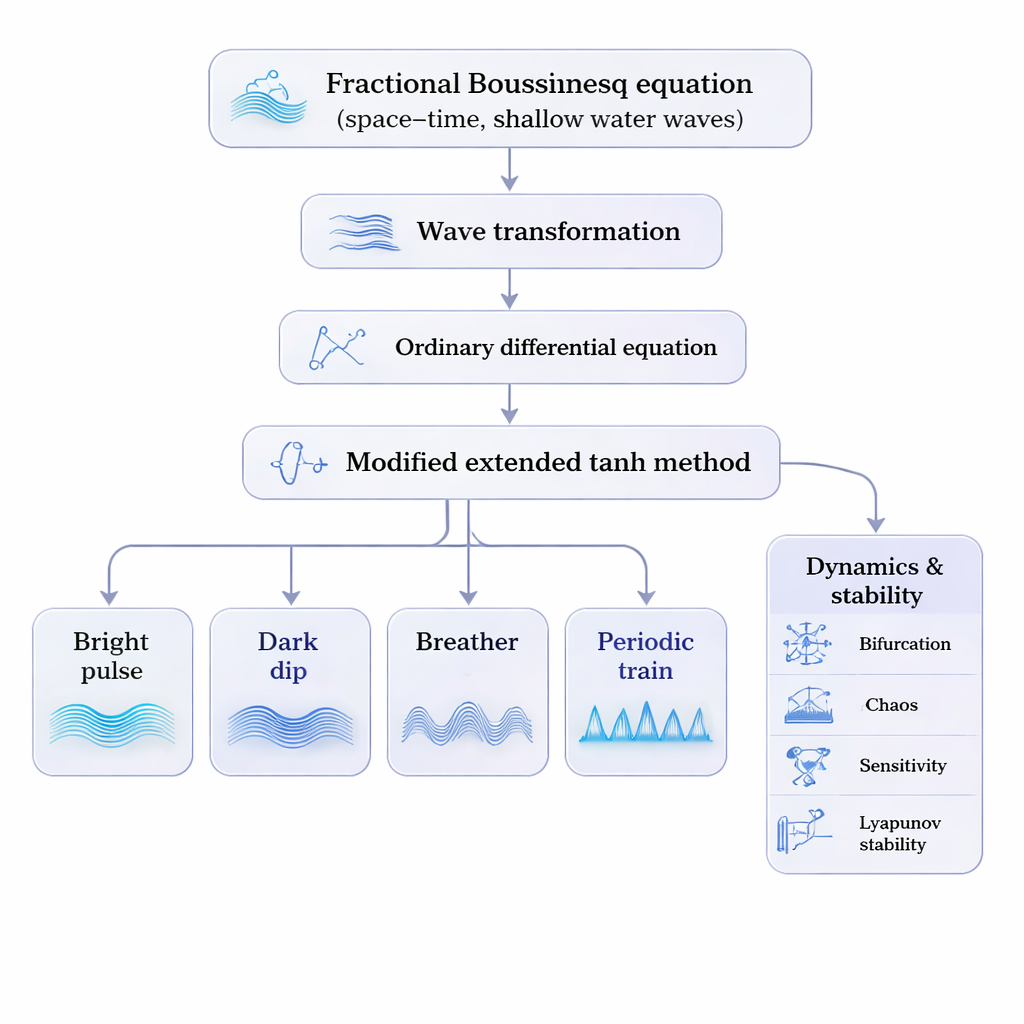
The authors start from the classical Boussinesq equation, a well‑known tool for describing long waves in shallow water, such as tides or surface waves on coastal shelves. They extend this equation by introducing so‑called fractional derivatives in both space and time. In plain terms, this upgrade allows the model to include memory and long‑range influence: the wave at a given point depends not only on what is happening nearby right now, but also on what happened earlier and farther away. Such behavior is typical of real systems ranging from water waves over uneven seabeds to plasmas and nonlinear crystal lattices, and even light pulses in complex optical fibers.
Building a toolbox of wave shapes
To extract useful solutions from this more complicated equation, the study uses a systematic technique known as the modified extended tanh method. This method converts the original wave equation into a simpler ordinary differential equation and then constructs solutions from combinations of elementary building blocks, much like assembling Lego bricks. By doing so, the authors obtain a catalog of explicit wave shapes: bright solitons that rise above a flat background, dark solitons that appear as localized dips, oscillating “breather” structures whose height pulsates in time, repeating wave trains that look like nonlinear ripples, and sharper so‑called μ‑type pulses with steep sides. Each family of solutions comes with formulas that link its height, width, and speed to the physical parameters of the system.
How memory changes the waves
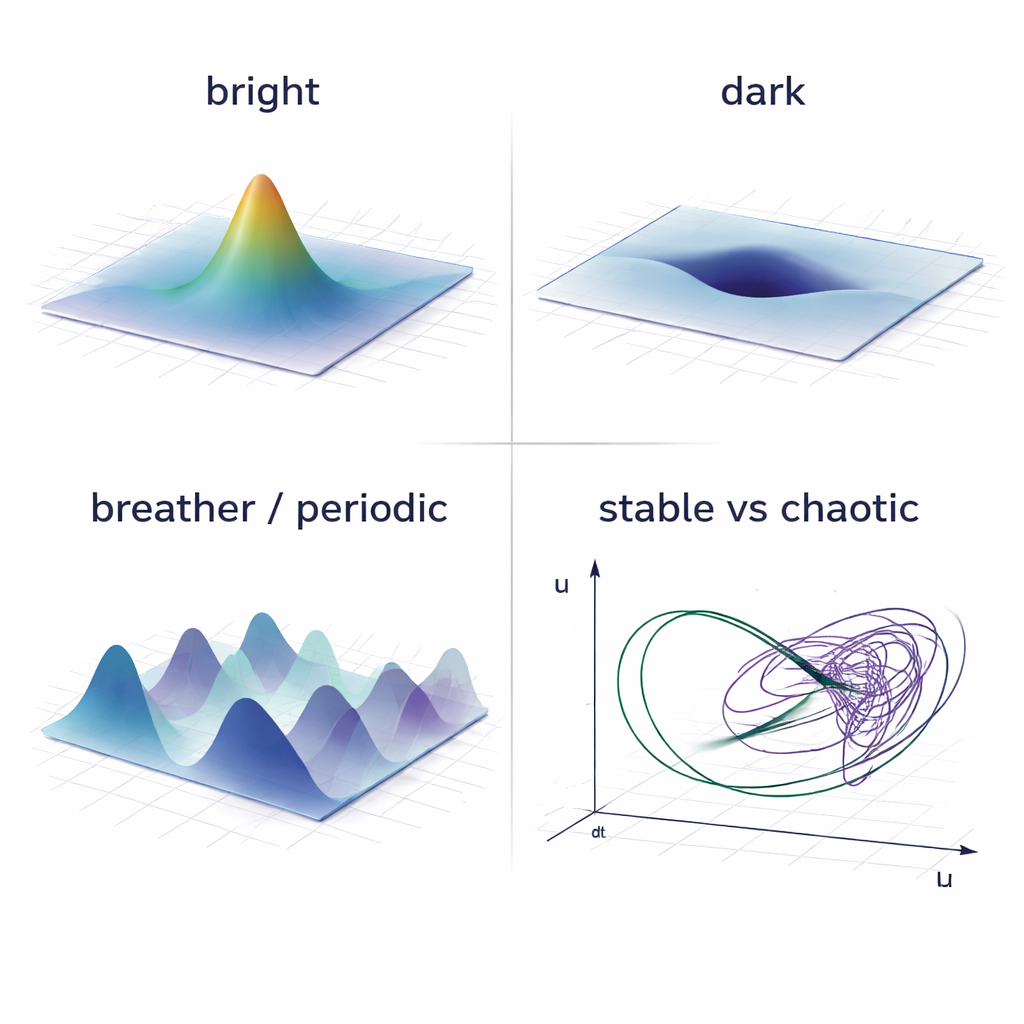
A key focus of the work is how the fractional orders in space and time control the look and motion of these waves. By varying the space‑fractional parameter, the authors show that wave profiles can sharpen, flatten, or become more distorted, affecting how abruptly the wave rises and falls. Changing the time‑fractional parameter alters how quickly the wave’s frequency and amplitude evolve, mimicking systems where past behavior strongly influences future motion. Through two‑ and three‑dimensional plots, the paper demonstrates how the same underlying equation can switch between bright, dark, breather, periodic, and μ‑type behavior simply by tuning these “memory” knobs and other model constants.
From steady pulses to chaos
Beyond finding neat formulas, the authors ask whether these waves are stable and how their motion changes when parameters are nudged. Using phase‑plane diagrams and bifurcation analysis, they track how equilibrium states of the system appear, disappear, or swap stability as control parameters change—a hallmark of transitions between different dynamical regimes. By adding a gentle periodic forcing, they reveal periodic, quasi‑periodic, and fully chaotic motions, illustrating how a system that can support clean solitons can also become unpredictable. Sensitivity analysis shows how small changes in initial conditions or parameters can dramatically alter trajectories, and Lyapunov‑type measures help distinguish truly stable behavior from regimes where nearby solutions diverge.
Why these results are useful
In everyday terms, the study shows that a single, memory‑rich wave equation can produce a wide variety of self‑organized patterns that either persist, morph, or descend into chaos, depending on how nature’s dials are set. Because the same mathematical framework applies to shallow‑water waves, plasma oscillations, optical fibers, and engineered lattices, the results offer a reference map for predicting when robust pulses will survive disturbances and when they will not. This understanding can inform better coastal flood models, more reliable optical communication schemes, and improved designs of materials that guide energy and signals. The authors also outline next steps—such as adding randomness and higher‑dimensional effects—to bring theory even closer to the messy, fascinating behavior of waves in the real world.
Citation: Rimu, N.N., Islam, M.A. & Dey, P. Soliton structures and dynamical characteristics of fractional nonlinear waves in the classical Boussinesq framework. Sci Rep 16, 7672 (2026). https://doi.org/10.1038/s41598-026-37442-w
Keywords: fractional waves, solitons, nonlinear dynamics, shallow water, chaos