Clear Sky Science · en
Analysis of different methods to calculate tertiary regulation reserves for renewable energy in Japan
Keeping the Lights On When Weather Is Unpredictable
As Japan leans more heavily on solar panels and wind turbines, a new question has emerged: how do you keep the lights on when tomorrow’s sunshine and wind are never quite what the forecast promised? This study looks under the hood of Japan’s power market to see how grid operators buy backup power to cover sudden shortfalls from renewables, and whether the current rules are giving the country good reliability for the money it spends.

Why Backup Power Matters for Green Electricity
Solar and wind plants do not behave like traditional coal or gas plants. Their output rises and falls with clouds and wind gusts, sometimes in ways that forecasters miss. If solar production falls short of what was expected a day earlier, the grid can be left scrambling for electricity at the last minute, risking frequency problems or even blackouts. To hedge against this, Japan’s grid operators must buy a special kind of backup called the Replacement Reserve for Feed‑in‑Tariff renewables, or RR‑FIT, which is meant to cover unexpected shortfalls from large fleets of solar and wind systems.
How Japan Currently Buys Its Safety Cushion
The RR‑FIT is calculated using a set of rules drawn up by Japan’s national coordination body for transmission operators. For each half‑hour of the coming day, grid companies take two years of past forecast errors, slice them into time‑of‑day and output ranges, and look at the largest errors that occurred in those conditions. They then try to strip out errors that appear close to real time—covered by a separate, faster reserve—by subtracting a high “tail” value of hour‑ahead errors from a similarly high value of day‑ahead errors. This produces a large table of recommended reserve levels that, in theory, should cover almost all serious overestimates of renewable generation.
What Real‑World Data Reveal About the Shortcomings
Using five years of detailed operational data from the Chubu region—one of Japan’s biggest power systems—the authors show that the current RR‑FIT method does not perform as advertised. Even though it targets very rare, extreme errors, the resulting reserves only covered the relevant forecast shortfalls about 70–80 percent of the time, and some hours saw reserve gaps of more than 2 gigawatts. Part of the problem is mathematical: subtracting two separately computed “worst‑case” values is not the same as sizing reserves directly from the actual difference between day‑ahead and hour‑ahead forecasts for each hour. The current method also divides data into coarse blocks by time and output level, which leads to patchy statistics, many zero or inconsistent values, and the need for ad‑hoc corrections.
Smarter Ways to Size the Safety Net
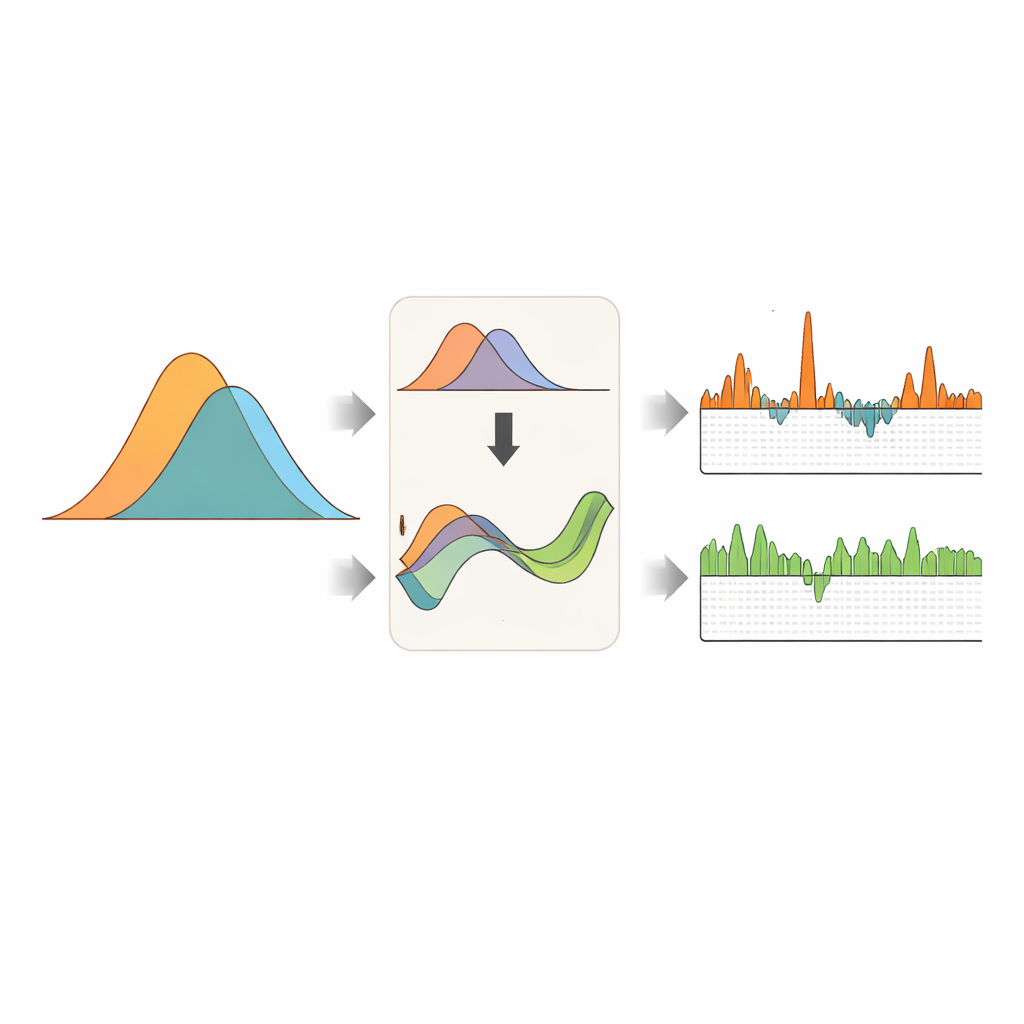
To fix these issues, the study tests two improvements. The first (modification I) bases the reserve directly on the distribution of the difference between day‑ahead and hour‑ahead forecast errors, rather than on the difference of their separate extremes. The second (modification II) smooths the blocky reserve table into a continuous curve using a spline fit, so similar forecast levels get similar reserve suggestions. Applied to the same Chubu data, these changes make reserve levels track actual forecast behavior more faithfully. For example, in 2021, a lower statistical threshold combined with the two modifications covered renewable shortfalls 78.7 percent of the time while requiring only 2.3 terawatt‑hours of RR‑FIT—about 7 percentage points more coverage with almost 30 percent less reserve than the current rule. The improved methods also trimmed the largest hourly reserve deficits and reduced unnecessary surpluses.
Hidden Help From Other Reserves and Market Design
Despite the RR‑FIT’s weaknesses, Japan’s grid has not become less reliable. The reason is that another pot of backup—the hour‑ahead reserve—quietly picks up most of the slack. When the authors combine RR‑FIT with leftover hour‑ahead reserves that were not needed for their original purpose, overall coverage of renewable forecast errors exceeds 95 percent even with modest RR‑FIT levels. This masking effect means system operators and policymakers can easily overestimate how well the RR‑FIT alone is working, and it makes it hard to judge how much of this costly reserve is truly necessary.
What This Means for Future Renewables and Costs
The study concludes that Japan can both improve reliability and save money by changing how it sizes reserves for renewable shortfalls. Directly using the statistics of forecast‑error differences and smoothing the reserve curve yield a closer match between backup power and actual risk. The results also indicate that current RR‑FIT volumes could be cut significantly with only a small drop in overall protection, because hour‑ahead reserves are already so generous. For countries worldwide planning grids with high shares of wind and solar, the message is clear: smart reserve calculation and market rules must evolve together, or else power systems risk paying too much for backup that is not targeted where it is most needed.
Citation: Fonseca, J.G.S., Hori, T. & Ogimoto, K. Analysis of different methods to calculate tertiary regulation reserves for renewable energy in Japan. Sci Rep 16, 8348 (2026). https://doi.org/10.1038/s41598-026-37441-x
Keywords: renewable energy reserves, power grid reliability, forecast uncertainty, electricity markets, Japan energy system