Clear Sky Science · en
Low-profile metasurface-backed wideband antenna array for mm-wave applications
Why faster wireless needs smarter hardware
Our phones, cars, and home gadgets are all racing to connect over new fifth‑generation (5G) wireless networks. To deliver fast, reliable links to so many devices at once, engineers are turning to very high radio frequencies known as millimeter waves. These waves can carry huge amounts of data but are easily blocked and weakened, so they demand antennas that are both powerful and tiny enough to fit inside handheld electronics. This study presents a new antenna design that aims to do just that: squeeze strong, precise millimeter‑wave performance into a thin, compact package suitable for future 5G gear.
Making small antennas act like big ones
Conventional flat antennas are attractive for consumer devices because they are thin, light, and easy to print onto circuit boards. Unfortunately, they usually do not provide the strong, focused beams needed for long‑range or high‑speed millimeter‑wave links. A common workaround is to build large arrays of many antenna elements so their signals add up, boosting the overall strength. Earlier designs, however, often ended up bulky, narrow‑band, or difficult to integrate into portable gadgets. The authors set out to find a middle ground: a low‑profile, wideband antenna array that keeps its footprint small while still offering higher gain and stable radiation patterns across an important slice of the 5G spectrum.

A thin array with a clever building block
The heart of the new design is a row of four identical antenna elements laid out on a high‑quality circuit board. Each element is shaped like two circular rings joined together, a geometry that helps shrink its physical size while still responding well at millimeter‑wave frequencies. These four elements are fed by a carefully designed network of microwave lines that splits the input power evenly and keeps the signal in step across the array. On the opposite side of the board, the ground metal is partially removed and notched, a trick that helps the structure respond over a wide span of frequencies—from about 27 to 40 gigahertz—rather than just at a single narrow channel.
A patterned mirror that reshapes radio waves
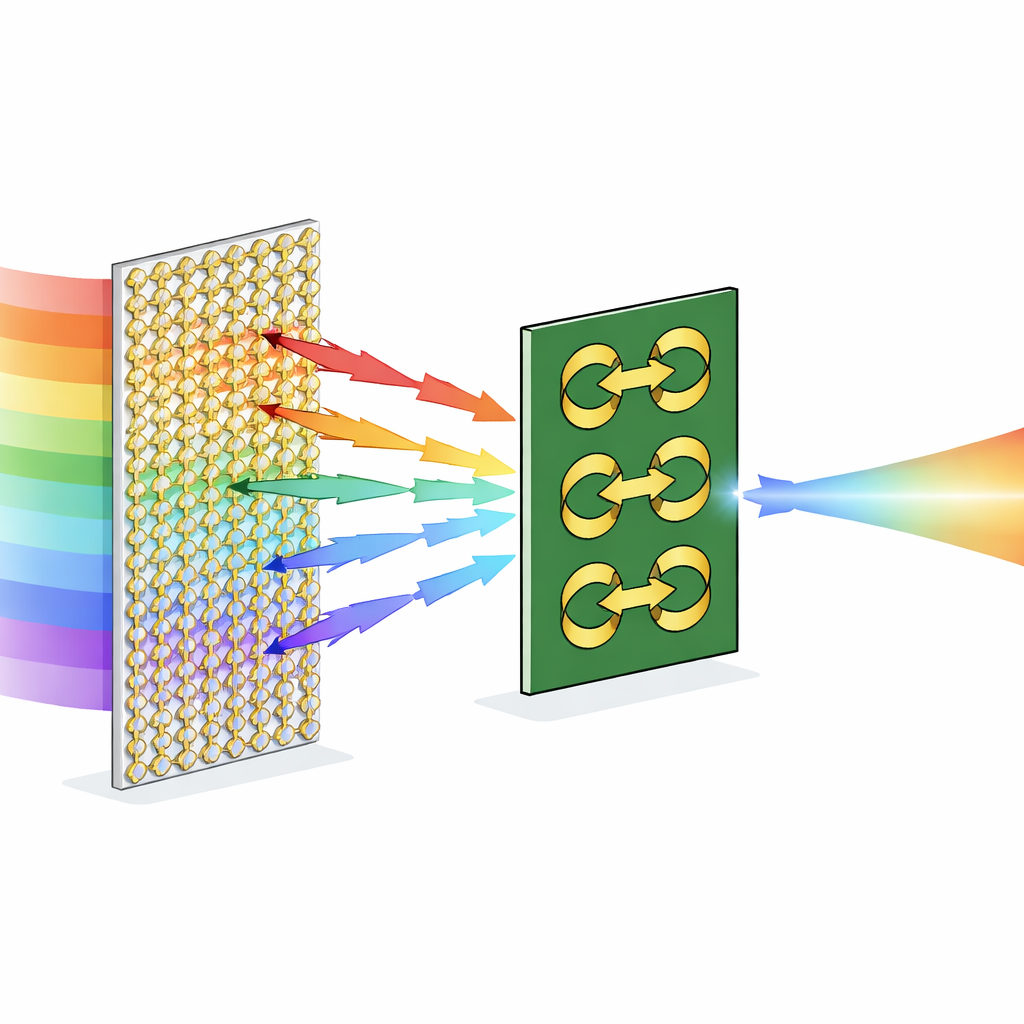
To further strengthen and tidy up the antenna’s radiation, the researchers add a second piece of hardware: a patterned “metasurface” panel that acts like a smart mirror for radio waves. This panel, placed a tiny distance behind the array, is made from many small repeated metallic shapes on another thin board. Together they form a surface that not only reflects incoming millimeter waves but also twists their polarization—the direction in which the electric field wiggles—by ninety degrees. Across a broad frequency range, the metasurface converts more than 90 percent of the incoming energy into this rotated form. In the combined system, backward‑going radiation from the main array hits the metasurface, gets reoriented, and then adds constructively with the forward radiation, concentrating more power in the desired broadside direction.
Putting the design to the test
After computer simulations, the team built a physical prototype consisting of the four‑element array and a matching metasurface made of three by ten unit cells. They mounted the two layers with a thin air‑like spacer to fine‑tune how the reflected waves line up in phase with the direct ones. Laboratory measurements of how much signal is reflected back into the feed confirmed that the antenna works efficiently from 27.14 to 40 gigahertz, covering a wide swath of millimeter‑wave bands. Measurements in an anechoic chamber—a room that absorbs stray radio waves—showed that the metasurface raises the antenna’s gain by about 2.5 decibels on average, with a peak value around 12.3 decibels, and produces more directional beams especially at the lower and middle parts of the band.
What this means for future 5G devices
Viewed from a layperson’s perspective, the proposed design is like giving a slim smartphone antenna the performance boost of a much larger dish without adding bulk. By teaming a compact four‑element array with a carefully tuned, ultra‑thin reflecting panel, the authors achieve wideband coverage, respectable gain, and a low overall thickness that is practical for embedded 5G hardware. The improvement in signal strength is modest but comes with cleaner, more controlled radiation patterns and high efficiency across many channels. Such metasurface‑backed antennas could help future millimeter‑wave devices maintain fast, stable links in crowded real‑world environments, while leaving valuable space inside gadgets for other components.
Citation: Kiani, S., Rafique, U., Shoaib, N. et al. Low-profile metasurface-backed wideband antenna array for mm-wave applications. Sci Rep 16, 8619 (2026). https://doi.org/10.1038/s41598-026-37435-9
Keywords: 5G antennas, millimeter-wave, metasurface, high-gain array, wireless devices