Clear Sky Science · en
Mitigating shoulder spoofing vulnerabilities in mobile payment systems: a security framework
Why watching eyes matters for your money
Mobile payments have made it effortless to pay for groceries, split a restaurant bill, or send money with a few taps. But every time you type in a PIN in a crowded shop or stand in front of a ticket machine, nearby eyes—or even hidden cameras—may be quietly watching. This paper presents a new way to give your phone a kind of sixth sense, so it can notice when someone is visually snooping on your screen and warn you before your financial details are exposed.
The hidden risk of prying eyes
Most of us trust that banking apps and payment systems are protected by strong codes and encryption. Yet many attacks skip the complex hacking and simply rely on looking over a victim’s shoulder to steal a PIN or password. Traditional defenses—like masking digits, dimming the screen, or using fingerprints—mainly guard data inside the app. They do almost nothing about people or cameras in the physical world. The authors call this “contextual blindness”: the phone has no idea if someone is staring at your screen while you pay, which quietly undermines user privacy and trust.
A phone that senses its surroundings
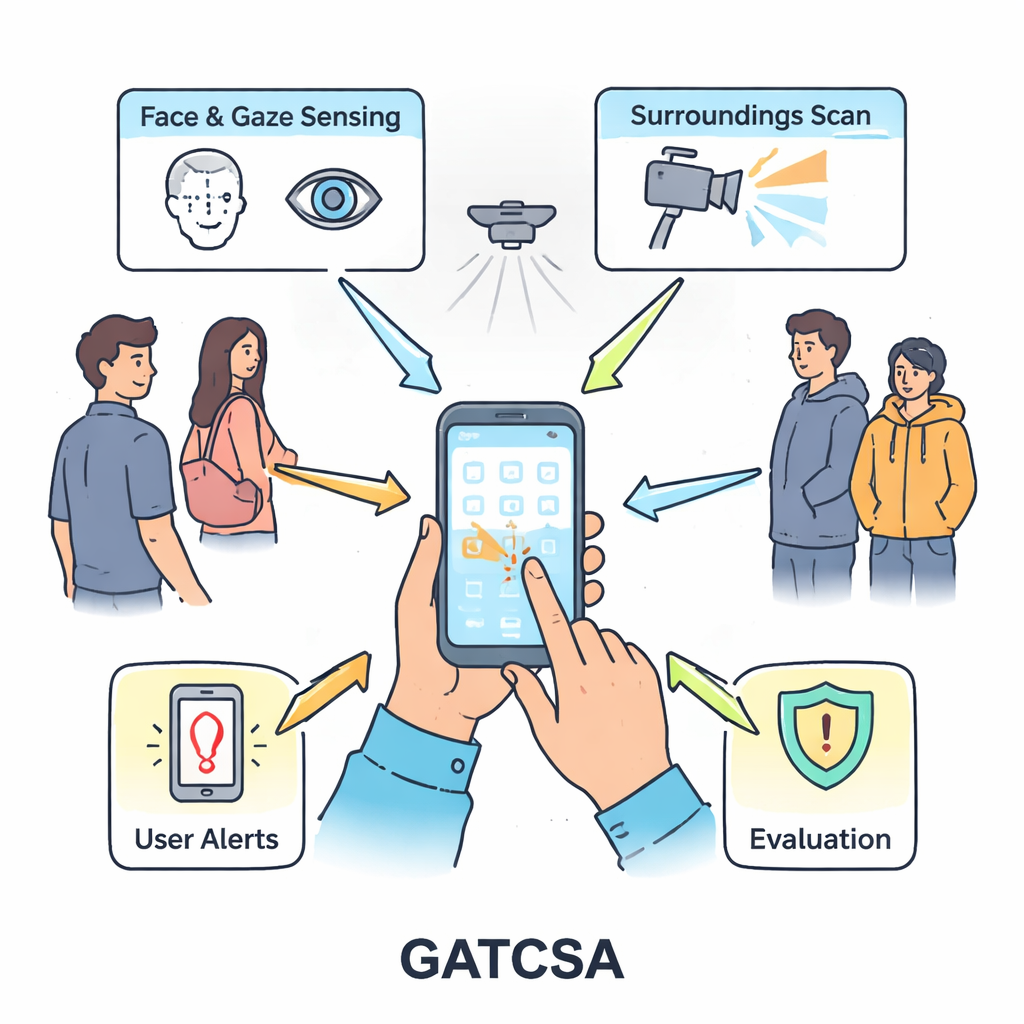
The researchers propose GATCSA, a system that turns the front camera of your phone into a real-time lookout while you make payments. As you enter your PIN, the camera briefly scans the scene. Lightweight computer vision software detects nearby faces, figures out where people are looking, and spots objects like surveillance cameras or other phones that might be recording. It also estimates how close these observers are, how long they keep their gaze on your screen, and how many potential snoopers are around. All of this information is combined into a single threat score that represents how risky the situation is at that moment.
From gaze and gadgets to a risk score
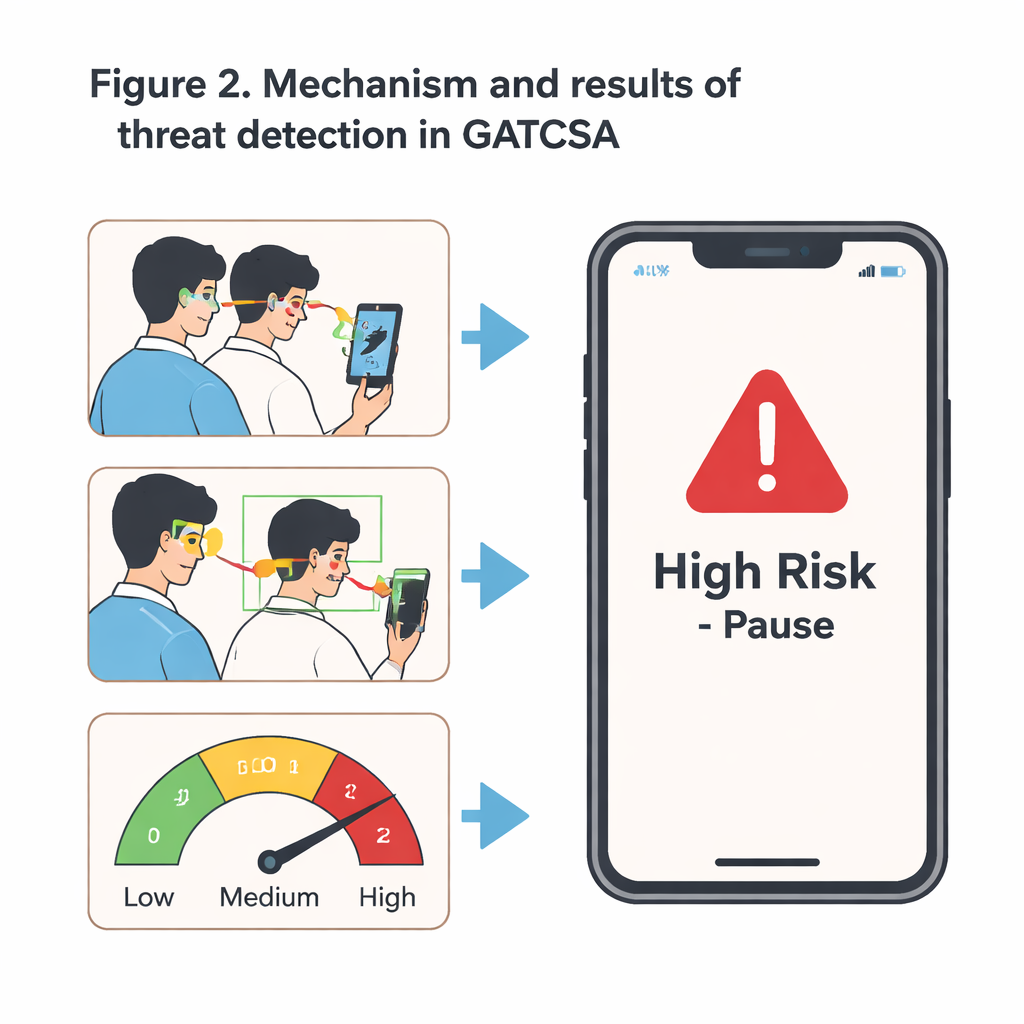
Under the hood, GATCSA works like a careful security guard. First, it cleans and standardizes camera frames so they are easy for the algorithms to read. Then it finds faces and locates key points around the eyes to estimate which direction a person is looking. In parallel, object-detection software searches each frame for items such as CCTV cameras or people holding phones in suspicious positions. A context module then weighs several factors—distance to the screen, angle of view, how long someone keeps looking, crowd size, and the lighting conditions—to produce a graded threat level: low, moderate, or high. Instead of a simple yes-or-no alarm, the system judges how serious the situation really is.
Timely alerts without sharing your video
Once GATCSA decides the risk level, it adapts how it warns you. For a low-risk situation, such as a brief glance from far away, the phone might show a gentle reminder or a small vibration suggesting you stay aware. For moderate or high risk—say, a person nearby staring directly at your screen or a camera clearly aimed at you—the phone can recommend tilting the device, enabling a privacy filter, or even pausing the transaction until the threat passes. Crucially, all of this processing happens entirely on your device. Video frames are analyzed in memory and then discarded, never stored or sent to a server, reducing both privacy concerns and data costs while keeping battery use manageable.
Does it actually work in real-world crowds?
To test whether this kind of visual bodyguard could work outside the lab, the team trained and evaluated GATCSA using both computer-generated eye images and real photos of people in varied lighting and poses. They then ran live trials on different Android and iOS phones, in bright shops, dim indoor spaces, and outdoor areas with changing light. The system detected shoulder-snooping threats with about 98 percent accuracy, reacted in under two tenths of a second on average, and users tended to respond to alerts within a few seconds. Compared with other advanced methods for fending off visual attacks, GATCSA achieved higher accuracy while remaining practical for everyday phones.
What this means for everyday payments
For non-specialists, the core message is straightforward: even the best digital locks cannot protect you if someone can simply see what you type. GATCSA shows that phones can actively watch their surroundings on your behalf, quietly judging when your screen is exposed and nudging you to take simple actions before a snooper captures your PIN. While there are still challenges—such as user comfort with camera use and tricky conditions like very low light—the study points toward a future in which mobile devices are not just secure on the inside, but also smart enough to notice and react to the real-world risks around you.
Citation: Alqahtani, O., Dileep, M.R., Ghouse, M. et al. Mitigating shoulder spoofing vulnerabilities in mobile payment systems: a security framework. Sci Rep 16, 6690 (2026). https://doi.org/10.1038/s41598-026-37426-w
Keywords: mobile payments, shoulder surfing, gaze detection, privacy protection, computer vision security