Clear Sky Science · en
Mu rhythm motor–auditory delay in imagined speech mirrors overt speech timing
Hearing the Voice in Your Head
When you silently rehearse a presentation or read these words "in your head," your brain behaves as if you were actually speaking. This study asks a deceptively simple question: does our inner voice follow the same timing and physical constraints as real, out-loud speech, or is it a sped‑up, unconstrained mental shortcut? The answer matters for understanding how the brain links movement and sensation, and it could ultimately inform technologies that decode imagined speech for people who cannot speak.
How the Brain Links Mouth Movements and Sounds
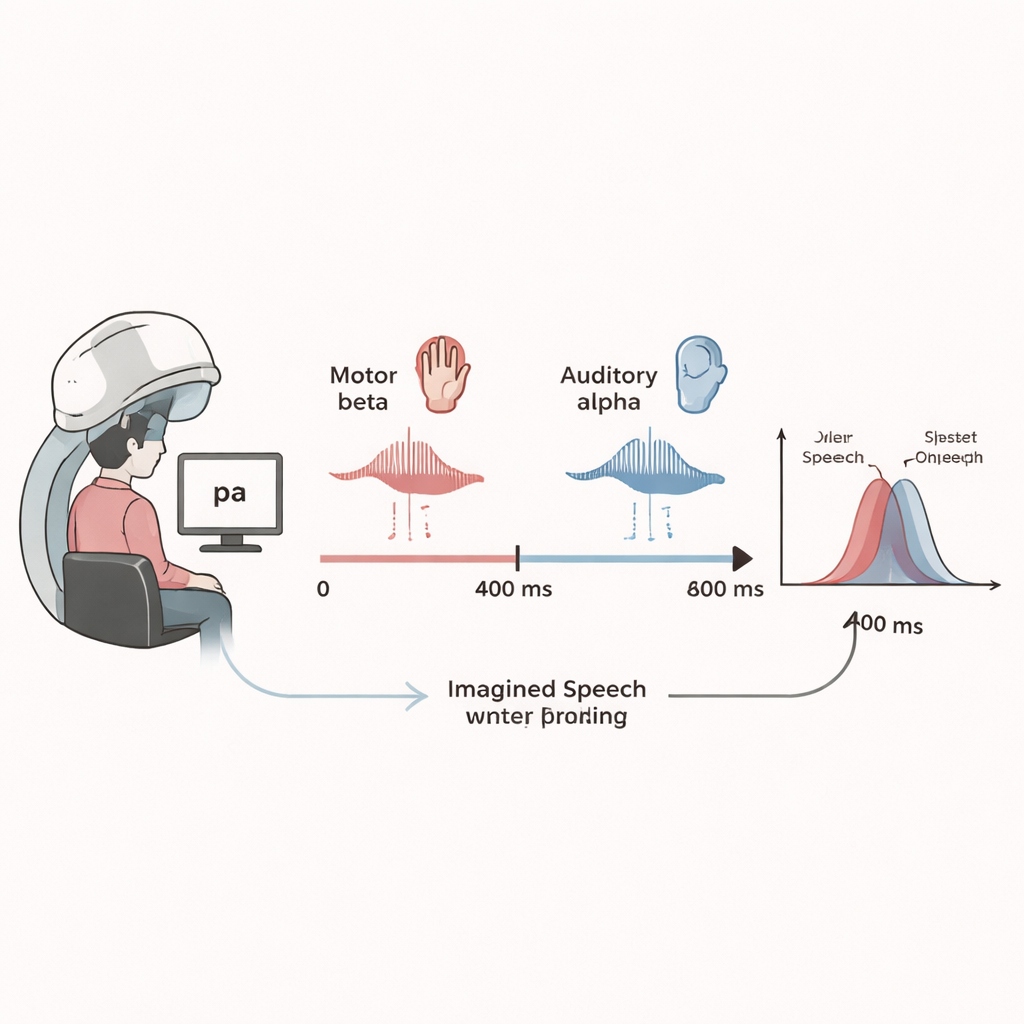
Speaking requires the brain to translate planned movements of the tongue, lips, and jaw into the sounds we hear. That translation takes time because motor signals and sounds are represented in different neural “languages.” Previous work with people actually speaking has shown that the brain compares what it intends to say with what it hears within a window of about one tenth of a second. But in imagined speech, there is no real movement and no sound—only internal simulations. The authors asked whether this internal process still respects the same timing as overt speech, or whether the brain collapses or speeds up the sequence when nothing leaves the mouth.
Quiet Syllables and Sensitive Brain Recordings
To strip speech down to its essentials, participants were shown simple syllables—pa, ta, and ka—and asked either to say them out loud (in a pretest) or to imagine saying them as quickly as possible while remaining completely still. The spoken pretest showed that, on average, people began producing the sound about 0.4 seconds after seeing the syllable, with surprisingly consistent timing across trials. During the main experiment, the researchers recorded brain activity using magnetoencephalography (MEG), a method that tracks the tiny magnetic fields generated by groups of neurons with millisecond precision. They also monitored tiny facial muscle signals to verify that participants were not actually moving when they only imagined speaking.
Two Rhythms, Two Brain Areas, One Delay
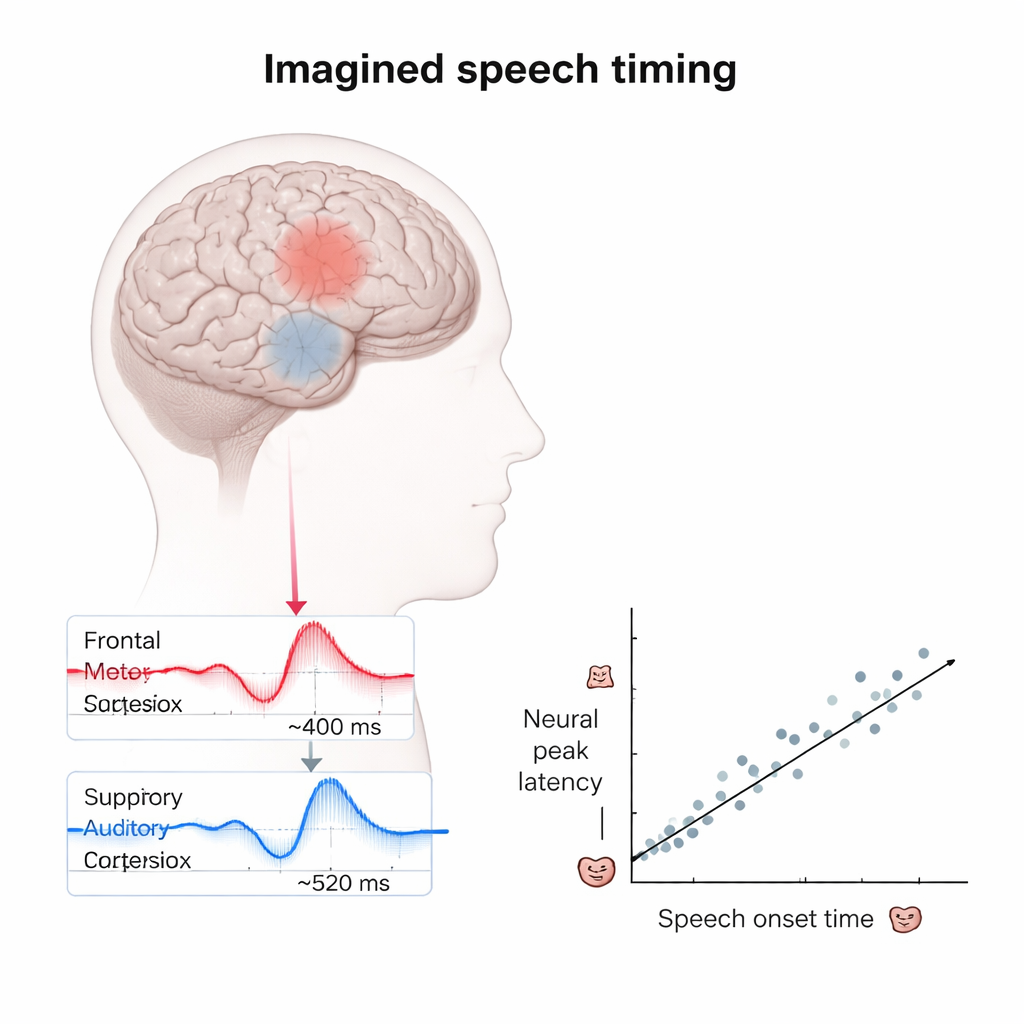
The team focused on a particular brain rhythm known as the mu rhythm, which spans two frequency bands: beta (15–30 Hz) and alpha (8–12 Hz). When people move—or even imagine moving—beta power tends to drop in motor regions, and when they process sounds, alpha power tends to drop in auditory regions. By examining changes in these rhythms relative to a resting baseline, the researchers found a clear sequence during imagined speech. First, beta power decreased in frontal motor areas; later, alpha power decreased in temporal auditory areas. On average, the motor-related beta drop began about 120 milliseconds before the auditory-related alpha drop, and this ordering held reliably across participants.
Inner Speech Mirrors Outer Speech
Crucially, this 120‑millisecond gap between motor and auditory events in the brain closely matched the time window previously reported when people actually speak and hear their own voice. The authors went further by comparing each person’s individual speaking speed in the overt pretest with the timing of their brain rhythms during imagery. People who spoke faster also showed earlier peaks in both motor beta and auditory alpha suppression during imagined speech. This tight alignment suggests that the brain’s internal simulation of articulation and sound follows each person’s natural speaking tempo, even when no sound is produced.
What This Means for the Voice in Our Heads
The findings indicate that inner speech is not a loosely timed, compressed sketch of talking. Instead, at least for simple syllables, it is a faithful replay of the same motor‑to‑sound sequence used in real speech, unfolding on the same time scale but with muscles largely inhibited. The distinct yet coordinated changes in beta and alpha rhythms provide a neural marker of how the brain links planned movements to expected sounds without relying on actual feedback. This marker could help scientists probe how we monitor our own speech, and may one day support brain–computer interfaces that interpret imagined words in people who cannot speak.
Citation: Mantegna, F., Poeppel, D. & Orpella, J. Mu rhythm motor–auditory delay in imagined speech mirrors overt speech timing. Sci Rep 16, 6528 (2026). https://doi.org/10.1038/s41598-026-37421-1
Keywords: inner speech, speech timing, sensorimotor coordination, brain rhythms, imagined speech