Clear Sky Science · en
Motion-numerical compatibility affects magnitude classification
How Moving Your Head Can Change How You Hear Numbers
When you hear the number “two” or “nine,” your brain does more than just recognize the word. It automatically places that number on an internal “number line,” running from small to large. This study asks an intriguing question for everyday life: does the way we move our bodies—specifically, turning or nodding our head—quietly influence how quickly we understand how big or small a number is? The answer sheds light on how closely our thoughts are tied to space and movement.
The Inner Number Line in Our Minds
For decades, research has shown that we tend to imagine numbers laid out in space: smaller numbers on the left or lower down, larger numbers on the right or higher up. People press left-hand buttons faster for small numbers and right-hand buttons faster for large ones. This pattern, called a spatial–numerical association, suggests that we don’t just think about “how much,” but also “where” a number belongs in space. The new study builds on this idea, asking whether these links survive when we drop simple left/right button presses and instead involve more natural body movements.
Listening to Numbers and Pressing Keys
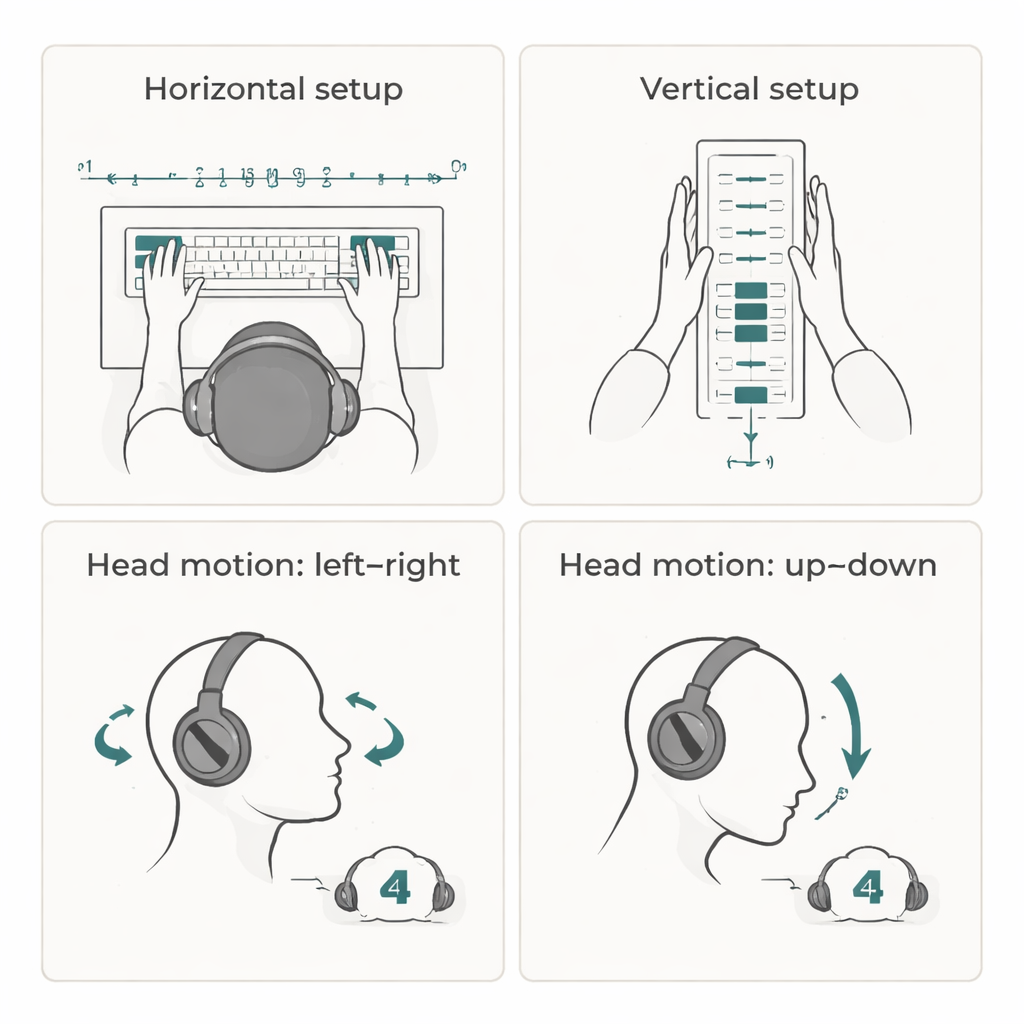
In the first step, the researchers confirmed that their volunteers actually showed the usual number–space patterns. Thirty-three adults listened to spoken numbers—“one,” “two,” “eight,” and “nine”—through headphones and decided whether each was smaller or larger than five. Sometimes they answered with two side-by-side keys; other times, the same two keys were arranged one above the other, so responses were truly vertical. People were faster and more accurate when small numbers matched left or lower keys, and large numbers matched right or upper keys. This showed that the familiar internal number line appeared both horizontally and vertically, even when numbers were only heard, not seen.
Adding Head Movements to the Mix
Next, the team made things more dynamic. Instead of choosing between two keys, participants now pressed a single key only when the number fit a rule (for example, “press if the number is larger than five”). At the same time, they rhythmically moved their head either left-right or up-down. Crucially, each judgment was made just before a planned head movement, so the researchers could ask: does planning to turn left or right—or nod up or down—change how quickly people decide whether a number is small or large? If body motion and number size tap into the same mental space, then turning the head toward the “small” side should help with small numbers, and turning toward the “large” side should help with large numbers.
When Sideways Motion Matters More Than Up and Down
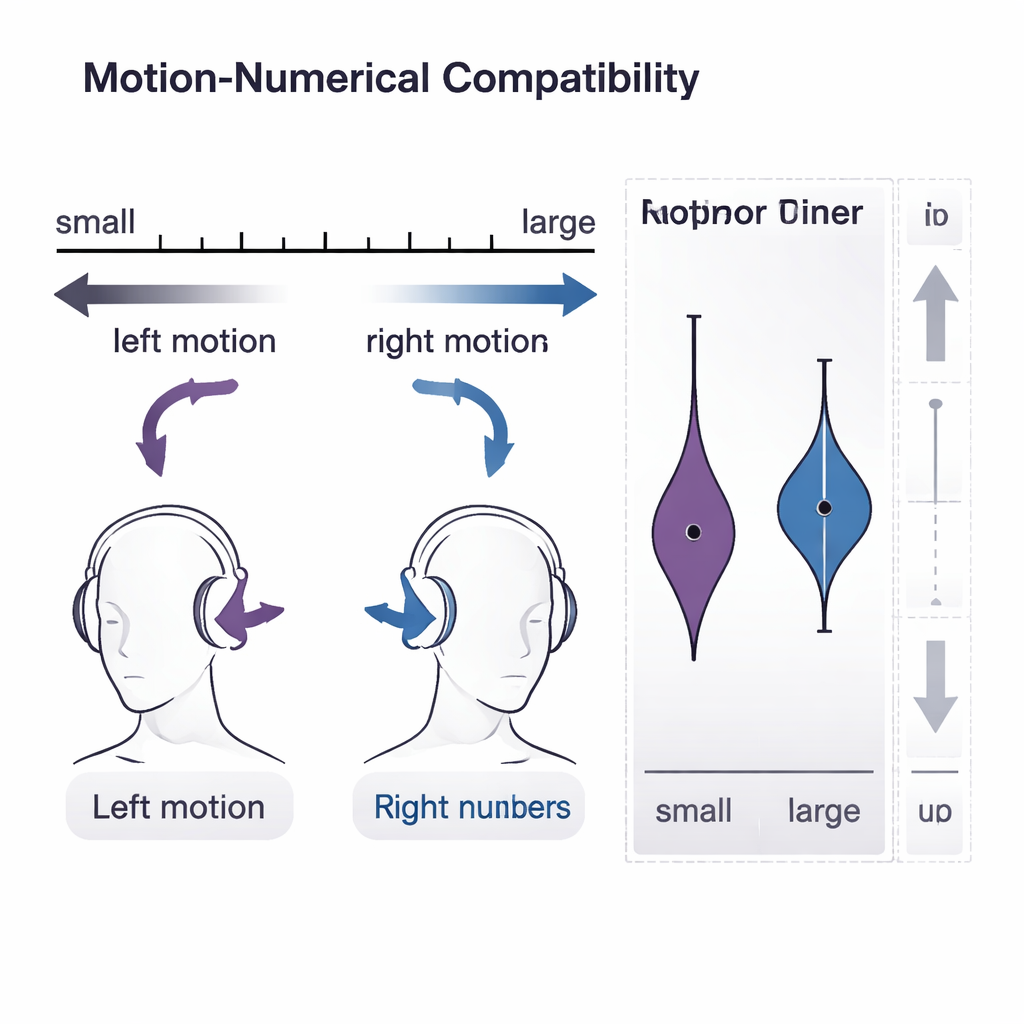
The results were strikingly one-sided. Horizontal head movements did influence number judgments: people were quicker to judge small numbers when they were about to move their head leftward, and quicker to judge large numbers when they were about to move rightward. In other words, planned motion and number size worked together when they pointed along the same side-to-side direction. But vertical head movements told a different story. Although participants responded somewhat faster when they moved their head upward rather than downward overall, there was no special speed-up when “up” matched large numbers or “down” matched small numbers. This suggests that, in this task, our mental number line was much more tightly tied to left and right than to up and down.
What This Means for How We Think About Numbers
To a layperson, the takeaway is that thinking about numbers is not a purely abstract, chalkboard activity in the mind. Instead, it is grounded in how we move and orient ourselves in the world. Turning your head to the left or right subtly nudges attention along an internal horizontal number line, making small or large numbers a bit easier to process depending on the direction of motion. However, the same link is weaker—or at least harder to detect—for up and down movements. This fits with daily experience in reading and navigating, where we mostly move and scan left to right on flat surfaces. Overall, the study shows that numerical thinking is closely tied to spatial attention and body motion, reinforcing the idea that we “navigate” abstract concepts like numbers using the same mental tools we use to navigate physical space.
Citation: Volpi, V., Zona, C. & Fischer, M.H. Motion-numerical compatibility affects magnitude classification. Sci Rep 16, 4760 (2026). https://doi.org/10.1038/s41598-026-37414-0
Keywords: mental number line, spatial attention, numerical cognition, embodied cognition, head movement