Clear Sky Science · en
Analysis of effects of elevation on the power output and efficiency of ground-mounted photovoltaic modules
Why panel height matters more than you might think
Solar panels have become a familiar sight on rooftops and in open fields. But beyond how many panels we install or how they are tilted, a quieter design choice can noticeably change how much electricity they produce: how high they sit above the ground. This study explores a simple question with big practical consequences for homes, farms, and solar farms alike—what mounting height gives ground‑mounted solar modules the best balance of cooling and sunlight, and how much extra energy can that choice deliver over the long term?
Testing three simple setups in the real world
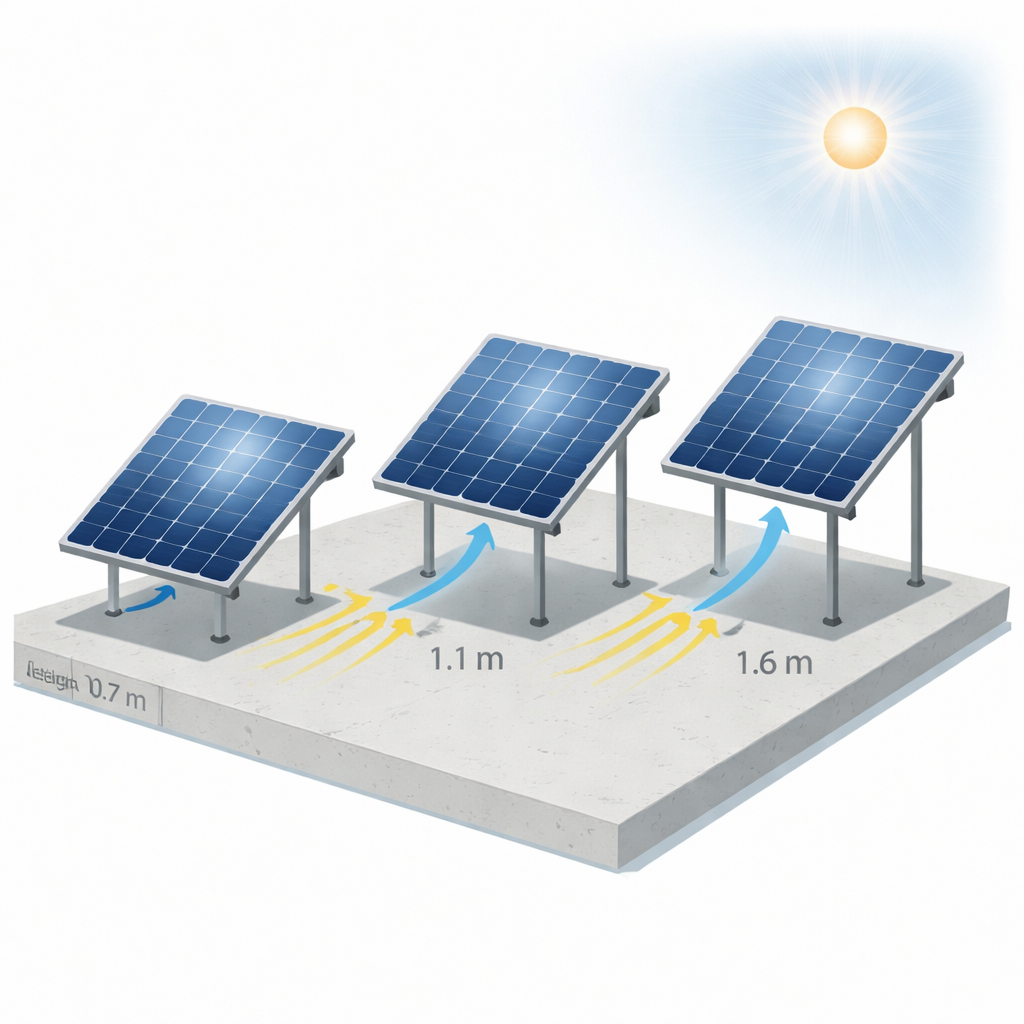
The researchers ran an outdoor experiment at a university campus in Hungary using three identical solar modules mounted over a concrete surface. The only difference between them was how high their lower edge sat above the ground: 0.7 meters, 1.1 meters, or 1.6 meters. All three faced south at the same 45‑degree tilt to ensure equal exposure to the Sun. On a clear autumn day, from late morning to late afternoon, instruments continuously recorded sunlight levels, air temperature, wind speed, panel temperatures, and the electrical output—voltage, current, power, and efficiency—of each module.
How air and ground light change panel behavior
Height above the ground changes two key influences on a panel. First, airflow: as wind moves under and around a panel, it carries heat away, cooling the solar cells and helping them work more efficiently. Too little air, and the cells overheat; too turbulent, and cooling becomes less effective. Second, reflected light from the ground, known as albedo: bright concrete bounces extra sunlight onto the panel, which can boost energy capture but also adds heat. By comparing the three heights under the same weather conditions, the team could see how these small microclimate effects played out in practice over the course of the day.
The sweet spot: a middle height wins
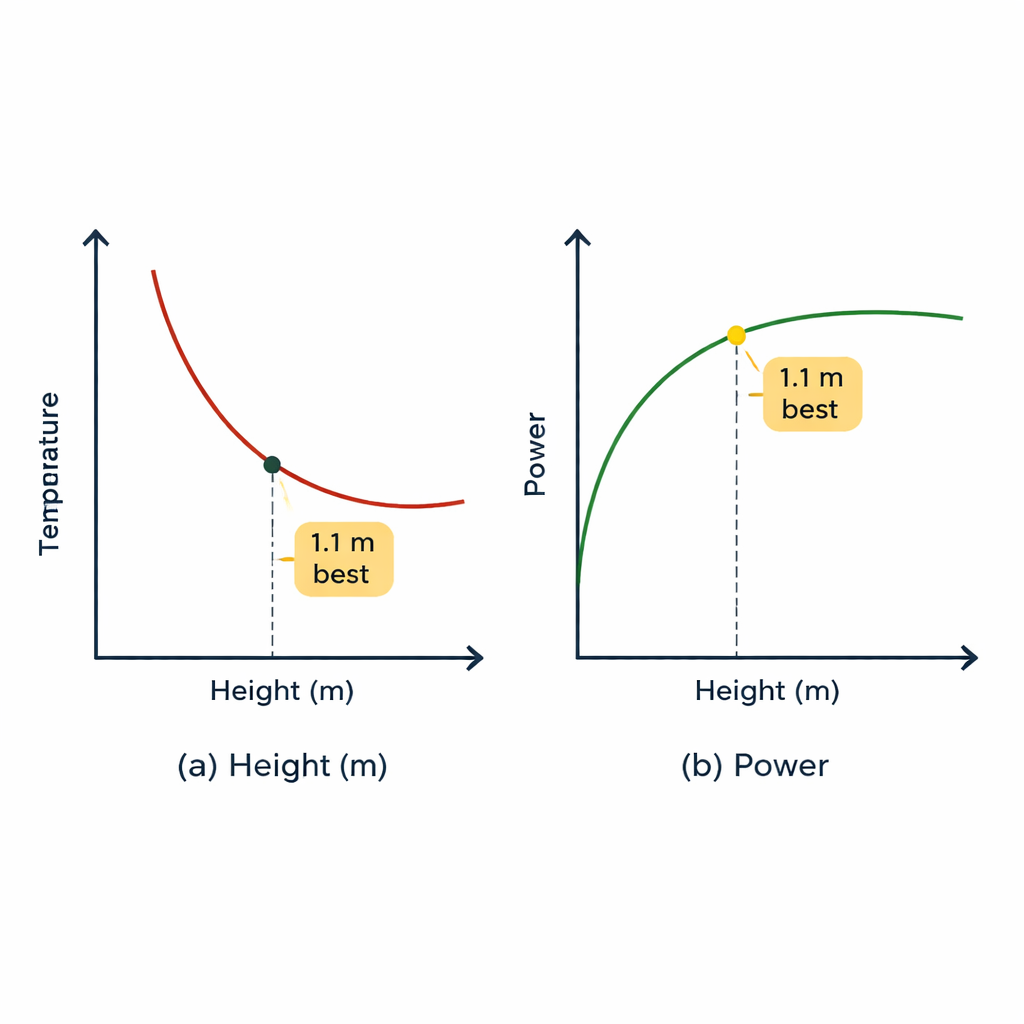
The results were clear. The module mounted at 1.1 meters consistently ran cooler and produced more power than the ones placed lower or higher. Its cell temperature stayed roughly 4–5 °C below that of the 0.7‑meter panel and 7–9 °C below the 1.6‑meter panel. Because solar cells lose voltage as they heat up, this temperature advantage translated into better electrical performance. On average, the 1.1‑meter module delivered about 31.6 watts of power with an efficiency of 6.67%, compared with 25.3 watts and 5.36% at 0.7 meters and only 19.7 watts and 4.29% at 1.6 meters. At peak times, the 1.1‑meter panel reached about 39 watts—several watts higher than its neighbors.
Checking that the differences are real
To make sure these gains were not just due to random fluctuations in sunlight or weather, the authors applied standard statistical techniques. A type of analysis called ANOVA, followed by a more detailed comparison test, showed that the differences in power and efficiency between the three heights were far too large to be explained by chance alone. In other words, height was a real, measurable design factor. Uncertainty checks on the instruments indicated that the power and efficiency readings were precise, with errors around only one percent. Together, the data support the idea that a middle elevation offers the best blend of steady airflow and helpful, but not excessive, reflected light from the concrete.
Energy bills, climate gains, and simple design choices
Although the experiment used a relatively small panel, the findings scale up to larger systems. Using standard economic formulas, the researchers estimate that a ground‑mounted system designed along these lines can generate electricity at about $0.084 per kilowatt‑hour over a 25‑year lifetime, while avoiding nearly 580 kilograms of carbon dioxide emissions compared with grid power. For homeowners, farmers, or planners of solar farms, this suggests that carefully choosing the mounting height—around 1.1 meters in conditions similar to this study—offers a low‑cost way to squeeze more energy and reliability out of existing technology. It is a reminder that in the push for clean energy, small engineering details can quietly add up to meaningful gains for both wallets and the climate.
Citation: Altaye, A.T., Farkas, I. & Víg, P. Analysis of effects of elevation on the power output and efficiency of ground-mounted photovoltaic modules. Sci Rep 16, 6311 (2026). https://doi.org/10.1038/s41598-026-37413-1
Keywords: solar panels, photovoltaic systems, mounting height, energy efficiency, renewable energy design