Clear Sky Science · en
A semi-analytical approach for solving a fractional-order mathematical model of skin cell damage and repair driven by environmental pollutants
Why City Air Matters To Your Skin
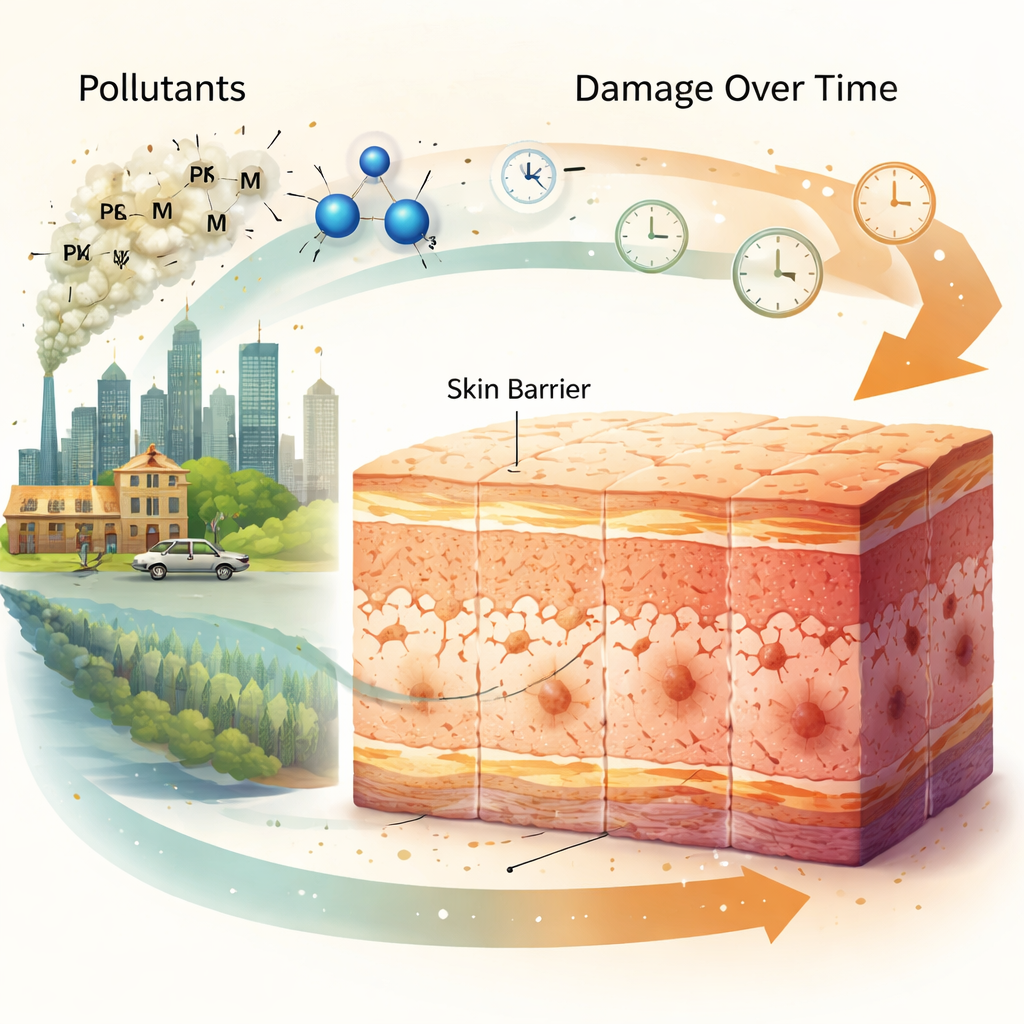
Most of us think of air pollution as something that harms our lungs or heart, but the very first organ it meets is the skin. Fine particles, ozone, and other pollutants constantly land on our faces and hands, quietly driving irritation, premature wrinkles, and poor healing. This study takes a fresh look at that slow damage by building a new kind of mathematical model—one that remembers past exposures instead of treating each day as a clean slate. The goal is to better understand why some skin bounces back from pollution while other skin slides into chronic trouble.
Following Damage And Repair Over Time
The authors focus on a single quantity: an overall "damage level" in skin cells that stands in for oxidative stress, DNA breaks, and related injuries. Pollution pushes this damage up, while the body’s own defenses—antioxidants, waste‑clearing systems, and DNA repair—work to pull it back down. Rather than assuming that skin reacts instantly to whatever is in the air today, the model lets yesterday’s and last month’s insults continue to shape what happens now. This better reflects real biology, where long‑lasting inflammation and wear‑and‑tear are known to drive visible aging and disease.
A New Way To Capture Skin’s Memory
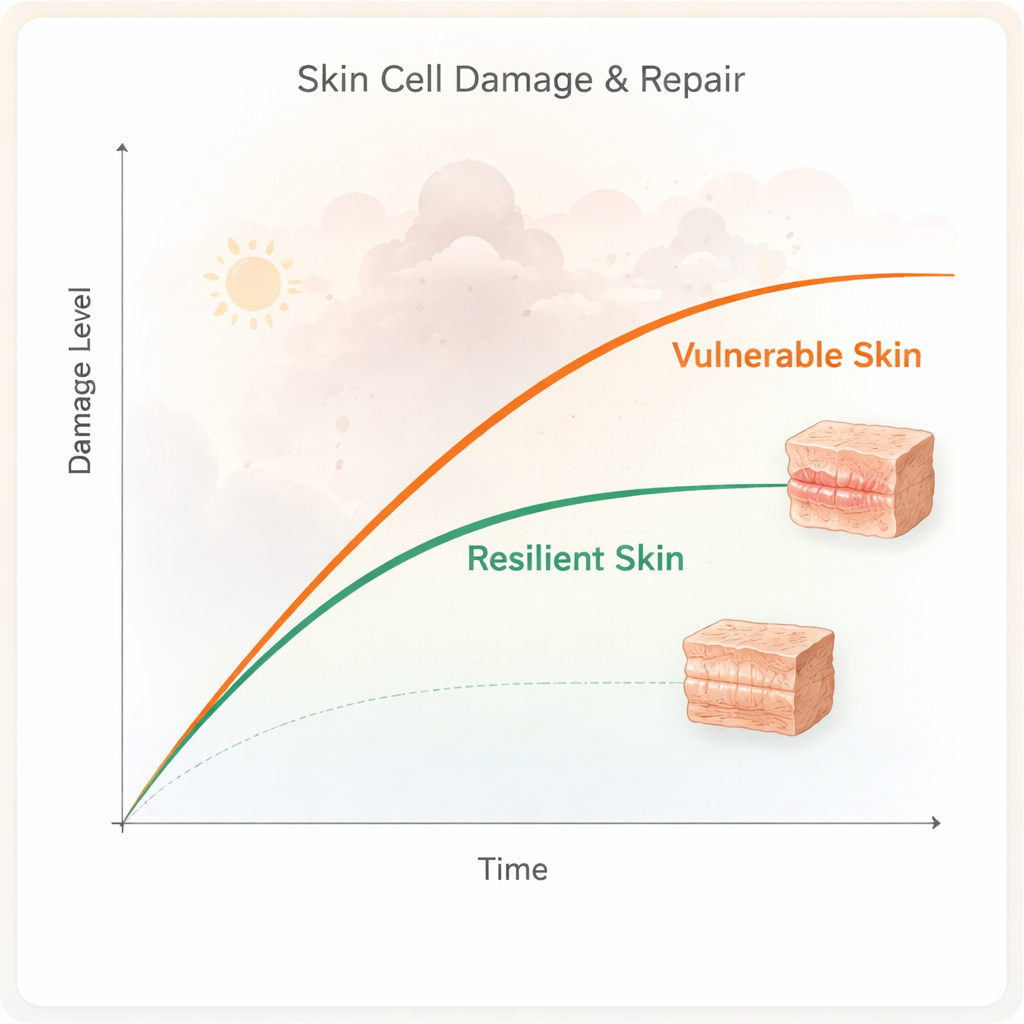
To build this memory into the equations, the researchers use a mathematical tool called a fractional‑order derivative. In simple terms, it means the model’s behavior depends not just on the current state of the skin, but on a weighted history of what it has been through. A key knob in the model, called α, tunes how strong that memory is. When α is close to 1, the skin behaves almost like a quick‑responding system: damage rises under pollution but levels off as repair catches up. When α is smaller, past exposures loom larger, so damage builds slowly but keeps accumulating, even when conditions improve.
Comparing Resilient And Vulnerable Skin
Using an advanced solution technique, the team simulates many different settings without resorting to heavy‑duty computing. They explore both the “instant” case (α = 1) and several fractional cases where memory matters. They also vary another parameter, β, which controls how strongly damage feeds back on itself once it becomes high. Together, α and β let the model imitate different kinds of skin. In a “healthy young skin” scenario, with relatively weak memory and more effective repair, damage rises under urban pollution but gradually flattens, suggesting that the tissue can still find a new balance. In an “aged or chronically exposed” scenario, with stronger memory and weaker repair, damage keeps climbing with no sign of a plateau, echoing the relentless deterioration seen in older or heavily exposed individuals.
When Damage Crosses A Point Of No Return
A striking prediction of the model is the presence of a critical damage threshold. Below this level, the skin can in principle steady itself: damage grows more slowly and tends toward a stable value. Above it, the math indicates that damage accelerates instead of calming down. This tipping‑point behavior matches laboratory and clinical observations, where beyond a certain stage of chronic irritation, tissues are more likely to show lingering inflammation, stubborn dark spots, or poor healing that no longer fully reverses, even if exposure is reduced.
What This Means For Everyday Skin Health
In plain language, the study suggests that our skin does not simply “reset” overnight after a smoggy day. Instead, it carries a memory of repeated pollution hits, and that memory can slowly push it toward a zone where damage feeds on itself. The new model captures this process in a compact, adjustable framework that can represent both resilient and fragile skin types. Although it is still a theoretical tool, it provides a road map for future lab tests and protective strategies—such as antioxidants, barrier‑strengthening products, or pollution‑shielding measures—aimed at keeping the skin safely below that critical damage threshold over a lifetime.
Citation: Alchikh, R., Fayyad-Kazan, M. & Khuri, S.A. A semi-analytical approach for solving a fractional-order mathematical model of skin cell damage and repair driven by environmental pollutants. Sci Rep 16, 6399 (2026). https://doi.org/10.1038/s41598-026-37410-4
Keywords: air pollution, skin aging, oxidative stress, mathematical modeling, fractional calculus