Clear Sky Science · en
Limited resolution of DNA barcodes and environmental influence on phytochemical diversity in Berberis integerrima (Berberidaceae)
Why a thorny shrub matters to your health
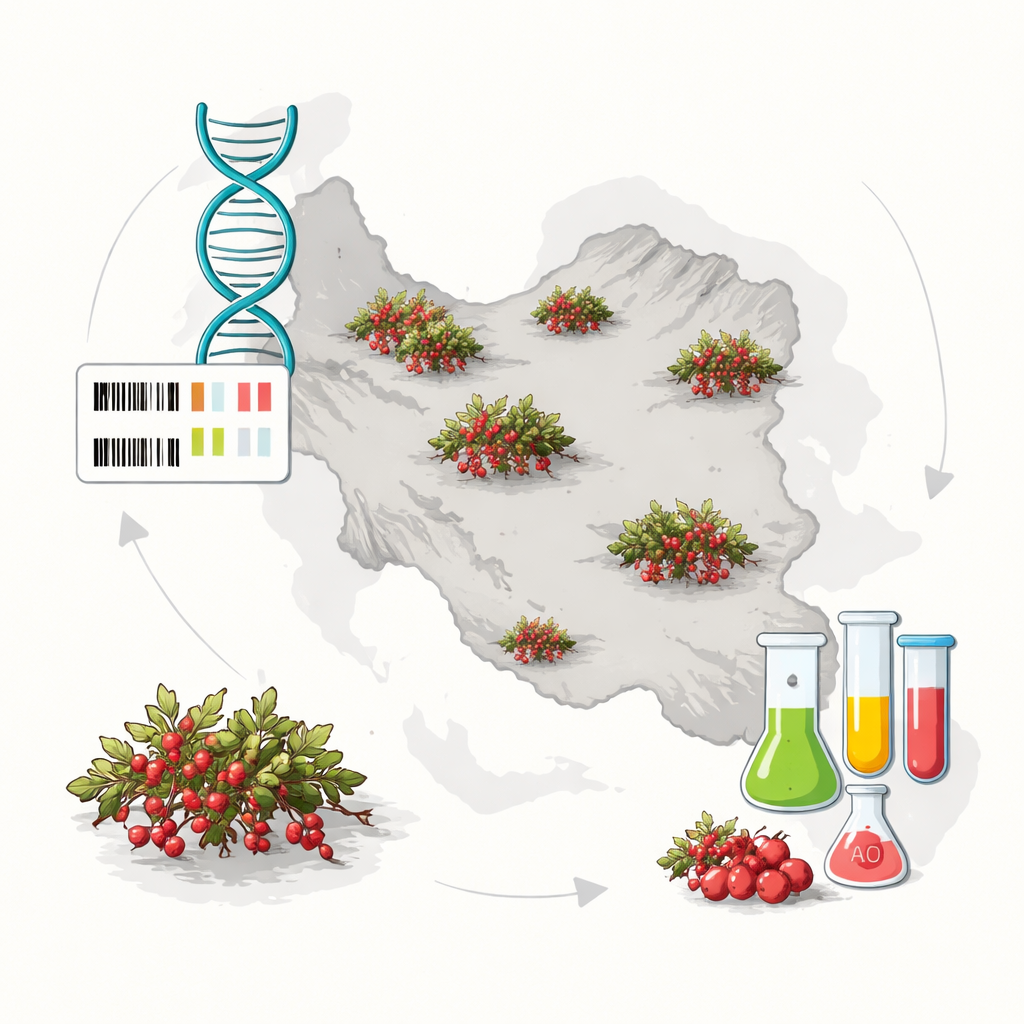
Barberry, a thorny shrub with bright red berries, is far more than a hedgerow plant in Iran and Central Asia. Its fruits and roots are deeply woven into local food and traditional medicine, used for treating high blood pressure, diabetes, infections, and inflammation. This study asks two big questions with real-world consequences: how genetically diverse are Iran’s wild barberry populations, and how do local environments shape the health-promoting chemicals in their fruits? The answers could guide better conservation, smarter farming, and more effective use of barberry as a natural source of antioxidants and medicinal compounds.
One plant, many faces
Berberis integerrima, a key barberry species in Iran, is notorious among botanists for its confusing appearance. Leaves and berries can look very different even on the same plant, and over time this variation has led to a tangle of names and supposed species. At the same time, barberry fruits and roots are widely used as food and herbal remedies, making it important to know which plants are which, and how they are related. The researchers sampled 96 barberry shrubs from Iran and neighboring regions, focusing on four closely related species, and took a closer look at 59 wild B. integerrima populations scattered across Iran’s mountains and valleys.
DNA barcodes that blur instead of sharpen
The team tried to use “DNA barcodes”—short, standard bits of genetic code—to tell closely related barberry species apart, much as a supermarket laser scanner reads product labels. They examined several nuclear and chloroplast regions commonly used for plant barcoding. While they successfully sequenced four of these regions, the genetic differences they found were surprisingly small. Even when they combined multiple barcodes, the resulting family trees did not cleanly separate the four species. Some B. integerrima individuals grouped with other species, and a few accessions of other species fell inside the main B. integerrima cluster. In other words, the genetic “barcodes” lacked enough resolution to draw sharp species boundaries in this group, hinting at recent divergence, interbreeding, or both.
Hidden genetic structure in wild Iranian barberry
Although the barcodes could not reliably separate species, they did reveal patterns within B. integerrima itself. Using statistical tools that cluster individuals based on their DNA, the researchers detected four main genetic subgroups among the Iranian plants. These subpopulations only partly followed geography: shrubs from the same or neighboring regions often clustered together, but there was also substantial mixing. Most of the genetic variation was found within local populations rather than between them, a hallmark of long-lived, insect-pollinated plants that readily cross with their neighbors. Network analyses suggested that many individuals share a few common genetic types, with only small mutational steps between them, consistent with relatively young, well-connected populations that may have exchanged genes over time through natural movement and human transport of planting material.
Environment sculpts the chemistry of the berries
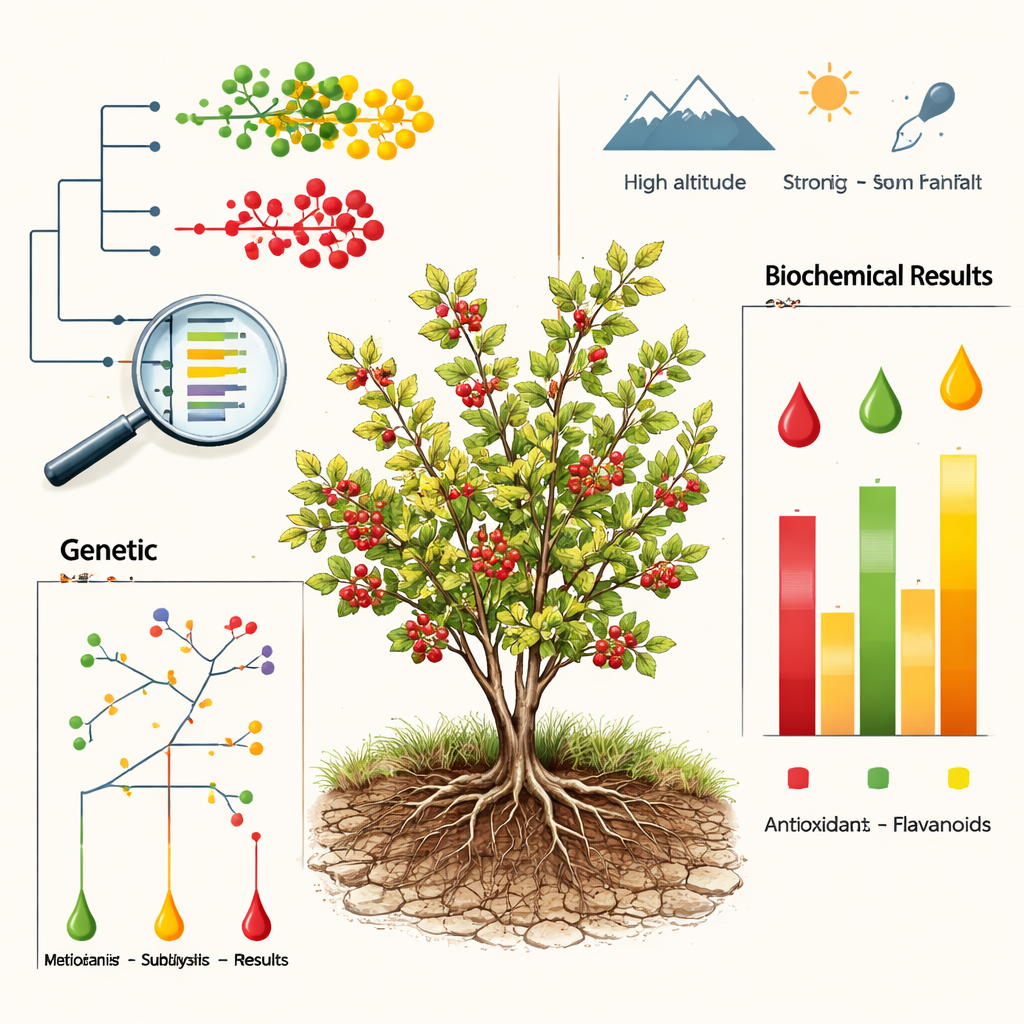
The authors then turned from genes to chemistry, measuring key health-related traits in fruits from 25 populations: total phenolics, flavonoids, anthocyanins (the red and purple pigments), and antioxidant activity in several standard tests. They found striking differences among regions. Some northern and northeastern populations had fruits packed with phenolics, flavonoids, pigments, and high antioxidant power, making them strong candidates for nutraceutical and functional food products. Others, such as one population from Kerman in the south, had much lower levels. By comparing chemistry with climate and geography, the team showed that cooler areas with higher latitude, stronger sunlight (more UV), and lower rainfall tended to produce fruits richer in protective compounds. These stress-prone environments appear to nudge barberry plants into ramping up their internal chemical defenses, which humans then harvest as beneficial antioxidants.
A seedless mystery and what it all means
In the wild, the researchers also documented a rare seedless barberry growing among normal, seeded shrubs in northern Iran. Genetic evidence, together with ecology and previous work, supports the idea that this seedless type is not a separate European species but a variety of B. integerrima. That matters because seedless fruits are highly prized in Iranian cuisine and agriculture. Taken together, the study shows that standard DNA barcodes alone are often too blunt to untangle recent, interbreeding lineages like these barberries, but they are still powerful for mapping genetic structure within a species. Combined with careful chemical profiling and environmental data, this work points to high-altitude, cooler, drier regions as reservoirs of especially potent, antioxidant-rich barberry, offering a roadmap for conserving wild germplasm, improving cultivated varieties, and making more informed use of this ancient medicinal shrub.
Citation: Samadi, S., Moazzeni, H., Pirani, A. et al. Limited resolution of DNA barcodes and environmental influence on phytochemical diversity in Berberis integerrima (Berberidaceae). Sci Rep 16, 6871 (2026). https://doi.org/10.1038/s41598-026-37409-x
Keywords: barberry, antioxidants, medicinal plants, genetic diversity, phytochemicals