Clear Sky Science · en
Geochemistry of middle jurassic coal-bearing strata from the Xingmei Mine, Xinjiang, and the origin of localized barium enrichment
Why the Story of Hidden Metals in Coal Matters
Coal is usually thought of simply as fuel, but it is also a natural archive of Earth’s history and a quiet storehouse of many elements we use in industry and technology. This study looks at Middle Jurassic coal-bearing rocks in the Xingmei Mine of Xinjiang, China, with a special focus on barium, a metal important for medical imaging and drilling fluids. By tracing where barium is concentrated, what minerals it sits in, and how it got there, the authors show how ancient climates, rivers, and even wildfires shaped the chemistry of a coal seam—and what that means for both resource potential and environmental safety.
Coal Layers in a Remote Desert Basin
The Xingmei Mine lies on the western edge of the Yanqi Basin in Xinjiang, a key coal-producing region for China. During the Middle Jurassic, this area was a low-lying basin flanked by uplifted mountains of the central and south Tianshan range. Rivers carried sand, silt, mud, and plant matter from these highlands into swamps and floodplains, where thick peat accumulated and was later transformed into coal. The studied seam, called No. 8−2, is about 1.6 meters thick and is sandwiched between dark mudstones. Chemically, the coal is relatively “clean”: it has low ash (mineral residue), low sulfur, and high volatile content, and is mainly made of a plant-derived component called vitrinite, with quartz, kaolinite clay, and small amounts of pyrite and other minerals filling the spaces between organic matter. 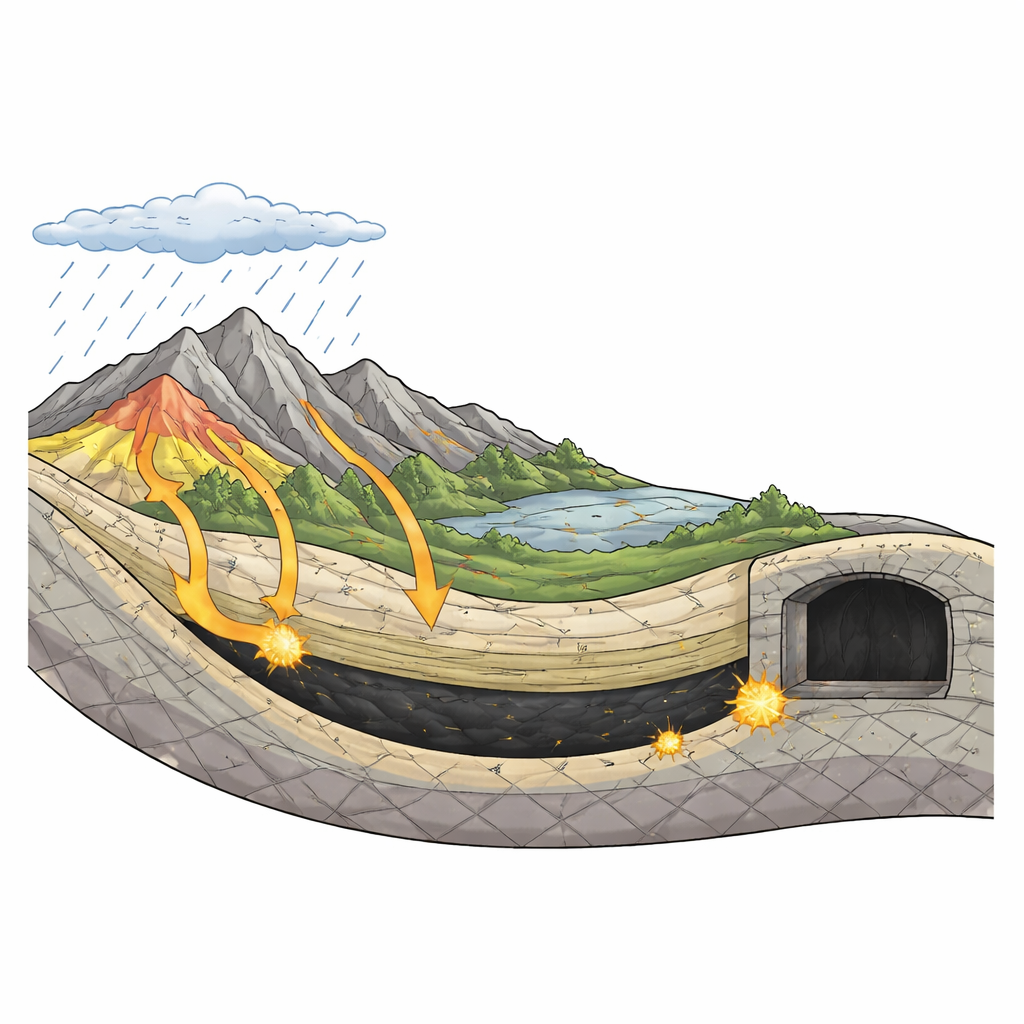
Tracing the Mountains That Fed the Swamp
To work out where the sediment and metals came from, the researchers measured a suite of elements in coal, parting, roof, and floor rocks and compared their patterns with known rock types. Ratios of aluminum to titanium, cobalt to thorium, and other relatively immobile elements, together with the behavior of rare earth elements, all point to a source dominated by light-colored, silica-rich igneous rocks in the nearby central and south Tianshan. The way rare earths are split into light, medium, and heavy groups, and their characteristic “fingerprints” when normalized to average continental crust, match these source rocks. This picture is reinforced by the basin’s structural setting and faults, which would have efficiently funneled eroded debris from the mountains into the peat-forming lowlands.
Ancient Climate Swings and Changing Waters
The chemistry of the rocks also preserves a record of shifting conditions in the Jurassic wetlands. Ratios of strontium to copper suggest a climate that swung from humid to more arid and then back to humid as one moves from the roof rocks down into the coal and then into the floor. Signals based on uranium and thorium, together with the size of tiny spherical pyrite grains, show that oxygen levels in the pore waters varied as well: the contacts near the roof and floor were only weakly oxygen-poor (dysoxic), while the interior of the seam was more reducing. Ratios of strontium to barium and yttrium to holmium indicate that the environment remained mostly freshwater, with only brief brackish intervals and little influence from the sea; the system was dominated by river-fed, land-derived input rather than marine incursions.
How Barium Became Trapped at the Coal Edges
Barium stands out among the trace elements the team measured. In the coal itself it is only slightly elevated, but it is noticeably enriched in the mudstones directly above, below, and within the seam, especially in two samples at the coal–roof and coal–floor boundaries. Using electron microscopy, the authors show that barium is hosted mainly in barite, a dense, very insoluble barium sulfate mineral. The study argues that barium ions were supplied from the weathering of Ba-rich felsic rocks in the Tianshan highlands, carried into the swamp as dissolved and fine-grained material. Sulfate, needed to form barite, likely came not from pyrite oxidation but from acid rain generated by widespread Jurassic wildfires that injected sulfur dioxide into the atmosphere. The key spots where barite formed were transitional zones at the edges of the coal, where fresh, oxygen-bearing waters met more reducing, organic-rich layers, and where ash and clastic influx were locally high, creating ideal conditions for barite to precipitate from pore waters. 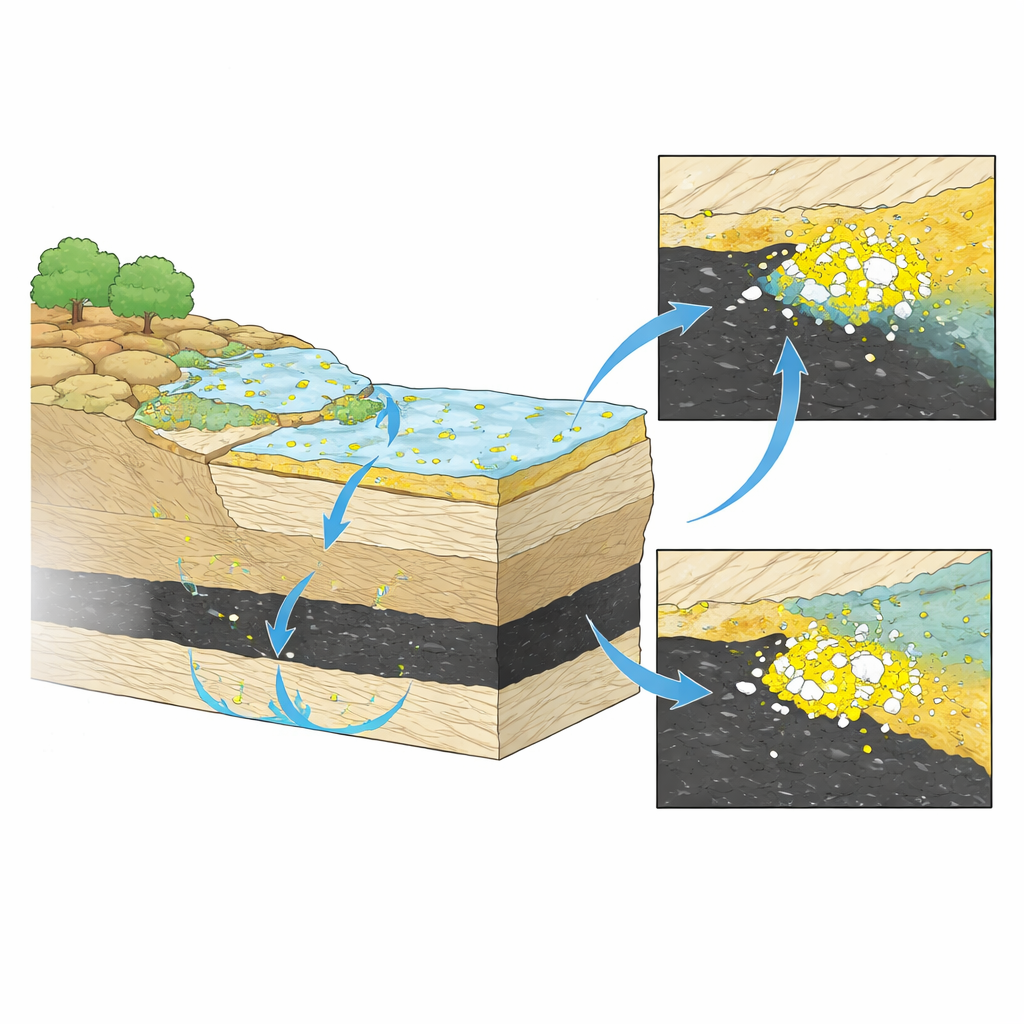
What the Findings Mean for Resources and Risks
For non-specialists, perhaps the most reassuring conclusion is that this hidden barium is unlikely to be either a valuable ore or a serious hazard. Even in the most enriched samples, barium levels fall far below the cutoff needed to mine barite economically, and most of the metal is locked into barite crystals that are chemically stable and barely dissolve under normal conditions. The Xingmei coal seam thus represents a clear, well-documented case of how local geology, ancient weather, and atmospheric processes can concentrate an industrially important element in very specific layers, without turning the deposit into either a bonanza or a toxic threat.
Citation: Wu, Y., Lu, Q., Wang, W. et al. Geochemistry of middle jurassic coal-bearing strata from the Xingmei Mine, Xinjiang, and the origin of localized barium enrichment. Sci Rep 16, 8423 (2026). https://doi.org/10.1038/s41598-026-37408-y
Keywords: coal geochemistry, barium enrichment, barite formation, Jurassic Xinjiang, sedimentary environment