Clear Sky Science · en
Study the influence of the precipitation of metallic Ag on the phase transitions in AgNbO3−δ perovskite
Why tuning tiny crystals matters
From electric cars to renewable power grids, our future depends on materials that can safely store and release large bursts of electrical energy. Many of the best-performing candidates today contain toxic lead. This study explores a safer alternative based on silver and niobium, and shows that carefully controlling how tiny bits of metallic silver form inside the material can subtly reshape its internal structure and improve its usefulness for next‑generation capacitors and other dielectric devices.
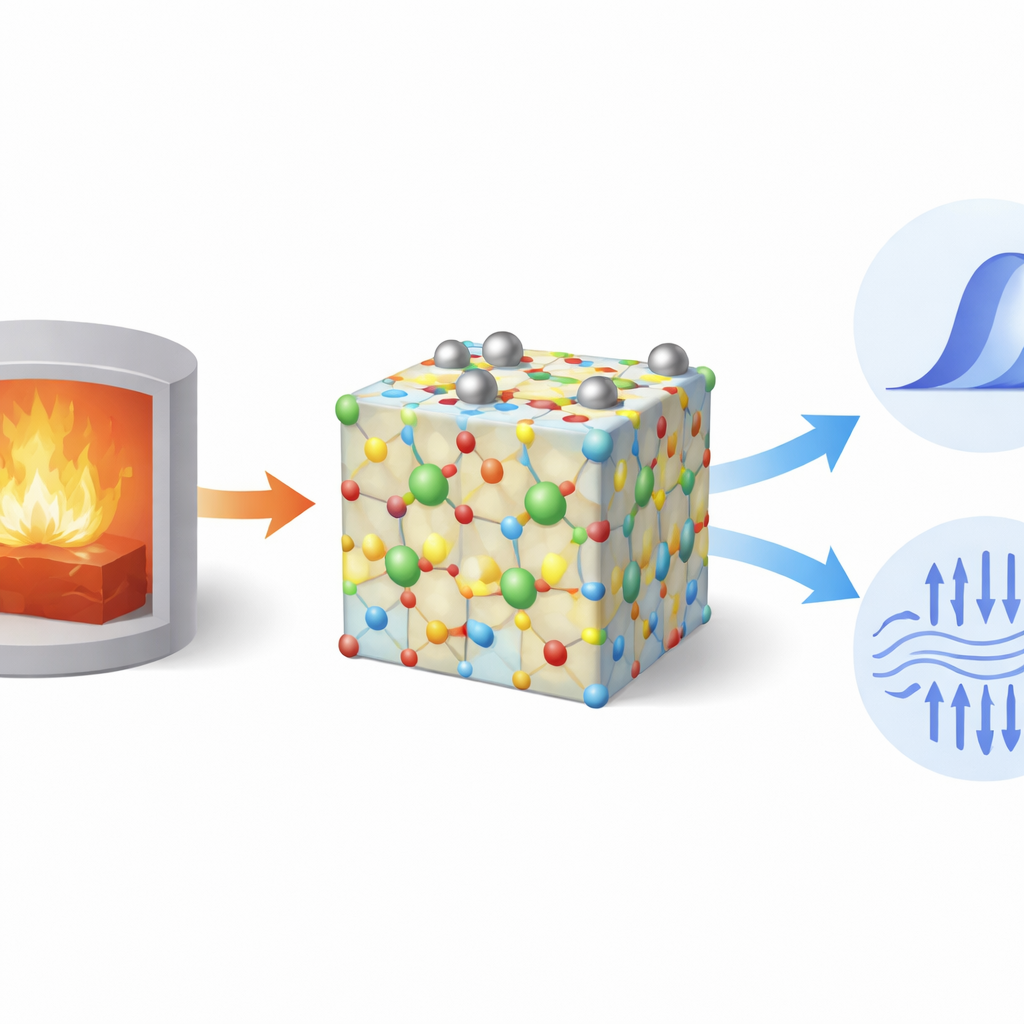
Building a silver-based ceramic
The researchers worked with a compound called silver niobate, AgNbO3, which belongs to a broad family of crystalline materials known for their strong electrical responses. They made a composite by mixing silver oxide and niobium oxide powders, milling them, pressing them into pellets, and then heating them in a furnace. During this high‑temperature treatment, part of the silver oxide decomposed and left behind tiny metallic silver particles dispersed in a silver‑niobate ceramic. X‑ray diffraction measurements showed that most of the sample kept the usual crystal framework of AgNbO3, while electron microscopy revealed nanometer‑scale silver specks decorating and threading through the ceramic grains.
Peeking inside the atomic framework
To understand what was happening on the atomic scale, the team used several spectroscopic tools. Infrared measurements confirmed that the niobium and oxygen atoms formed the expected network of linked octahedra, the basic building blocks of the crystal. Raman scattering, which is sensitive to subtle distortions of this network, showed that a signature linked to strong electric ordering was noticeably weaker than in pure silver niobate. X‑ray photoelectron spectroscopy revealed a mix of oxidized silver ions, metallic silver, niobium in a high oxidation state, and oxygen atoms, along with detectable oxygen vacancies. This chemical fingerprint indicates that as some silver left the crystal to form metal particles, it also changed the balance of missing atoms and defects within the remaining ceramic.
Light absorption and electronic behavior
The team next studied how the composite interacts with light. Using ultraviolet–visible spectroscopy, they observed strong absorption in the ultraviolet and features associated with collective electron motion on the tiny silver particles. By analyzing how the material absorbed light of different energies, they estimated two characteristic energy gaps, one direct and one indirect, larger than those of pure silver niobate. In plain terms, removing some silver and reducing the number of oxygen-related defects cleans up electronic states that usually sit inside the gap, effectively widening it. This confirms that the composite behaves as a semiconductor whose electronic landscape is tuned by the presence of metallic silver and carefully controlled vacancies.
How structure changes with temperature and field
Silver niobate is known to pass through a series of structural “phase” changes as it is heated, each with different electrical character. By using differential scanning calorimetry and temperature‑dependent dielectric measurements, the authors tracked these transitions in their composite. They found five distinct changes, much like in pure AgNbO3, but all shifted to lower temperatures. This shift is linked to silver deficiency and oxygen vacancies, which favor states with weaker permanent electric ordering. Measurements of the dielectric constant and energy loss over a range of frequencies showed clear anomalies at the transition points, along with behavior consistent with a semiconducting solid where charges can hop between defect sites as the temperature rises.
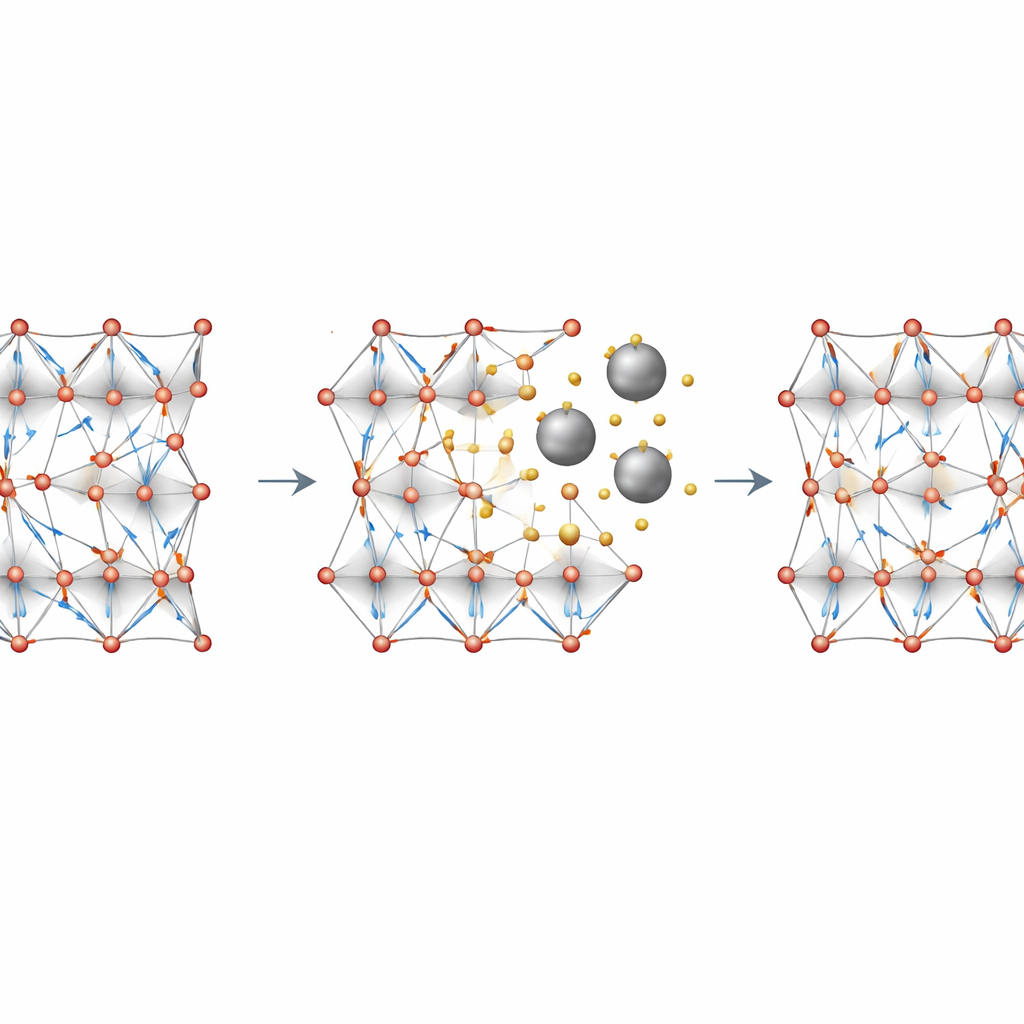
Softening the electric response
Finally, the team probed how the material responds when an electric field is applied and then removed, by tracing polarization–field hysteresis loops. Instead of a strong, square‑shaped loop characteristic of robust ferroelectrics, the composite showed slim, unsaturated loops that grew only modestly with field strength. This indicates weak ferroelectric behavior intertwined with antiferroelectric order. In everyday terms, the internal dipoles do not lock into a large, permanent alignment, which is actually desirable for certain energy‑storage applications because it reduces wasted energy and improves stability under cycling.
What this means for future devices
Overall, the study shows that allowing a controlled amount of metallic silver to precipitate out of silver niobate, and thereby introducing silver vacancies and tuning oxygen defects, weakens unwanted ferroelectric distortion while preserving a rich sequence of phase transitions. The resulting lead‑free Ag/AgNbO3−δ composite has wider electronic band gaps, lower transition temperatures, and gentle electric switching behavior, making it a promising candidate for dielectric components in capacitors and high‑power electronics where efficient, reliable energy storage is critical.
Citation: Almohammedi, A., Abdel-Khalek, E.K. & Ismail, Y.A.M. Study the influence of the precipitation of metallic Ag on the phase transitions in AgNbO3−δ perovskite. Sci Rep 16, 9402 (2026). https://doi.org/10.1038/s41598-026-37405-1
Keywords: silver niobate, dielectric materials, lead-free ceramics, ferroelectric suppression, energy storage