Clear Sky Science · en
Effect of xanthan gum on mechanical strength and microstructure of Cu (II)-contaminated soil subjected to freeze–thaw cycles
Why frozen, polluted soil matters to all of us
Across the world, millions of hectares of land are laced with heavy metals from industry and farming. In cold regions, those same soils repeatedly freeze in winter and thaw in spring, which can crack the ground, weaken its strength, and help pollutants spread into crops and water. This study explores an unexpected helper drawn from everyday life—xanthan gum, a common food thickener—to see whether it can both strengthen copper‑polluted soil and keep it stable through harsh freeze–thaw seasons.
A sticky helper borrowed from the kitchen
Xanthan gum is a soft, plant‑based gel made by bacteria and widely used to thicken salad dressings and gluten‑free bread. Here, researchers mixed different small amounts of this gum (up to 3 percent of the dry soil weight) into clayey soil that had been deliberately loaded with a high level of copper, similar to the contamination found around some factories and mines. They formed cylindrical soil samples, let them cure for several days in a humid room, and then tested how much pressure each sample could withstand before crumbling. To peek inside the soil at the grain level, they also used high‑magnification electron microscopes to visualize how xanthan gum changed the arrangement of particles and pores. 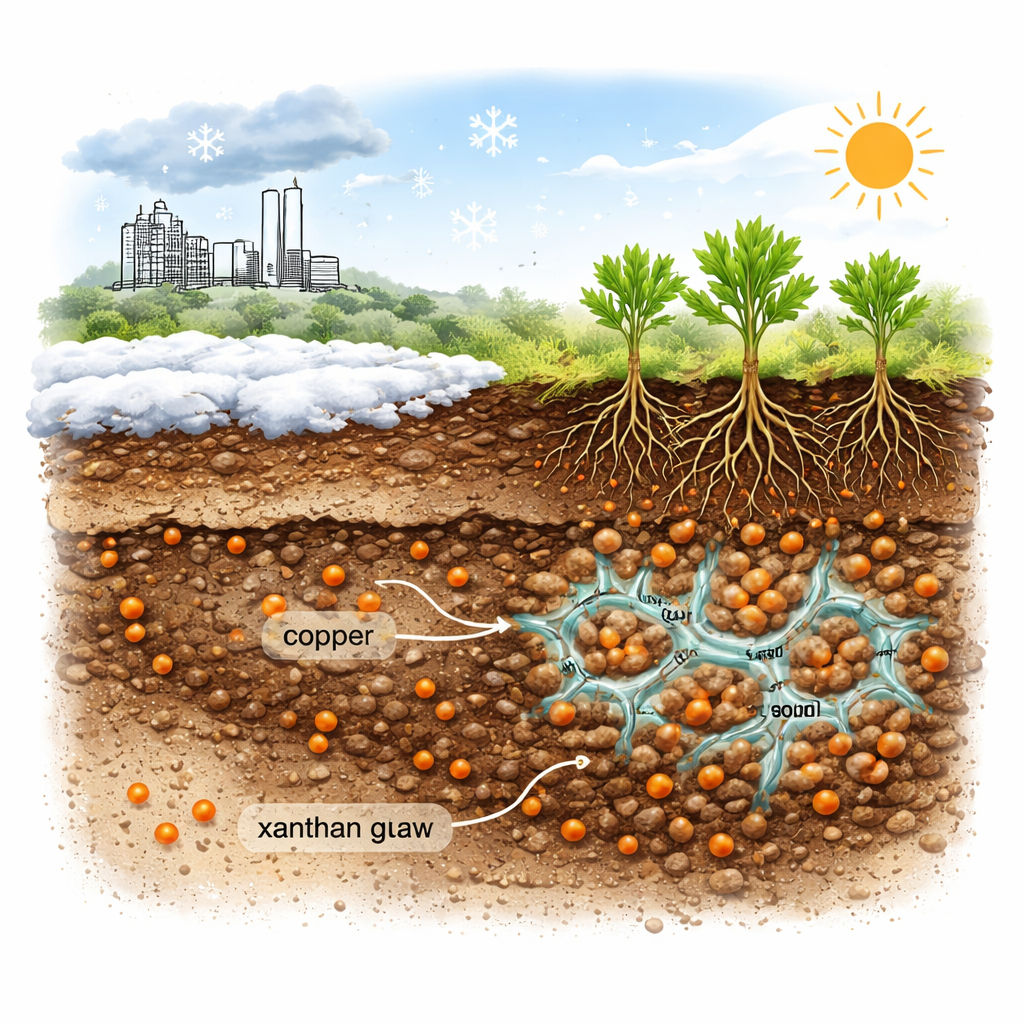
Turning loose grains into a solid network
The tests showed that even modest doses of xanthan gum transformed the mechanical behavior of the polluted soil. With more gum and more curing time, the soil cylinders supported much higher loads before failure, and they deformed more smoothly instead of shattering suddenly. At the microscopic scale, the gum formed thin films and bridges around fine soil particles, turning sharp point‑to‑point contacts into broader, sheet‑like connections. These gel coatings filled many of the tiny gaps between grains, reduced overall pore space, and tied particles together into clusters. In practical terms, the soil behaved less like a loose powder and more like a single, cohesive block.
Surviving winter’s freeze and spring’s thaw
Real northern landscapes don’t sit at room temperature, so the team cycled their samples between freezing at −20 °C and thawing at 20 °C up to twelve times, mimicking several seasons. Freezing water inside soil expands to ice and then contracts again as it melts, creating internal stresses that can open cracks and weaken the ground. As expected, the strength of all samples dropped as the number of freeze–thaw cycles increased, and their stress–strain curves showed growing signs of softness and permanent deformation. Yet soils treated with xanthan gum consistently remained stronger than untreated ones, and after several cycles the rate of damage slowed and began to level off. The gum’s ability to hold particles together and guide water through more stable pathways appeared to blunt the worst effects of repeated freezing. 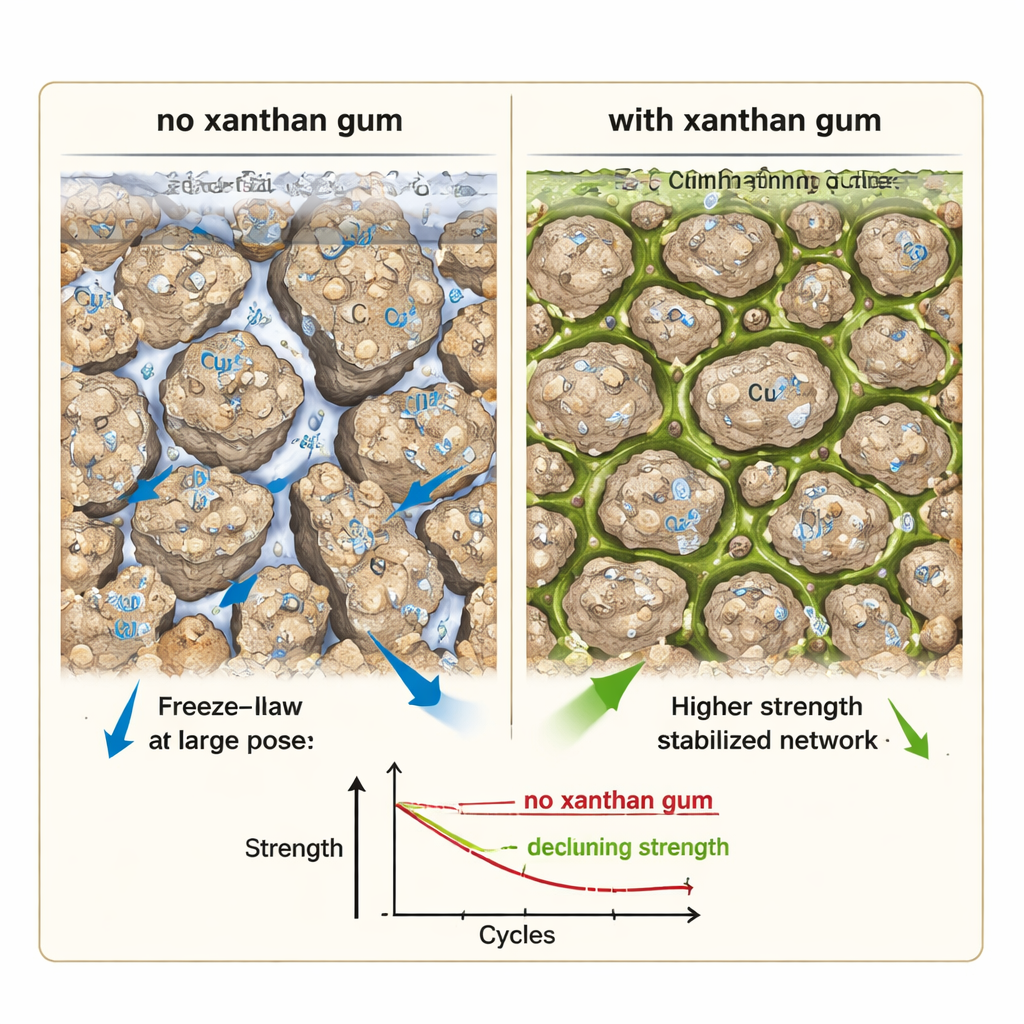
A closer look inside the frozen soil
Microscope images helped explain these mechanical trends. Before freezing, xanthan‑treated soil showed a dense, continuous matrix: grains were tightly wrapped in a gel‑like film with few visible pores or cracks. After several freeze–thaw cycles, some of this matrix broke up and new voids appeared, but the structure was still more compact than in untreated soil, where larger pores and clear separations between grains dominated. The researchers argue that xanthan gum acts like a flexible glue that both binds particles and cushions some of the expansion and contraction that would otherwise tear the soil apart. This micro‑level resilience translates directly into higher strength and better durability at the scale of foundations, embankments, and farmland.
What this means for cleaner, safer land
For non‑specialists, the key takeaway is that a cheap, bio‑based thickener already familiar from food products can help stabilize heavily copper‑polluted soils, even under punishing winter conditions. Xanthan gum improves how such soils bear weight and reduces the structural damage caused by repeated freezing and thawing, while also helping to trap metal ions within a tighter, less leaky framework. The study is an early step—limited to one soil type, one high copper level, and relatively short curing times—but it points toward greener, lower‑carbon alternatives to cement for shoring up contaminated ground and making land in cold regions safer to build on and farm in the long run.
Citation: Ma, Q., Tao, Y., Wu, J. et al. Effect of xanthan gum on mechanical strength and microstructure of Cu (II)-contaminated soil subjected to freeze–thaw cycles. Sci Rep 16, 6430 (2026). https://doi.org/10.1038/s41598-026-37400-6
Keywords: xanthan gum, copper contaminated soil, freeze thaw cycles, biopolymer soil stabilization, heavy metal remediation