Clear Sky Science · en
Development of multilayered polymer-BaSO4 composites for flexible and efficient lead-free X-ray shielding
Safer Shields for Everyday X‑Rays
From dental checkups to airport scanners, X‑rays quietly support modern life—but the heavy, lead-lined aprons that protect workers and patients bring their own health and environmental concerns. This study explores a new class of soft, fabric-based shields that block X‑rays without using toxic lead, pointing toward lighter, safer protective clothing for hospitals, industry, and nuclear facilities.
Why We Need New Protective Fabrics
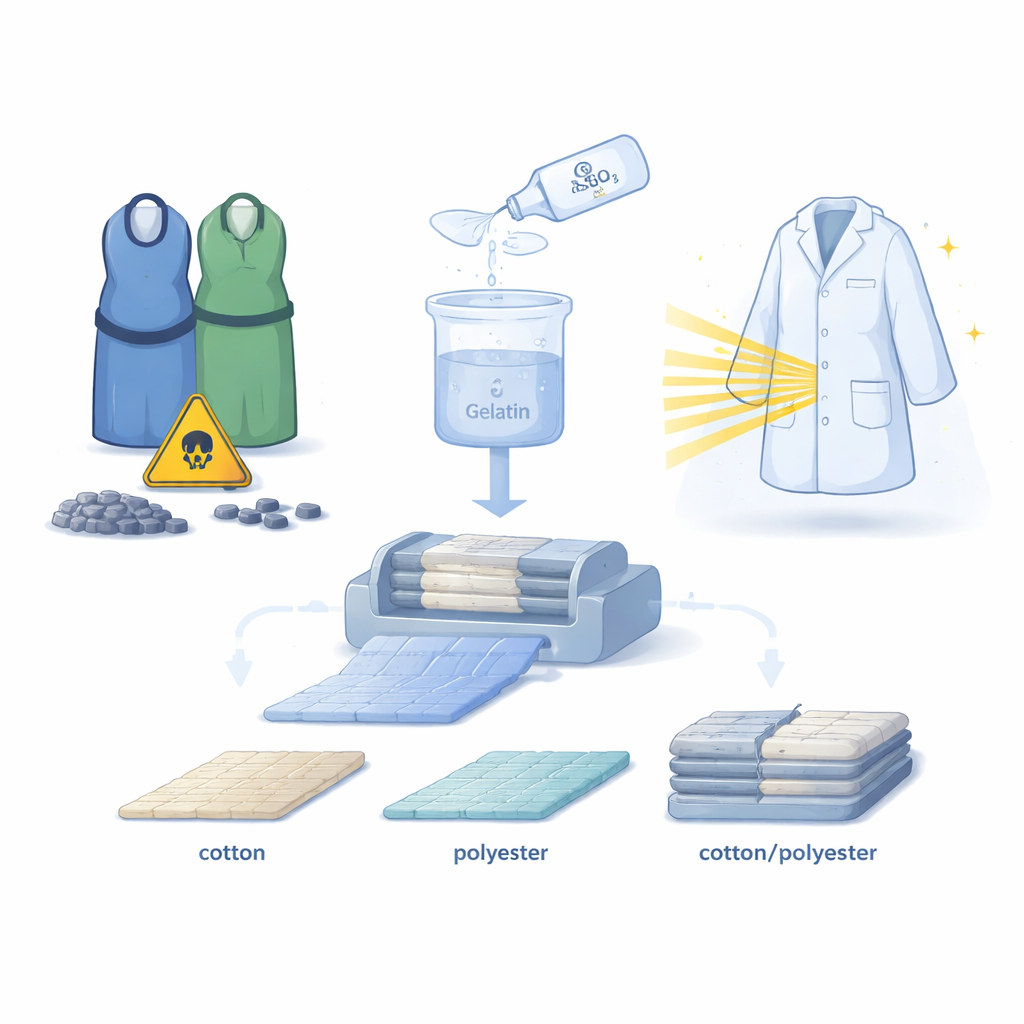
Conventional X‑ray shields rely on lead, a dense metal that stops radiation well but is heavy, stiff, and poisonous if mishandled or discarded improperly. As imaging and radiation-based technologies spread, so does long-term exposure for technicians, nurses, and industrial workers. The ideal shield would be thin, flexible, and comfortable like ordinary clothing, yet still block a large share of X‑rays—without introducing new hazards. Textiles are an appealing base because they are breathable and familiar, but they must be infused with the right ingredients to stop high‑energy rays.
Turning Everyday Fabrics into Radiation Barriers
The researchers focused on barium sulfate (BaSO₄), a white, non‑toxic powder already used as a contrast agent in medical imaging and known to absorb X‑rays effectively. They mixed BaSO₄ into a solution of gelatin, a biodegradable, film‑forming material derived from collagen, to make a kind of liquid “armor paint.” Using a common textile finishing method called pad‑dry, they soaked and squeezed this mixture through three types of knitted fabrics—pure cotton, pure polyester, and a cotton/polyester blend—then dried them. By repeating the coating up to five times and varying the BaSO₄ content from 20% to 60% by weight, they created a family of multilayered, lead‑free shielding textiles.
How the New Coatings Perform
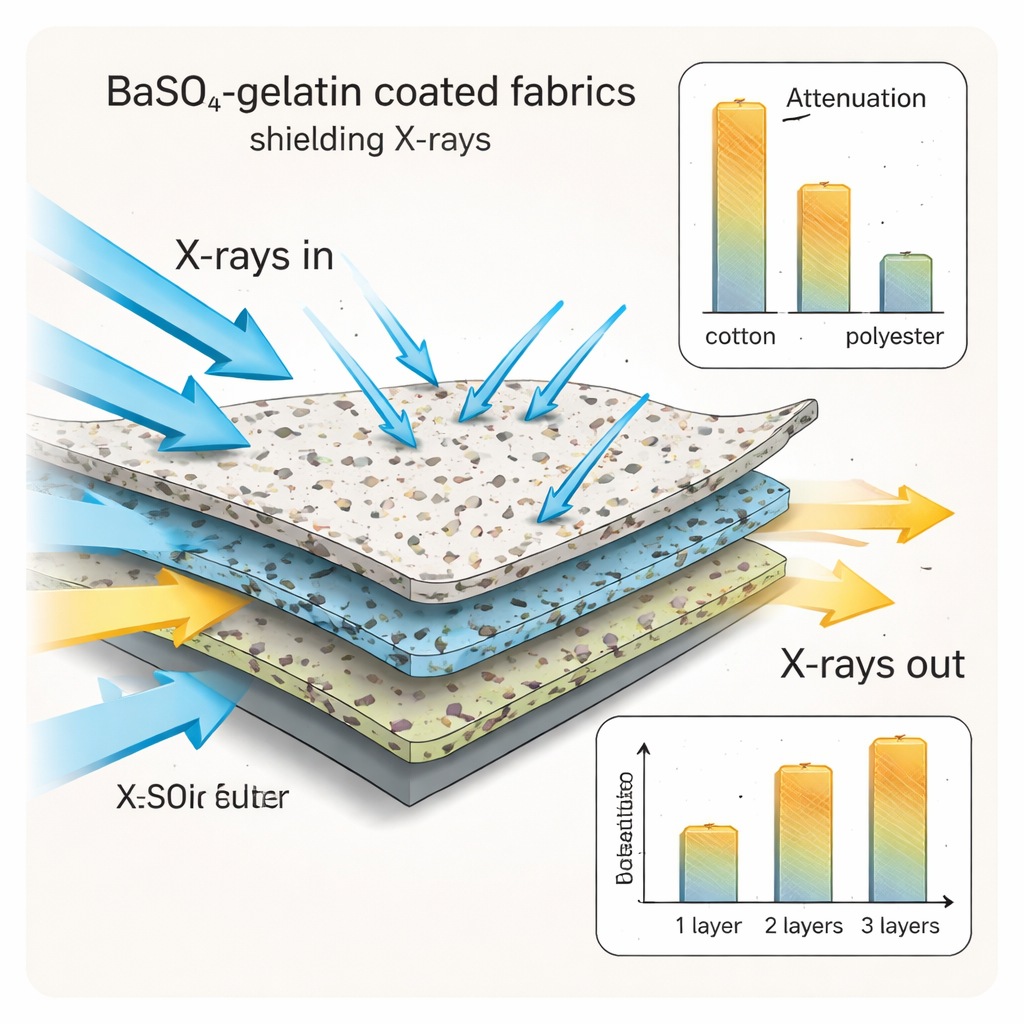
To see whether the fabrics really gained protective power, the team tested how much X‑ray intensity passed through each sample at different energies. They found a clear pattern: more BaSO₄ and more layers meant better shielding. Cotton fabrics treated with five layers containing 60% BaSO₄ blocked about 85% of incoming X‑rays at commonly used medical energies around 60 keV, approaching the protection offered by much heavier materials. Microscopic imaging showed that the gelatin helped anchor tiny BaSO₄ particles evenly across and within the fabric surface, while heat‑resistance tests revealed that the mineral filler also improved the material’s stability at high temperatures. At the same time, water‑droplet tests showed that stacking layers made the surfaces increasingly water‑repellent, helping the coatings resist moisture that could otherwise weaken performance.
Balancing Protection, Comfort, and Durability
Adding mineral powder to soft cloth inevitably changes how it feels. As BaSO₄ loading and layer count increased, the fabrics became thicker, heavier, and stiffer. Cotton, which absorbs the most coating, showed the greatest gain in shielding but also the largest jump in weight and rigidity, making it better suited for panels, aprons, or outer layers rather than everyday shirts. Polyester stayed lighter and more flexible but held less BaSO₄, so it offered lower protection at the same conditions. Blended fabrics sat between these extremes, suggesting a tunable trade‑off between comfort and shielding. Importantly, even the more heavily loaded samples remained bendable and drapable up to moderate BaSO₄ levels and three layers—enough for many wearable applications.
What This Means for Future Radiation Safety
Overall, the study shows that simple, industry‑ready coating methods can turn ordinary fabrics into effective, lead‑free X‑ray shields by embedding them with BaSO₄ held in a thin gelatin matrix. These multilayered textiles can block a large fraction of medical‑grade X‑rays while remaining relatively light and flexible, especially when cotton and polyester are blended thoughtfully. For the public, this points toward future protective garments—aprons, vests, sleeves, and curtains—that are safer to make, easier to wear, and kinder to the environment than traditional lead gear. Before such products reach clinics and factories, their long‑term durability under washing, abrasion, and repeated bending still needs to be proven, but this work lays a strong foundation for a new generation of soft, sustainable radiation shielding.
Citation: Okda, H.M.Y., Sheha, E.R., Zahran, F. et al. Development of multilayered polymer-BaSO4 composites for flexible and efficient lead-free X-ray shielding. Sci Rep 16, 6719 (2026). https://doi.org/10.1038/s41598-026-37398-x
Keywords: lead-free X-ray shielding, radiation-protective textiles, barium sulfate composites, medical protective clothing, polymer-coated fabrics