Clear Sky Science · en
Spatial distribution and risk assessment of polychlorinated biphenyl compounds from open incineration of used medical disposable face masks
Why burning old masks still matters
The COVID-19 pandemic left the world with mountains of used medical face masks. In many African countries, where formal waste collection is limited, a simple solution has often been to burn these masks in the open. This study asks a troubling question: when we burn masks in this way, what exactly are we breathing in—and how dangerous is it for nearby communities?
Hidden toxins in everyday mask materials
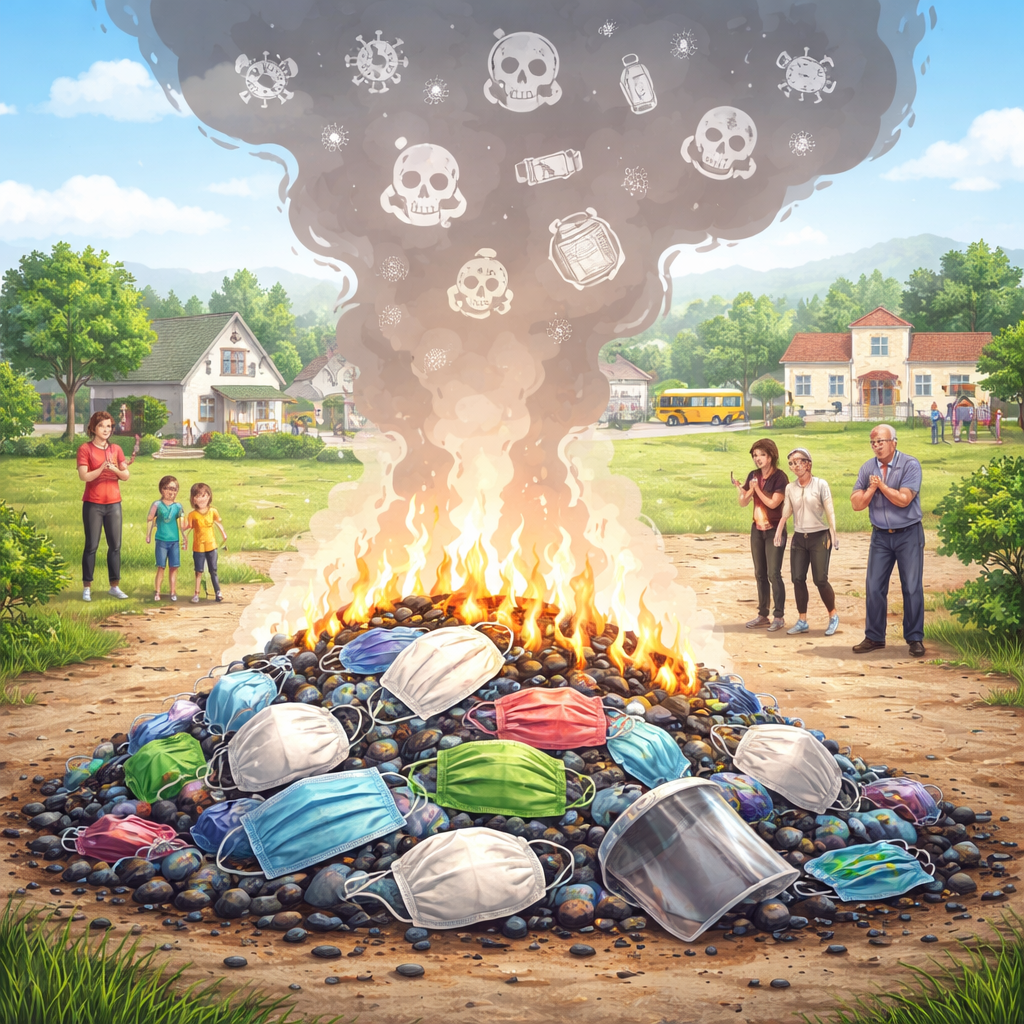
Most medical masks are made from plastics such as polypropylene, along with other polymers and fabrics. When these materials burn at low, uncontrolled temperatures—like in an open pit—they do not simply vanish. Instead, they can break down into a range of toxic substances. The researchers focused on one group in particular: polychlorinated biphenyls, or PCBs. These are long-lived industrial chemicals once used in transformers and other equipment, now banned or tightly restricted because they can damage the immune system, disrupt growth and reproduction, and increase cancer risk. The team wanted to know how much PCB pollution different types of discarded masks release when burned, and how far those pollutants spread through the surrounding air.
Putting used masks to the test
Scientists collected a variety of real-world waste masks from a hospital dump site in Nigeria, including WHO-recommended surgical masks and N95 respirators, as well as cloth masks made from cotton, linen, towel material, and other fabrics, plus plastic face shields. In a controlled outdoor setup that mimicked open burning, they burned measured amounts of each mask type and captured the smoke using filters and special foam that trap airborne chemicals. Back in the laboratory, they used sensitive instruments to identify and measure individual PCB compounds in the smoke. They then fed these measurements into a computer model that simulates how the pollutants move and dilute in the air over hours, days, and a full year around the burn site.
Which masks pollute the most?
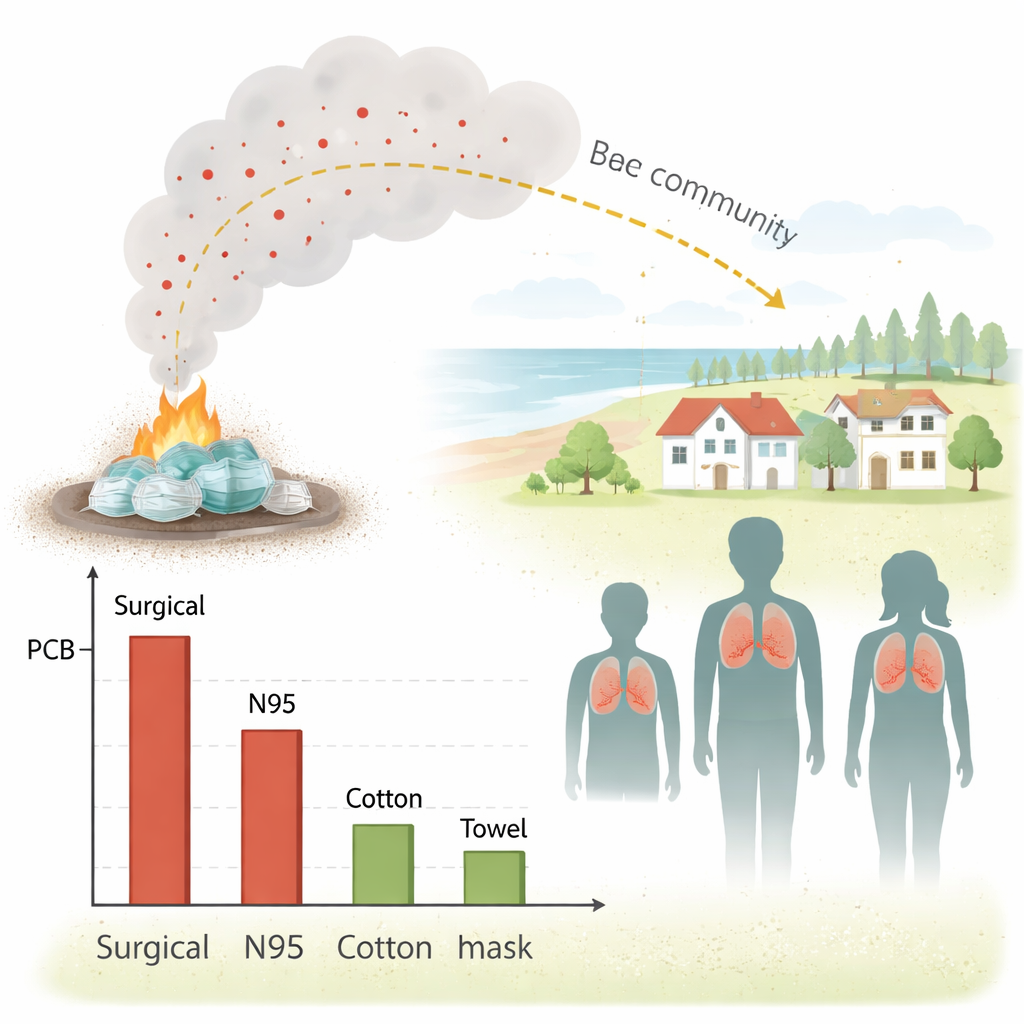
The results showed that all mask types released concerning amounts of PCBs when burned, but some were far worse than others. Total PCB levels in the smoke ranged from about 250 to more than 730 micrograms per cubic meter of air. Surgical masks, N95 masks, and linen masks were among the highest emitters, while towel and cotton masks produced the lowest PCB levels. The team also looked closely at “dioxin-like” PCBs, a particularly toxic subgroup that acts in the body in ways similar to infamous dioxin compounds. Even for a single burn event, these dioxin-like PCBs made up at least about one-eighth of the total PCB load, and their concentrations were highest for surgical, N95, and towel masks.
What this means for nearby residents
To translate chemistry into real-world health meaning, the researchers estimated how much PCB-laden air adults and children would breathe over time and compared those doses with international health guidelines. For both age groups, the calculated daily exposure and lifetime cancer risk from inhaling the smoke often exceeded World Health Organization safety benchmarks. Children, who breathe more air per kilogram of body weight, faced especially elevated potential risks. The analysis also produced a “hazard quotient” for non-cancer effects such as organ damage. For every mask type, this value was greater than one, a common warning sign that long-term exposure could lead to chronic health problems. The dispersion model suggested that, even a year after repeated burning, meaningful PCB concentrations could still be present within roughly three kilometers of the site.
Why better mask disposal is urgent
For many communities, open burning of medical masks may appear to be the quickest and cheapest way to get rid of a visible problem. This study shows that the practice simply trades one hazard for another, less obvious but potentially more serious one: long-lived toxic chemicals in the air people breathe. In clear terms, the work suggests that routinely burning used masks—especially plastic-based surgical and N95 types—could raise both cancer and non-cancer health risks for nearby residents. The authors conclude that safer waste handling methods for medical masks, such as controlled incineration with pollution controls, secure landfilling, or recycling where possible, are urgently needed, particularly in resource-limited settings across Africa.
Citation: Adesina, O.A., Adeniran, J.A., Ige, E. et al. Spatial distribution and risk assessment of polychlorinated biphenyl compounds from open incineration of used medical disposable face masks. Sci Rep 16, 6567 (2026). https://doi.org/10.1038/s41598-026-37397-y
Keywords: face mask waste, open burning pollution, PCBs, air toxics, health risk assessment