Clear Sky Science · en
Climate warming is shifting northern aquatic ecotones
Why shifting northern lakes matter to everyone
Far to the north, where forests give way to tundra, thousands of lakes dot the landscape. These waters are more than scenic—they store carbon, nurture wildlife and influence global climate. This study shows that as the Arctic warms much faster than the rest of the planet, the invisible boundaries that separate different types of northern lakes are sliding northward, revealing how quickly entire ecosystems are being reshaped by climate change.
Lakes along a long northern journey
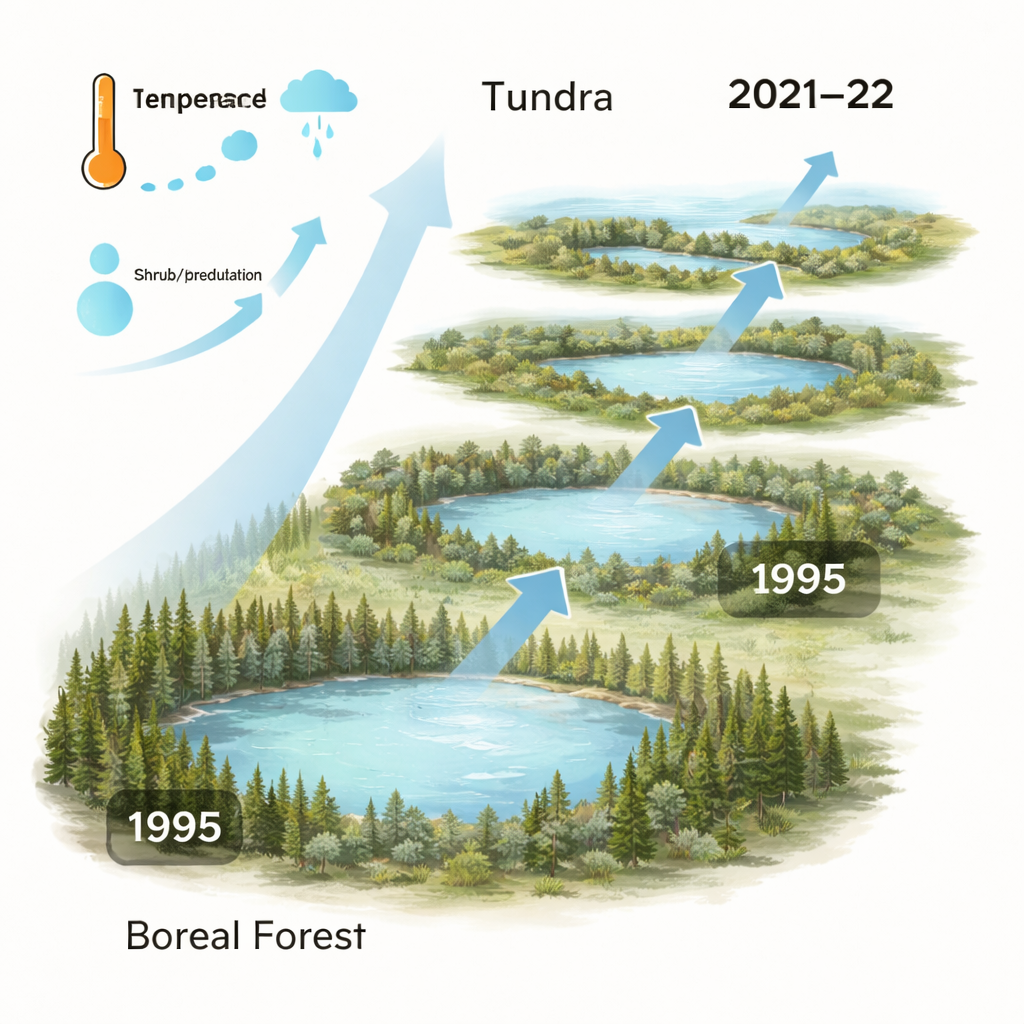
To track these changes, researchers returned to a remarkable natural laboratory: a chain of 69 lakes stretching about 1,400 kilometers across northern Quebec and Labrador, from dense boreal forest in the south to open tundra in the north. Many of these lakes were first studied in 1995, just before strong regional warming took off. By re-sampling the same waters more than 25 years later, the team could directly compare past and present conditions and see how both the lakes and their surrounding landscapes had responded to a rapidly changing climate.
Tiny algae as sentinels of change
Instead of focusing on fish or large plants, the scientists used microscopic algae called diatoms as their main trackers of change. These single-celled organisms, encased in glass-like shells, are very sensitive to water temperature, light, and chemistry, and they form the base of lake food webs. By examining diatoms preserved in surface sediments and measuring modern water chemistry, the team could group lakes with similar biological and environmental traits. Where these groups shifted sharply along the north–south line, they defined broad transition zones—"aquatic ecotones"—that mark where one kind of lake community gives way to another.
Hidden boundaries on the move
The researchers found three major aquatic ecotones along the transect. In the mid‑1990s, these zones lined up closely with well-known shifts on land, such as the change from closed boreal forest to more open subarctic woodland, and then to forest‑tundra. By 2021–22, all three aquatic ecotones had moved noticeably north, in some cases by up to about 150 kilometers. This means that the kinds of lake communities once typical of more southern climates are now found much farther into the north. In some places, species differences within an ecotone shrank, suggesting that lakes are becoming more similar to one another—a sign of “biotic homogenization” where local uniqueness is lost.
Warming, wetting and changing shorelines
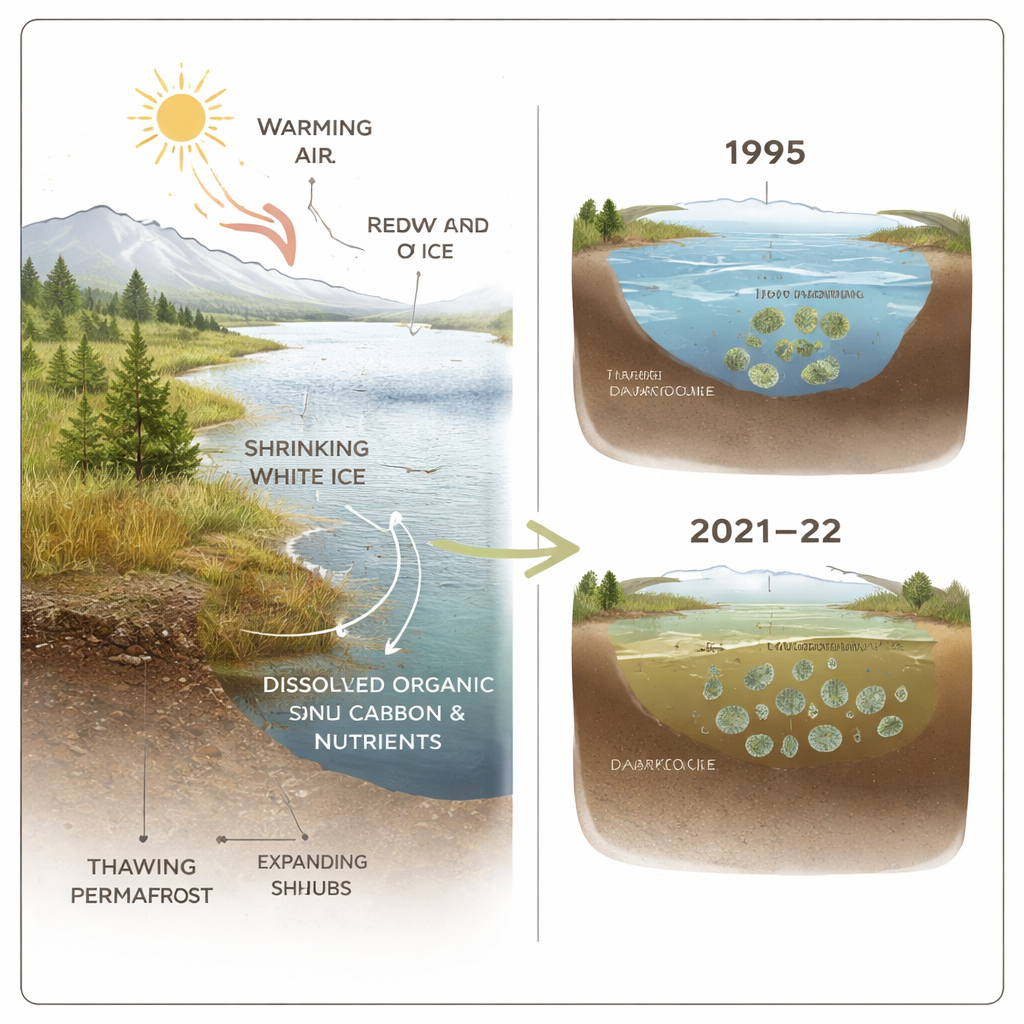
These shifting boundaries did not occur in isolation. Over the same period, the region experienced rising air temperatures, more frost‑free days, and widespread “greening” as shrubs and other vegetation expanded. At the same time, permafrost—the long‑frozen ground that underlies much of the north—has been thawing. Together, these changes alter how water, nutrients and carbon flow from land into lakes. The study found that lakes near the moving ecotones were especially tied to increases in summer warmth and, to a lesser extent, changes in rainfall. Dissolved organic carbon, the material that can make lake water look tea‑colored or “browned,” changed in many lakes, but not always in the same direction, reflecting the complex mix of local soils, vegetation, and weather events.
What this means for the future north
For non‑specialists, the message is clear: microscopic life in northern lakes is already reorganizing itself in step with rapid climate warming. Aquatic communities that once marked the border between forest and tundra are marching north, tracking new combinations of temperature, rainfall, vegetation, and thawing ground. These shifts could ripple up through entire food webs, affecting insects, fish, birds and mammals, and altering how northern landscapes store carbon and provide clean water. The study’s moving lake boundaries offer an early warning that the ecological “map” of the north is being redrawn within a human lifetime.
Citation: Alibert, M., Pienitz, R. & Antoniades, D. Climate warming is shifting northern aquatic ecotones. Sci Rep 16, 6735 (2026). https://doi.org/10.1038/s41598-026-37392-3
Keywords: Arctic lakes, climate warming, ecotones, northern ecosystems, permafrost thaw