Clear Sky Science · en
A Geometric Whale Optimization Algorithm with Triangular Flight for Numerical Optimization and Engineering Design
Smarter Search for Better Designs
From lighter car parts to cheaper energy pipelines, modern engineering depends on choosing the best possible design out of countless options. But exhaustively testing every combination is impossible. This paper presents a new computer-based search method, inspired by whale hunting behavior and geometric patterns, that can quickly home in on excellent designs for complex engineering systems.
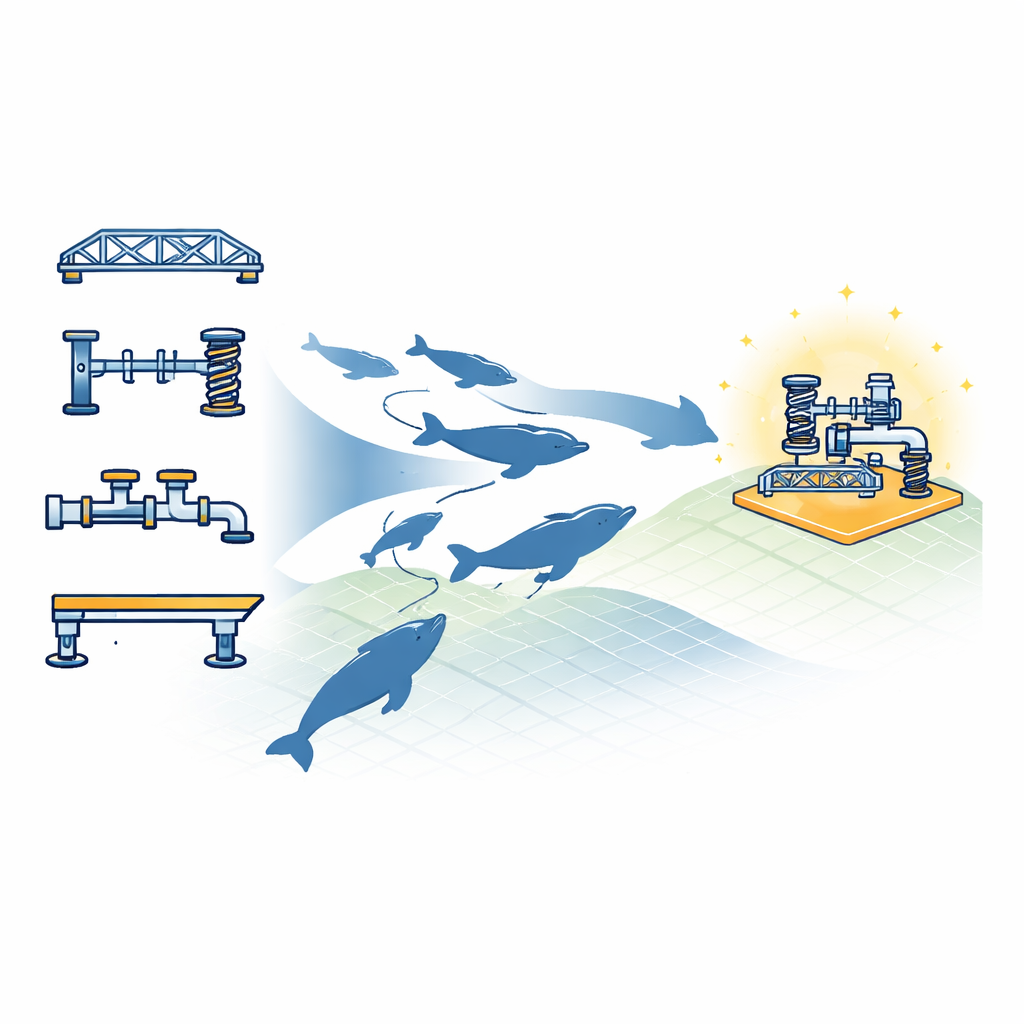
Why Finding the “Best” Design Is So Hard
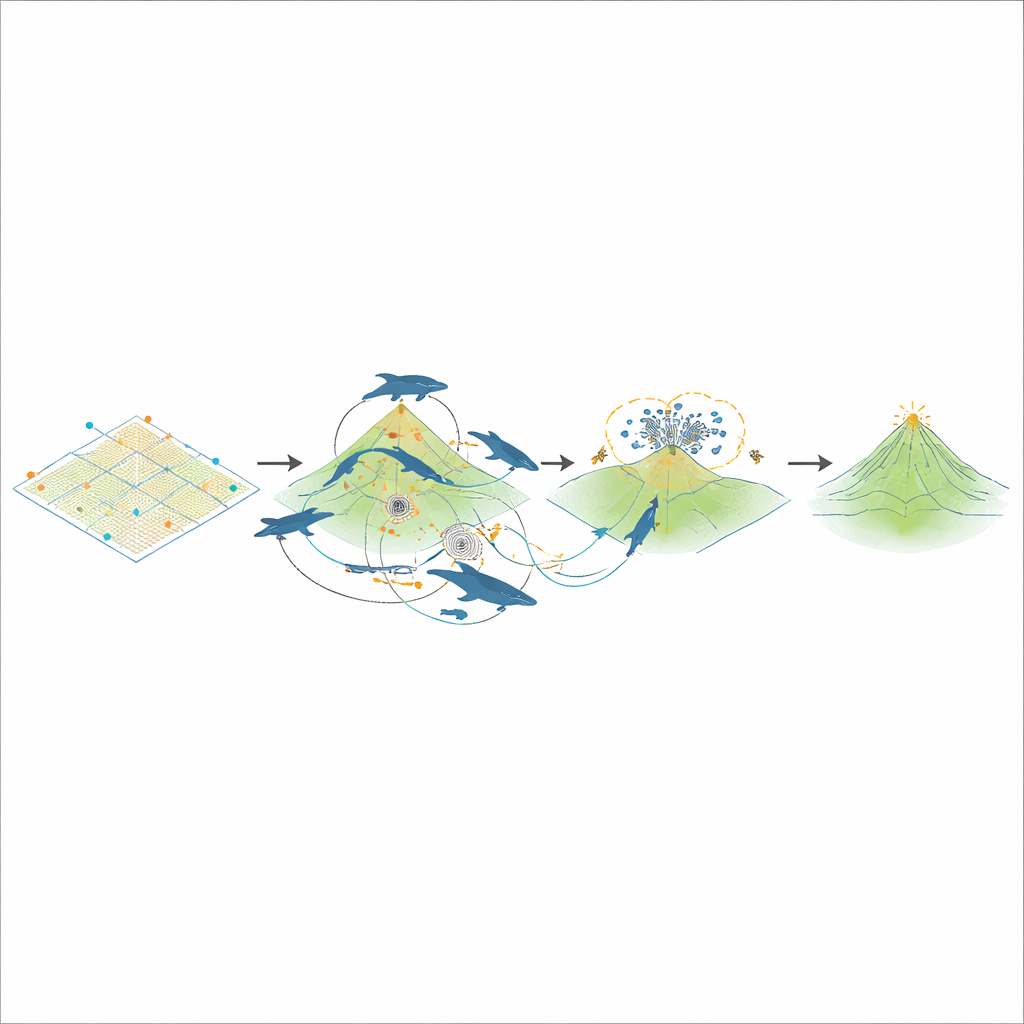
Many real-world design problems—from springs and beams to gas compressors and reactor networks—are like landscapes with countless hills and valleys. Each point represents one specific design; height represents how good or bad it is. Traditional methods that follow local slopes can easily get stuck on a nearby small hill instead of finding the highest peak. Metaheuristic algorithms were invented to tackle this: instead of marching in a straight line, they send out a “swarm” of candidate solutions that explore the landscape together, looking for better options while sharing information.
How Whale-Inspired Search Works
The Whale Optimization Algorithm models how humpback whales surround and spiral around prey in the ocean. Each virtual whale is a trial design; as they move, the best-performing whale acts as a leader, and others adjust their positions to close in on promising regions. This original approach is simple and flexible, but in tough problems it can lose diversity, crowd too quickly around a mediocre solution, and stop improving. The authors analyze these weaknesses—poor starting positions, directionless wandering, and overly rigid movement rules—and set out to repair them without making the method too heavy or slow.
Geometric Tricks for Better Searching
The new method, called the Geometric Whale Optimization Algorithm with Triangular Flight (ESTGWOA), reshapes how whales spread out and move. First, it uses a Good Nodes Set to place initial whales in a very even geometric pattern, so the search covers the whole space instead of clumping randomly. Then an Elite-Guided Searching step steers whales using both the current best design and the population’s average position, giving motion that is purposeful but not blindly obedient to the leader. Two new movement patterns mimic graceful, curved maneuvers: a spiral-based “encircling” motion that lets whales probe around good areas without locking in too fast, and a triangular-style spiral hunting path that adds controlled randomness to escape local traps and refine solutions.
Adding a Dash of Controlled Randomness
To avoid the stagnation that often happens late in the search, the authors borrow ideas from another powerful technique, Differential Evolution. They create “mutated” copies of some designs by combining information from several whales, then add gentle Gaussian nudges of different sizes. These mutations occasionally push the search out of a rut and into unexplored regions near promising spots. At the same time, a key internal control, called the convergence factor, is no longer reduced in a straight line; instead it follows an S-shaped curve. Early on, this encourages wide exploration, then transitions rapidly to focused fine-tuning, and finally slows down again to preserve a bit of flexibility.
Proving It Works on Tests and Real Designs
The team evaluates ESTGWOA on 23 standard mathematical test functions that include smooth bowls, rugged landscapes with many local peaks, and intricate mixed shapes. Across moderate and high dimensions (30, 50, and 100 variables), the new algorithm outperforms several well-known rivals, including earlier whale-inspired variants and other animal- and physics-inspired methods. It reaches better solutions on average, with less scatter between runs, and statistical tests confirm the improvements are not due to chance. The authors then tackle seven classic engineering design challenges, such as multi-disk clutches, gas transmission compressors, springs, beams, trusses, and levers. In nearly every case, ESTGWOA finds lighter or cheaper designs while still respecting all safety and performance limits.
What This Means for Everyday Technology
In plain terms, the new geometric whale method is a smarter way for computers to “search the design ocean.” By spreading out evenly, following flexible spiral and triangular paths, and occasionally mutating promising solutions, it maintains a healthy balance between broad exploration and careful refinement. The result is an algorithm that reliably discovers high-quality designs for complex, real-world systems without extra mathematical assumptions. For industries that must weigh cost, strength, safety, and efficiency all at once, such tools can shorten development cycles and reveal solutions that might never be found by intuition alone.
Citation: Wei, J., Zhang, R., Gu, Y. et al. A Geometric Whale Optimization Algorithm with Triangular Flight for Numerical Optimization and Engineering Design. Sci Rep 16, 8526 (2026). https://doi.org/10.1038/s41598-026-37387-0
Keywords: metaheuristic optimization, whale optimization algorithm, engineering design, numerical optimization, swarm intelligence