Clear Sky Science · en
Exponential stabilization and finite time blow-up in a fractional thermal piezoelectric beam with delay
Why this smart beam matters
From noise-cancelling airplane wings to energy-harvesting floors, “smart” materials that can sense and respond to their environment are moving from the lab into everyday technology. Among the most versatile of these are piezoelectric beams, which convert mechanical motion into electricity and vice versa. This article explores how such a beam behaves when we add realistic complications: heat, materials with fading memory, and delays in the feedback electronics. The authors show when these effects work together to calm vibrations—and when they instead trigger a sudden, catastrophic failure.
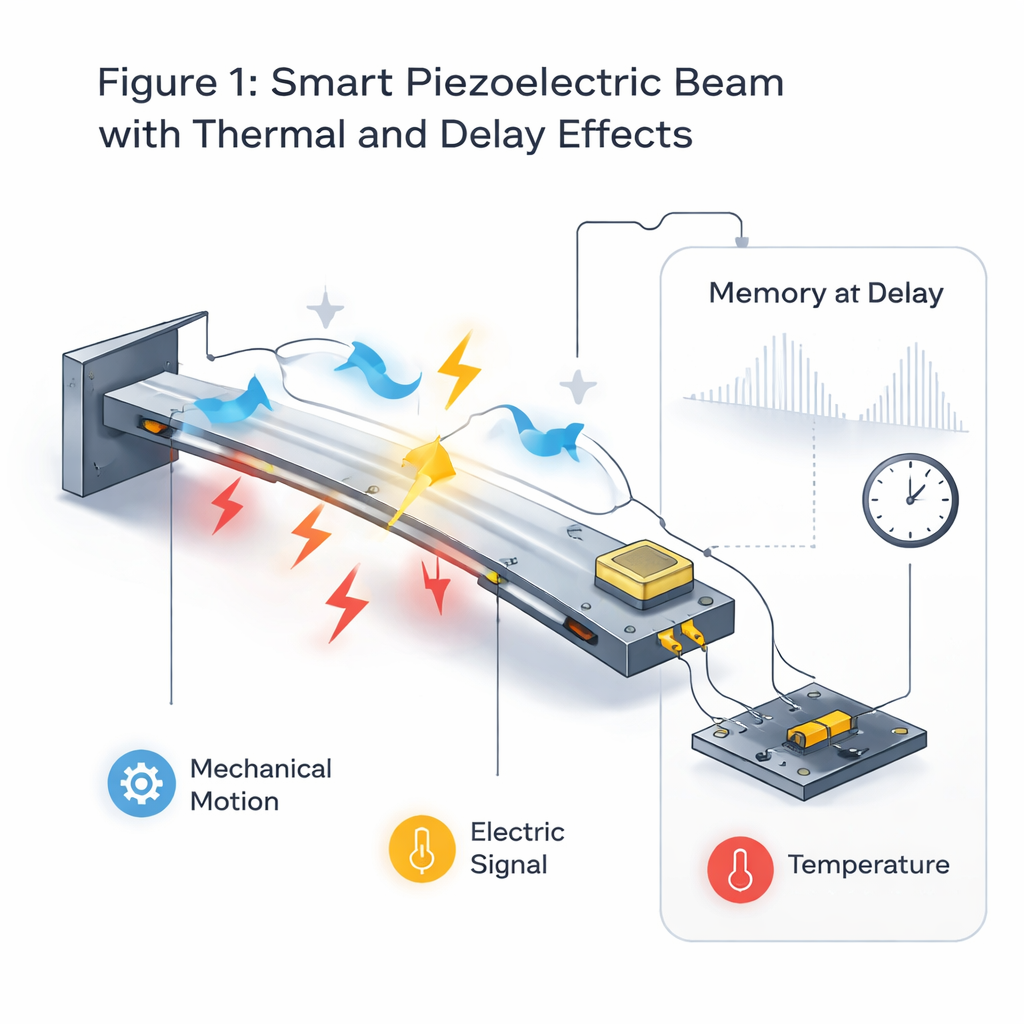
A beam that feels, remembers, and heats up
The study considers a long, thin piezoelectric beam that can stretch and contract along its length while its temperature changes. Because of the piezoelectric effect, mechanical motion and electric fields are tightly linked, and the device operates under electrostatic conditions typical of sensor and actuator setups. The model also includes heat flow along the beam, so that mechanical motion and temperature influence each other, capturing thermo-mechanical coupling important in high-performance “smart” structures exposed to varying environments.
Delayed reactions and fading memory
Real devices do not respond instantly: sensors, controllers, and actuators all introduce time delays. The beam in this work is subject to such an internal delay, meaning the damping forces depend on how the beam was moving a short time in the past. In addition, the material has memory: its current behavior depends on a weighted history of past deformations. Instead of assuming an unrealistic infinite memory, the authors use a “tempered fractional” description, where the influence of the past decays both slowly (like a power law) and exponentially. This captures viscoelastic materials whose memory is strong but not endless, and it allows a unified treatment of viscous damping, memory damping, and delay feedback.
Balancing damping, delay, and strong nonlinearity
On top of these effects, the beam’s response is governed by a special logarithmic nonlinearity. This mathematical term represents very strong, but slowly growing, electromechanical effects that do not follow simple power laws. Such nonlinearities are known to lie on a knife edge between safe operation and runaway behavior. The authors first prove that, under natural conditions on the material and feedback parameters, the full system is mathematically well-posed: given reasonable initial data, there is a unique solution that makes physical sense. They achieve this by recasting the problem into an expanded system with auxiliary “history” variables and then applying modern semigroup and fixed-point methods.
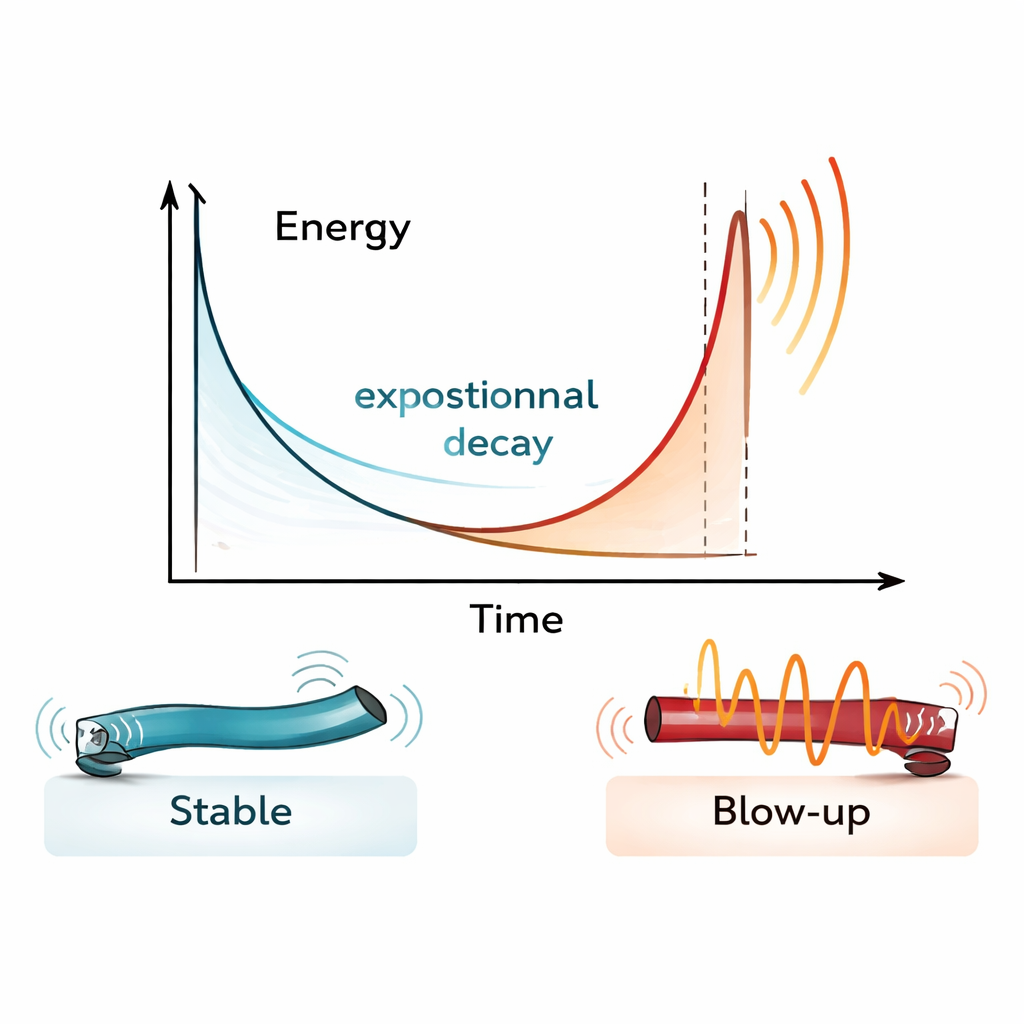
When vibrations die out—and when they explode
With the model firmly established, the authors design a sophisticated energy-like quantity, called a Lyapunov functional, that tracks both thermal effects and the material’s hereditary memory. By estimating how this energy changes over time, they identify explicit conditions on the damping strengths, delay size, and memory parameters that guarantee exponential decay: the beam’s vibrations and temperature variations shrink steadily and predictably. However, the same analysis also uncovers a darker side. If the system starts with negative effective energy—a regime linked to the strong logarithmic source—then the mathematical solution cannot exist for all time. Instead, the energy blows up in finite time, signaling a sudden loss of stability that corresponds, physically, to a rapid and destructive failure of the structure.
What this means for smart structures
In accessible terms, the article shows that a piezoelectric beam with realistic heat transfer, memory, and delayed feedback can behave in two radically different ways. With carefully tuned damping and modest initial disturbances, the system is self-stabilizing: vibrations and excess heat die out at an exponential rate. But if the initial state is too “energetic” in the sense defined by the model, or if the delay and nonlinear effects dominate the damping, the same structure can fail abruptly in finite time. These mathematical results provide engineers with guidelines and thresholds for designing safer, more reliable smart materials and devices that harness powerful nonlinear effects without crossing into dangerous territory.
Citation: Ullah, Z., Hao, J., Thabet, S.T.M. et al. Exponential stabilization and finite time blow-up in a fractional thermal piezoelectric beam with delay. Sci Rep 16, 6479 (2026). https://doi.org/10.1038/s41598-026-37381-6
Keywords: piezoelectric beam, smart materials, vibration control, fractional damping, finite-time blow-up