Clear Sky Science · en
Disturbance event impact on aboveground carbon storage and vulnerability of large trees in old-growth coniferous forest stands in Latvia
Why big old trees matter for climate
When we think about fighting climate change, we often picture planting new trees. But in many northern forests, it is the oldest, largest trees that quietly hold most of the carbon taken from the air. This study from Latvia asks a deceptively simple question: what happens to the forest’s carbon bank if a few of these giants die in storms, insect outbreaks, or simply of old age?
Ancient forests in a changing Europe
Across Europe, truly old, relatively untouched forests have become rare after centuries of logging and modern forestry. In Latvia and its neighbors, patches of "old-growth" coniferous forest—dominated by Scots pine and Norway spruce—survive as living archives of what forests once looked like. The authors compared 44 such old stands, about 170–200 years old, with 47 “mature” stands roughly half that age, but growing on the same types of mineral soils and in the same hemiboreal climate zone. By measuring thousands of trees and pieces of deadwood in detailed sample plots, they could estimate how much carbon was stored above ground in living trees and in dead wood, and how vulnerable that carbon is to the loss of the biggest stems.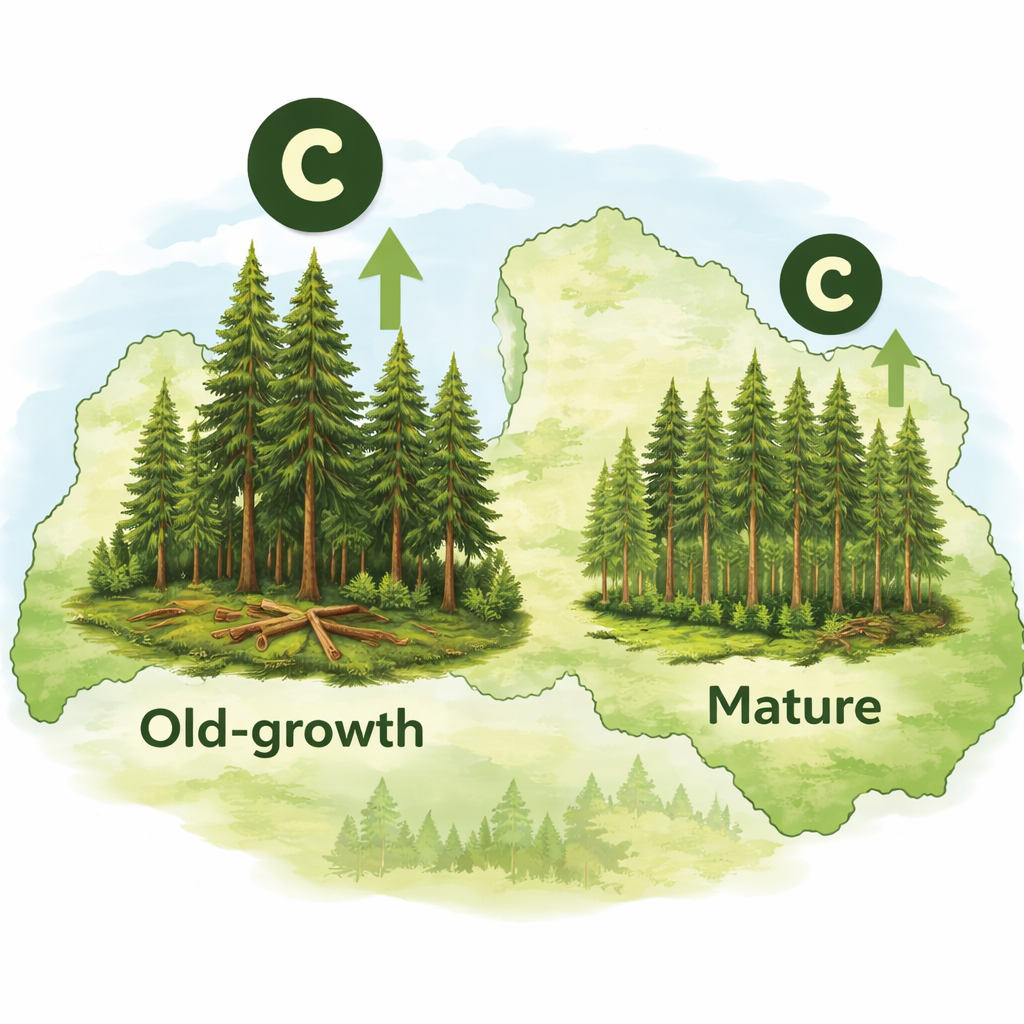
A few giants carry most of the weight
The measurements revealed a striking pattern: old-growth stands had far fewer trees per hectare than mature forests, but their trees were much larger. In the old stands, big trees with trunks wider than 40 cm made up only 14–22% of all trees, yet they stored about half (49–58%) of all tree-biomass carbon. In the younger stands, big trees were rare—around 4% of trees—and held only 11–14% of the carbon. On average, an individual large pine in an old stand carried roughly one ton of carbon by itself. Overall carbon stocks in living trees were highest in old pine forests, somewhat lower in old spruce, and similar between the two species in mature stands. This shows that, given enough time and relatively low disturbance, these older conifer forests can build up very substantial carbon reservoirs.
Dead wood tells a story of slow loss
Old forests are not just about live trees. Fallen logs and standing dead trunks also store carbon and shelter a wealth of organisms. As expected, deadwood carbon stocks were many times higher in old-growth than in mature stands for both tree species, though they varied widely from place to place. In spruce forests, more than half of this carbon lay in fallen logs; in pine forests, nearly half was in standing dead trees that may take a long time to topple and decay. Most dead wood was in early or moderate stages of decomposition, suggesting ongoing, but not catastrophic, tree death. At the same time, deadwood made up only about one-fifth of total stand volume, hinting that these sites have seen relatively little recent large-scale disturbance—which makes their current carbon stores impressive, but also fragile if disturbance intensifies.
What if the biggest trees disappear?
To mimic future damage from wind or insects, the researchers performed a simple experiment on paper: they repeatedly recalculated carbon storage after “removing” the 1 to 15 largest trees in each plot. Because so much carbon was concentrated in these giants, the modeled losses were dramatic, especially in old-growth stands. In pine forests, cutting or losing just six largest trees in a small plot reduced tree-biomass carbon by about half; in spruce, removing only five giants had a similar effect. Mature stands also lost carbon when big trees were taken out, but needed more trees removed—about eight to nine—to reach the same 50% reduction. In other words, old-growth forests are superb carbon vaults precisely because they lean so heavily on a small number of massive trees; that same dependence makes them particularly sensitive to any process that targets or topples those trees.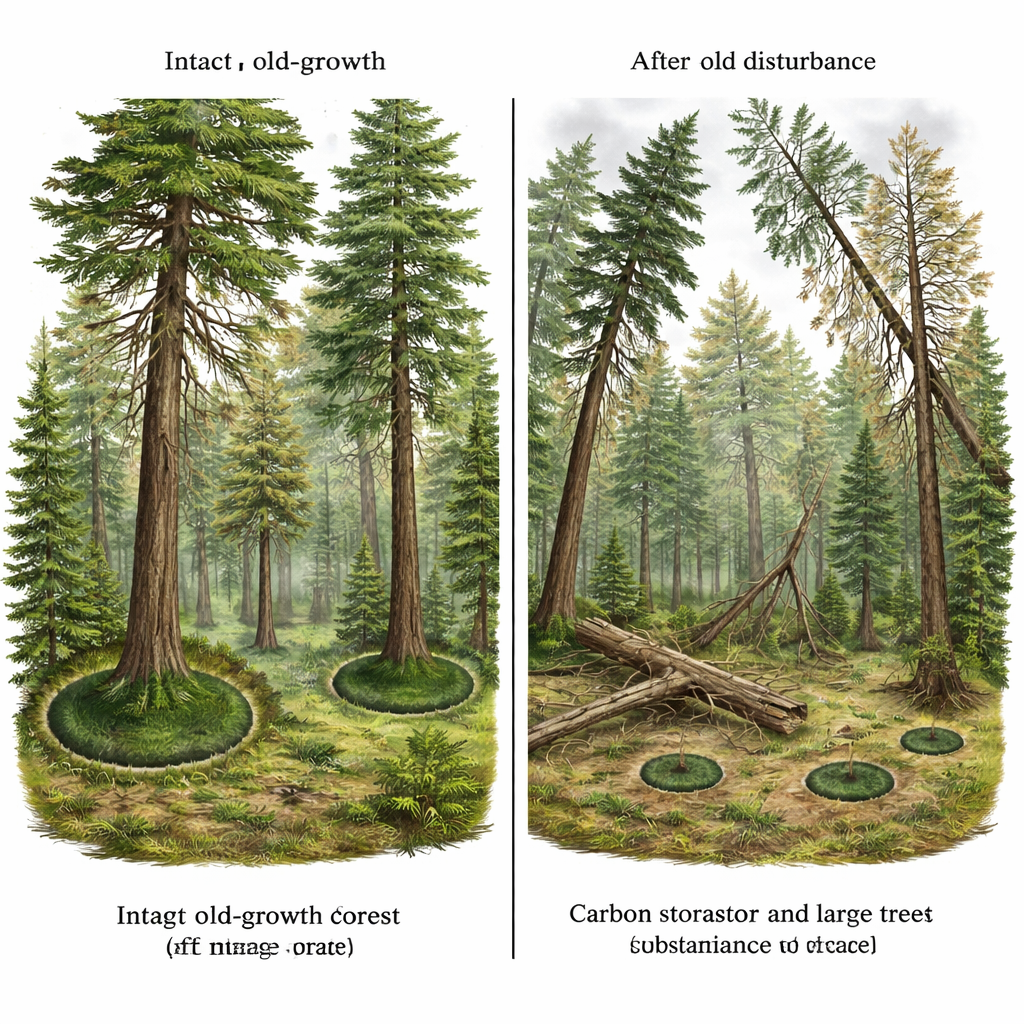
A delicate balance in the forest carbon bank
For a lay reader, the takeaway is clear: old, large conifers act like oversized batteries storing climate-warming carbon. Latvia’s old-growth pine and spruce stands appear near the upper limit of what such forests can hold above ground. Yet this richness is precarious. Lose just a handful of the biggest trees—through ageing, stronger storms, or insect outbreaks that are expected to worsen with climate change—and a forest can rapidly give up much of its stored carbon. The study suggests that protecting remaining old-growth stands, monitoring disturbance, and thinking carefully about how to keep large trees standing will be crucial if these forests are to continue serving as reliable, long-term allies in climate mitigation.
Citation: Ķēniņa, L., Elferts, D., Jaunslaviete, I. et al. Disturbance event impact on aboveground carbon storage and vulnerability of large trees in old-growth coniferous forest stands in Latvia. Sci Rep 16, 6471 (2026). https://doi.org/10.1038/s41598-026-37378-1
Keywords: old-growth forests, forest carbon storage, large trees, Latvia conifer forests, disturbance impacts