Clear Sky Science · en
Global spatiotemporal analysis of interactions between urban heat islands and extreme heat waves
Why City Heat Matters More Than Ever
When a heat wave hits, city dwellers often feel it most. Concrete, asphalt, and dense buildings trap warmth, creating urban heat islands—cities that stay hotter than their surroundings. This study asks a crucial question: when extreme heat waves strike, do they simply add to city heat, or do they interact with urban environments in ways that make nights in particular much more dangerous? By looking at cities across the entire globe over nearly three decades, the authors uncover when and where heat waves and urban heat islands combine to create especially intense heat, and what physical processes are responsible.
How the Study Looked at Cities and Heat
Instead of focusing on just one city, the researchers used a land-surface climate model to simulate air temperatures in both urban and nearby rural areas for 3,648 city grid cells worldwide from 1985 to 2013. They defined a heat wave as at least three days in a row when daily maximum temperature at a rural reference area exceeded the local 98th percentile for summer. Urban heat island intensity was measured as the difference between city and rural air temperature two meters above the ground—the layer where people actually live and breathe. The key quantity in this work is how much stronger (or weaker) the city–rural temperature gap becomes during heat-wave days compared with typical summer days.
Where and When Cities Heat Up the Most
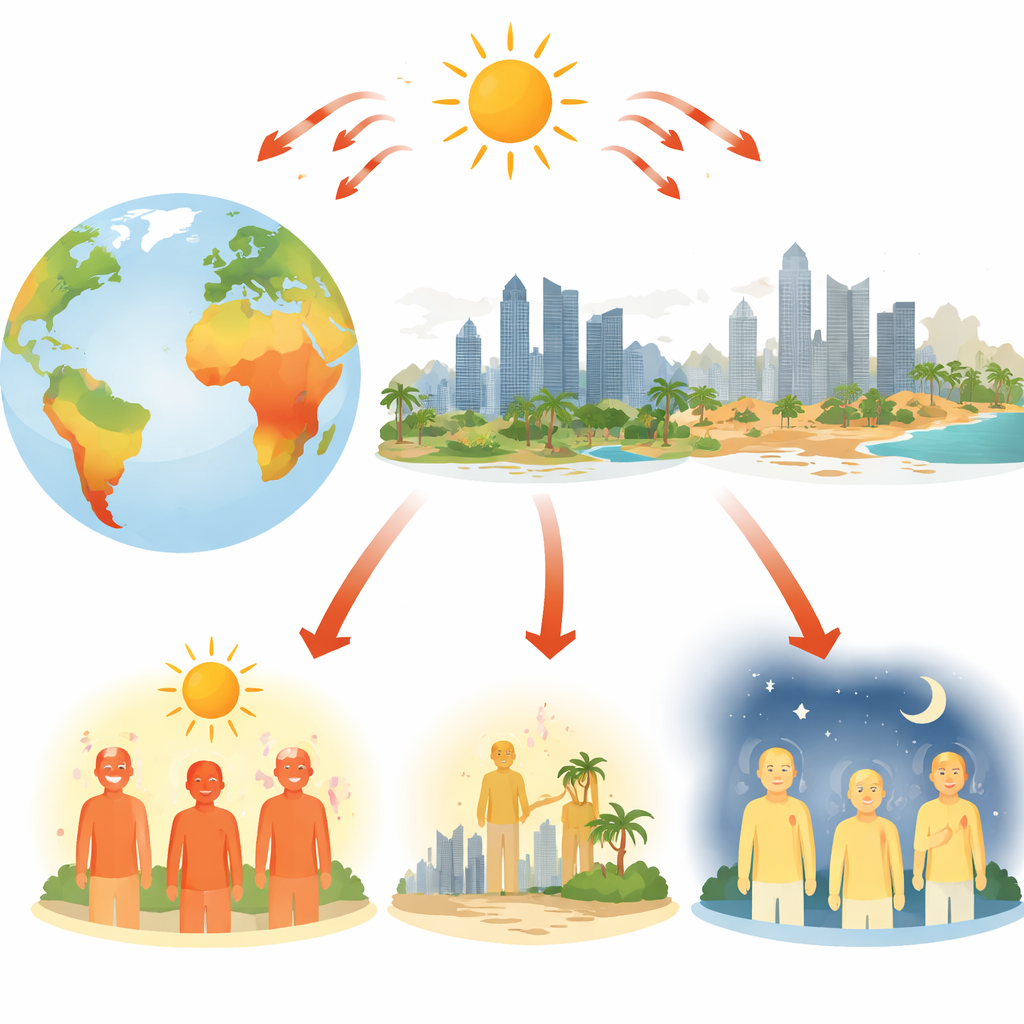
Across the globe, the team found a strong daily rhythm in how heat waves affect city heat. The extra urban warmth peaks just before sunrise, when cities can be about a third of a degree Celsius hotter than they would be on a non-heat-wave summer night, and it briefly dips around mid-morning, when the interaction can even turn slightly negative. On average, nights show far more synergy between heat waves and urban heat islands than days: nighttime city–rural differences increase by about 0.27 °C during heat waves, while daytime changes are close to zero. Spatially, daytime patterns are patchy—some agricultural and coastal regions show little or even weaker city heat during heat waves—whereas nighttime patterns are more uniform, with especially strong hotspots over northern India and northern China, where extra nighttime city warming can exceed 0.8 °C.
How Climate Background Shapes City Heat
The researchers then grouped cities by broad climate types—arid, continental, temperate, and tropical—to see how background climate controls these patterns. All climate zones share the same basic timing: extra heat-wave-related city warming is strongest at night and weakest in late morning. But the strength and variability differ. Continental climates, with hot summers and strong seasonal swings, show the largest boost in city heat during heat waves, especially at night. Tropical climates, by contrast, show the greatest spread from place to place: some tropical regions, like parts of India, experience strong reinforcement of city heat, while others, such as parts of Mexico and Central America, show weakened or neutral interactions. This variation reflects how much moisture is available in rural areas and how sharply city and countryside differ in surface properties.
What Drives the Extra Heat in Cities
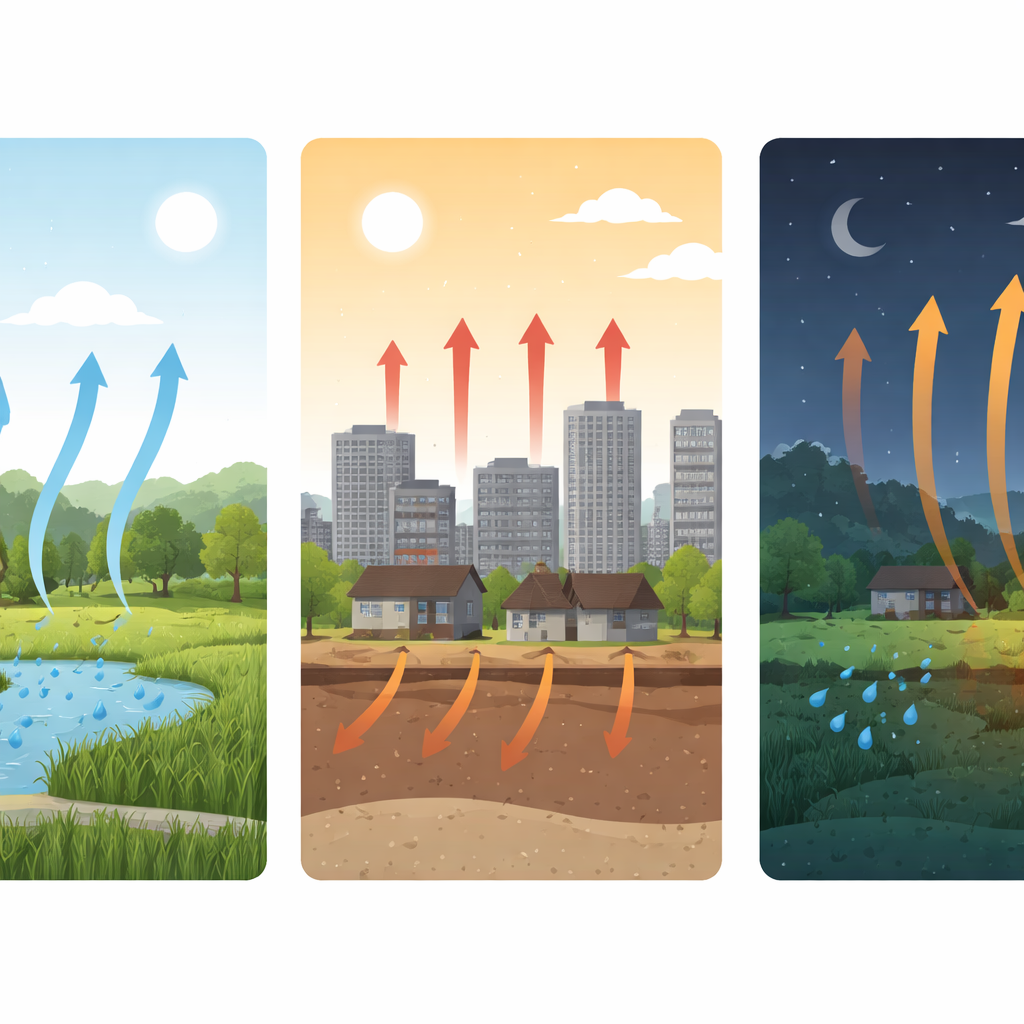
To untangle which physical factors matter most, the team used a machine-learning model trained on more than six million hourly observations, combined with an interpretation tool that ranks each factor’s contribution. The strongest indicator of extra city heat during heat waves is how much long-wavelength radiation—essentially, infrared heat—is emitted from urban surfaces compared with rural ones. At night, city buildings and pavements slowly release stored heat, boosting this outward radiation and keeping city air warmer than nearby countryside. Moisture also plays a central role, especially during the day in humid regions. When rural areas stay moist, plants there can use incoming energy to evaporate water and cool the air, while paved, drier cities cannot. This widens the humidity gap between city and countryside and channels more energy into heating urban air. Wind speed and sensible heat flux—the direct transfer of heat from surfaces to air—become more important in drier climates, particularly when low winds prevent built-up heat from dispersing.
What This Means for People Living in Cities
The study shows that heat waves and city design do not simply add their effects—they interact in ways that can significantly worsen nighttime heat, especially in certain climates. In moist agricultural or temperate regions, the biggest risk occurs when heat waves dry out cities more than their surroundings, sharpening moisture contrasts and cutting natural cooling. In continental and arid regions, the main culprits are stored heat in buildings and still air that traps warmth over city streets. For city planners and public health officials, this means that effective protection from extreme heat must be tailored to local climate: boosting shade and moisture in humid regions, improving nighttime cooling and ventilation in drier ones, and always paying special attention to nighttime conditions, when bodies have the least chance to recover from daytime heat.
Citation: Guo, J., Lee, X. & Zhang, K. Global spatiotemporal analysis of interactions between urban heat islands and extreme heat waves. Sci Rep 16, 9012 (2026). https://doi.org/10.1038/s41598-026-37372-7
Keywords: urban heat island, heat waves, climate adaptation, urban climate, heat risk