Clear Sky Science · en
Functional imaging of time on task and the involvement of dopaminergic and cholinergic substrates in cognitive effort and reward
Why staying focused feels like hard work
Anyone who has tried to keep their mind on a simple, boring task for more than a few minutes knows that it quickly starts to feel effortful. We get slower, make more mistakes, and have to push ourselves to stay on track. This study asks what is happening in the brain during that kind of mental grind, and how the promise of a reward changes the way our brain powers through. By scanning the brains of hundreds of volunteers as they carried out an easy but repetitive task for money, the researchers traced how different deep brain systems help us sustain attention and effort over short stretches of time.
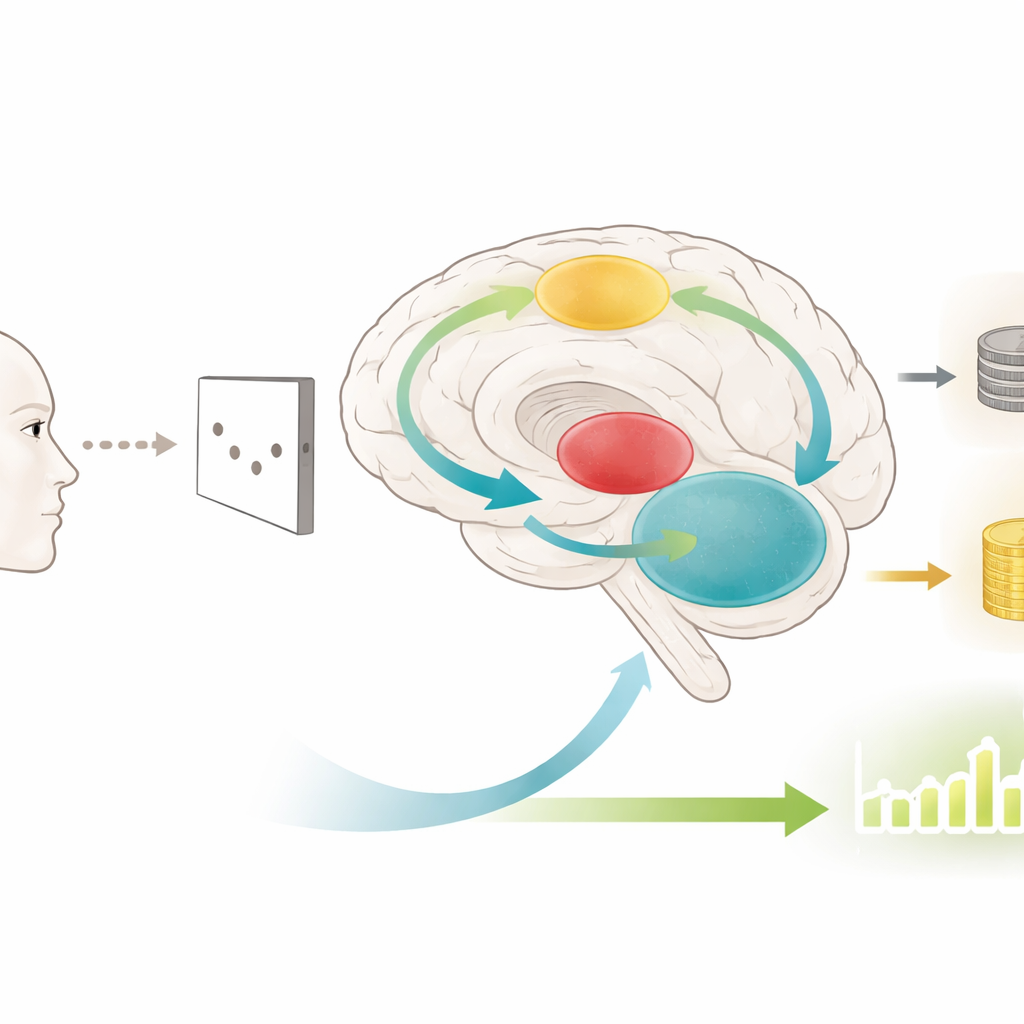
A simple game to tax steady attention
Volunteers lay in a brain scanner and watched a screen where small dots repeatedly appeared to the left or right of a central cross. Their job was straightforward: press the matching button as fast and accurately as possible each time a dot appeared. Before each short block of trials, a cue announced whether correct responses in that block would earn a high or a low amount of money. Crucially, the task was designed to be easy enough that almost everyone could respond correctly nearly all the time, but long enough that staying fully engaged required ongoing mental effort. The researchers treated the position of each trial within a block as a measure of “time on task,” allowing them to see how brain activity changed as attention had to be sustained second after second.
Small changes in performance, big changes in the brain
Behaviorally, people did very well: they answered correctly in more than 99 percent of trials. Still, subtle but reliable patterns emerged. As time on task increased within a block, responses became slightly slower and a bit less accurate, a sign that even brief stretches of repetitive work start to wear on attention. Higher reward blocks pulled performance in the opposite direction, speeding responses and improving accuracy. These modest behavioral shifts were paired with widespread shifts in brain activity. Large swaths of the frontal and parietal lobes, often linked to attention and control, became more active as time on task increased, suggesting that the brain was progressively “turning up” control to keep performance from slipping.
Deep brain systems that track value and effort
Earlier work had shown that a reward hub deep in the brain called the ventral striatum signals how much reward is expected from a task. This region did respond to the overall reward level in a block, but in the present study it did not closely track the rising effort of staying on task. Instead, two other deep regions stood out. One was the ventral tegmental area, part of the dopamine system often associated with motivation. The other was a cluster of cells in the basal forebrain that sends the chemical messenger acetylcholine widely across the cortex. Both of these regions ramped up their activity as time on task increased, and both were more strongly engaged when rewards were higher. At the same time, parts of the motor and sensory cortex actually decreased their activity with time on task, perhaps reflecting the brain becoming more efficient at processing the repeated, predictable movements and sensations.
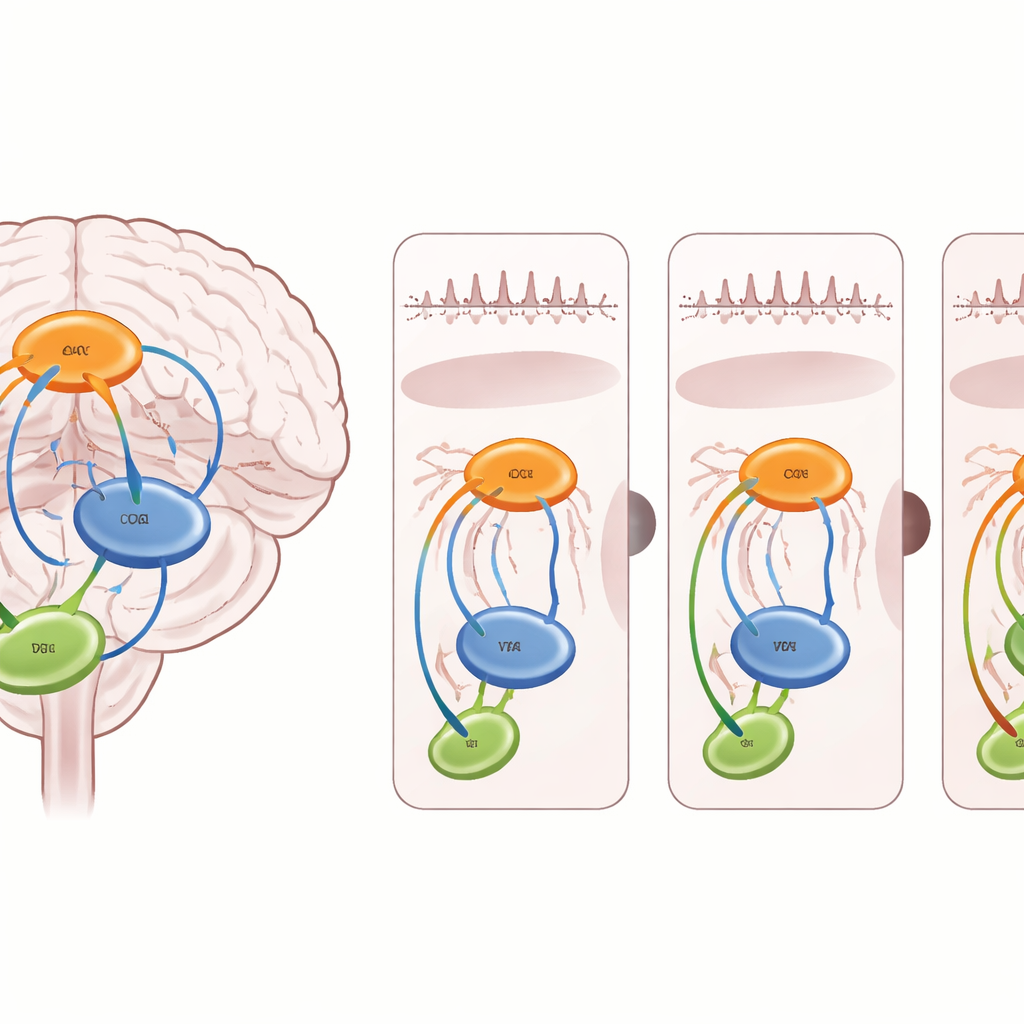
A spotlight on the brain’s effort network
The interaction between time on task and reward levels highlighted a key network on the brain’s surface. A midline region toward the front of the brain, often implicated in weighing the costs and benefits of exerting control, showed especially strong sensitivity to both sustained effort and reward. It was tightly linked with the right anterior insula, a region thought to monitor important events and signal when increased control is needed. Together with lateral frontal and parietal regions, these areas formed a connected network whose activity rose more steeply over time when rewards were high, consistent with the idea that the brain invests more control when the payoff makes the extra effort worthwhile.
What this means for everyday mental effort
Viewed together, the findings suggest that when we grind through a simple but demanding task, our brain recruits a broad attention network on the surface, while deep cholinergic and dopaminergic centers help sustain that effort and tune it according to how much reward is at stake. Rather than a single “motivation center,” the study points to a partial split between regions that track how valuable a task is and regions that help us keep doing it despite growing mental costs. For everyday life, this supports the familiar experience that incentives can make tedious work feel easier, not by changing the task itself, but by changing how vigorously the brain’s effort systems support sustained attention.
Citation: Orsini, C., Bosch, J.E., Labek, K. et al. Functional imaging of time on task and the involvement of dopaminergic and cholinergic substrates in cognitive effort and reward. Sci Rep 16, 7898 (2026). https://doi.org/10.1038/s41598-026-37370-9
Keywords: sustained attention, cognitive effort, brain imaging, reward motivation, basal forebrain