Clear Sky Science · en
Enhancing red color performance in three-color electrophoretic displays using high-frequency voltage and low-voltage differential oscillation
Sharper reds for next‑generation e‑paper
Electronic paper screens are easy on the eyes and sip power, making them ideal for e‑readers and outdoor signs. But adding rich color—especially a vivid, fast‑changing red—has been a stubborn challenge. This study shows how carefully shaped electrical signals can make the red pixels in three‑color e‑paper respond faster, flicker less, and look more saturated, bringing colorful, low‑power displays a step closer to everyday use.
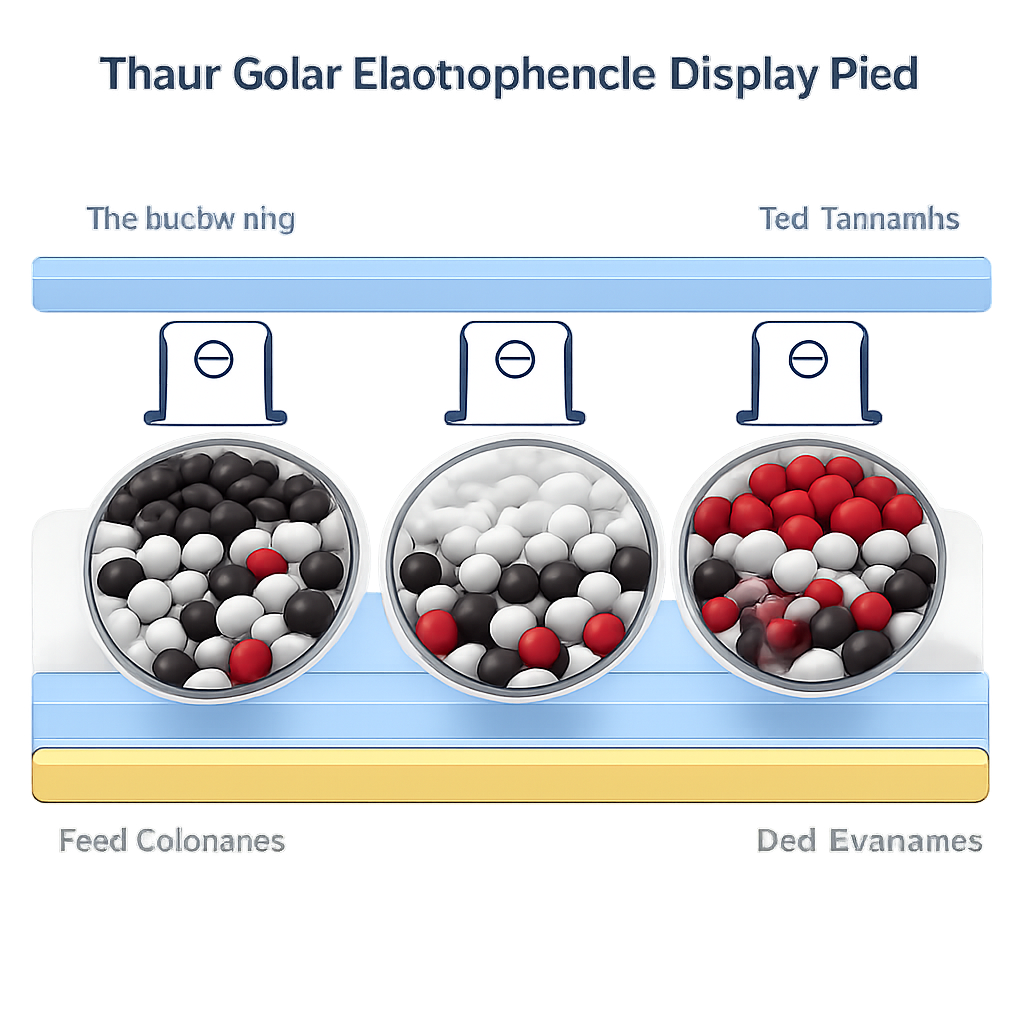
How colorful e‑paper works
Unlike glowing phone and laptop screens, electrophoretic displays work more like printed paper: they reflect ambient light instead of emitting their own. Each pixel contains countless microscopic capsules filled with a clear liquid and three kinds of pigment particles—black, white, and red—each carrying an electric charge. When a voltage is applied, the charged particles drift up or down inside the capsule. Whichever color ends up closest to the viewing surface is the color we see. In today’s three‑color e‑paper, the red particles are larger and heavier than black and white ones, so they move more slowly and are harder to position precisely. The result is sluggish red updates, washed‑out reds, and annoying flicker as the screen cycles through intermediate states.
The problem with sluggish red pixels
Previous efforts to fix red performance focused on "driving schemes"—the sequences of voltages sent to the display to erase an old image, activate the pigments, and write a new image. Conventional schemes can clear ghost images and manage grayscale, but they still suffer from long red response times and distracting brightness swings. If the voltage is too low, red particles barely move, yielding dull color. If it is too high, black particles tag along with the reds, muddying the tone. Low‑frequency voltage swings can jostle the particles into place but cause noticeable flicker as the screen visibly flashes during updates.
A new way to shake red particles into action
In the new work, the researchers used computer simulations to track how the three kinds of particles move under different voltages inside a model pixel. By combining basic physics of motion and fluid drag with an accurate electrical model, they tested how square‑wave voltages of different strength and frequency affect each color. The simulations suggested that a high‑frequency, low‑voltage "shake" could activate red particles strongly—giving them extra motion energy—while leaving black and white particles relatively undisturbed. Guided by this insight, the team designed a three‑stage driving scheme: first erase the pixel to a uniform gray, then rapidly oscillate the voltage with a small difference between positive and negative levels to wake up the red particles, and finally apply a gentle steady voltage tailored to drive red pigments to the top without pulling black ones along.
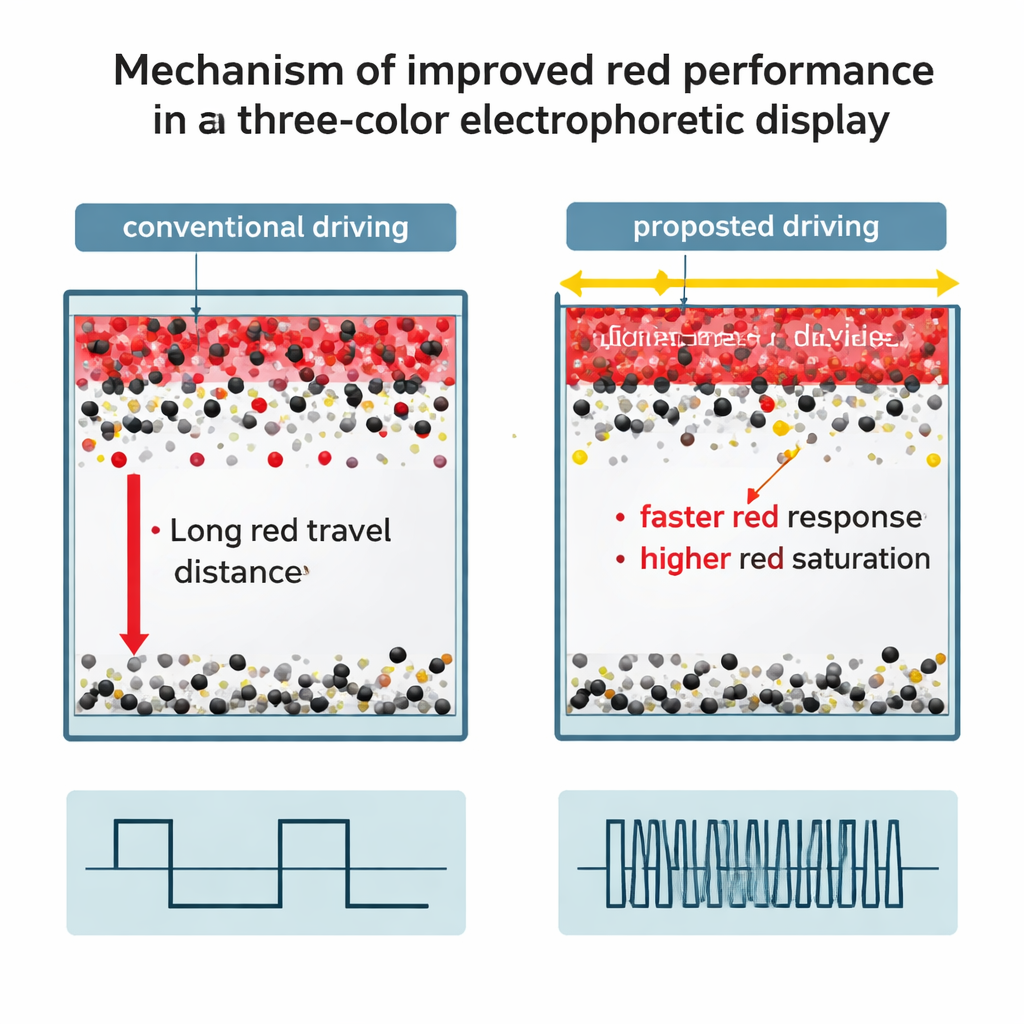
Tuning the signal for cleaner, faster red
To put the scheme to the test, the authors built an optical measurement setup with a programmable signal generator, amplifier, three‑color e‑paper panel, and a color meter. They systematically varied key parameters: the final red driving voltage and duration, the size of the oscillation during the activation stage, and the frequency and number of oscillation cycles. They found that a modest red driving voltage of about 2.5 volts was enough to fully bring reds to the surface without activating black particles. An activation sequence using a 6‑volt peak‑to‑peak oscillation, a 10‑millisecond period (corresponding to high frequency), and around 30 cycles gave the best trade‑off between particle activity and total update time. Under these tuned conditions, the red pixels reached a higher color purity, and the screen no longer needed long, low‑frequency flashes to settle into the target color.
Results that matter for real‑world screens
Compared with several existing driving methods, the new scheme cut the red response time from more than four seconds in a traditional approach to just 1.76 seconds, while also cutting the number of visible flickers from nine down to one. At the same time, the maximum red saturation—essentially how vivid the red appears—rose from 0.45 in a standard scheme to 0.53 with the new one, outperforming other fast‑response methods as well. In everyday terms, this means red graphics on future e‑paper signs or readers could appear quicker, look cleaner, and be less visually jarring during refresh, without sacrificing the technology’s hallmark low power use and eye comfort.
Citation: Jiang, M., Yi, Z., Wang, J. et al. Enhancing red color performance in three-color electrophoretic displays using high-frequency voltage and low-voltage differential oscillation. Sci Rep 16, 6082 (2026). https://doi.org/10.1038/s41598-026-37368-3
Keywords: electrophoretic displays, electronic paper, color e-ink, display driving waveform, low-power screens