Clear Sky Science · en
Multi-omics analysis reveals that ginsenoside Rb1 improves prognostic outcomes in sepsis by modulating mitochondrial metabolism MTHFD2 targets
Why this matters for people with severe infections
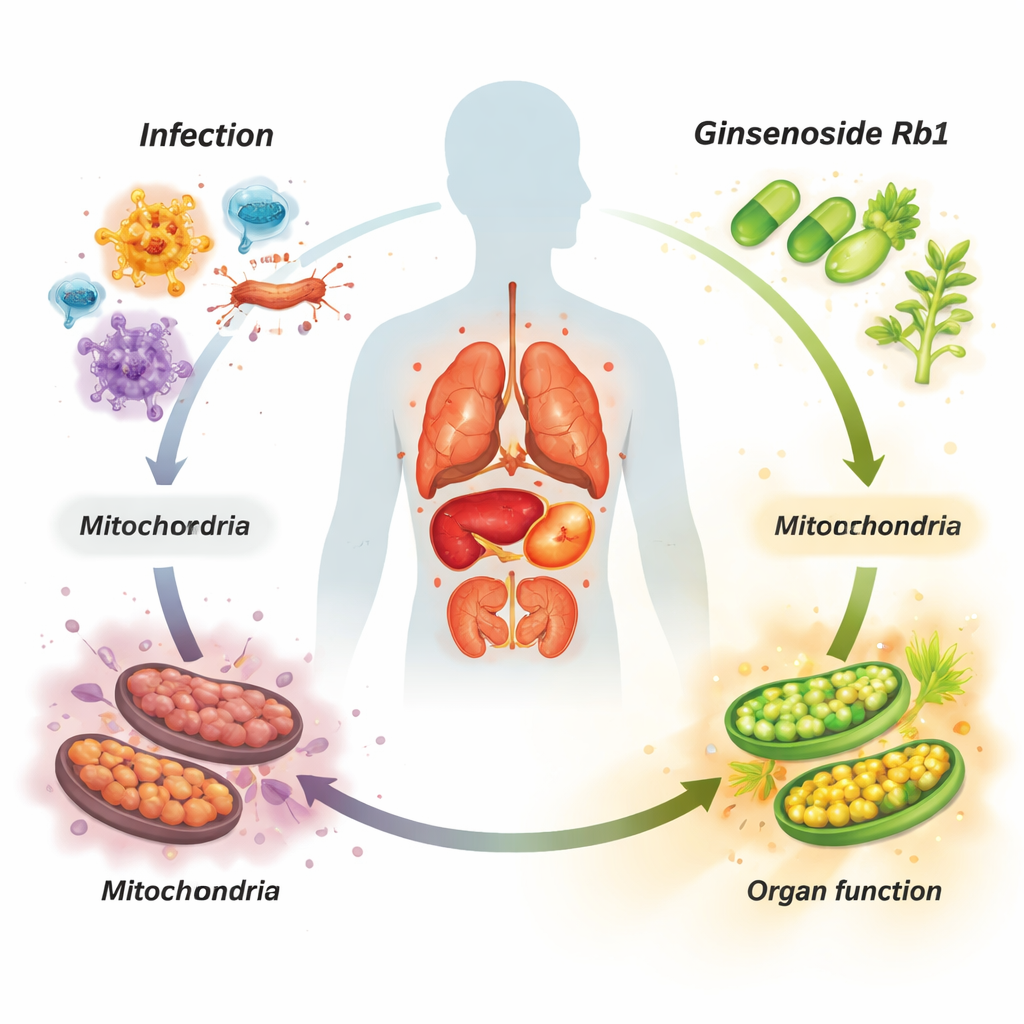
Sepsis—an extreme reaction to infection—kills millions of people worldwide each year, often despite antibiotics and intensive care. Doctors still struggle to predict who will get worse and to find drugs that do more than just support failing organs. This study explores how tiny power plants inside our cells, the mitochondria, behave during sepsis, and whether a natural compound from ginseng called ginsenoside Rb1 might help protect patients by calming this hidden energy crisis.
Looking inside the cell’s power plants
The authors began by mining large public databases of blood samples from nearly 500 people with sepsis and healthy volunteers. They focused on genes linked to mitochondrial metabolism—the way mitochondria produce energy and manage key chemical reactions. Out of thousands of genes, they identified a small set that behaved very differently in sepsis. These genes were involved in basic fuel handling, such as purine and fatty acid metabolism, which are central to how cells generate the energy needed to survive stress.
Building a risk score to sort patients
From this set, the team built a three-gene "mitochondrial metabolism" score based on MAOA, NME4 and especially a gene called MTHFD2. Patients whose blood showed higher activity of these genes had a clearly higher risk of dying within 28 days. Using this score, the researchers divided patients into lower- and higher-risk groups and even created a simple chart that combined age and the gene score to estimate an individual’s short-term survival chances. Across training and validation datasets, the score consistently distinguished people more likely to survive from those at greater risk.
The immune system and blood platelets in the spotlight
Next, the study asked how this mitochondrial score related to the body’s defense system. Patients with higher scores tended to have weaker signatures of helpful immune cells, such as activated B cells and killer T cells, and overall lower immune activity, patterns consistent with the immune paralysis often seen in late sepsis. Single-cell RNA sequencing—reading out which genes are active in tens of thousands of individual blood cells—revealed that MTHFD2 was switched on across many cell types, but was especially high in platelets, the tiny blood fragments best known for clotting. Platelets with more MTHFD2 also showed stronger signals for platelet activation and altered energy pathways, hinting that disturbed platelet metabolism may link mitochondrial stress to clotting problems and organ damage in sepsis, although this remains a hypothesis rather than proven fact.
A ginseng compound as a potential helper
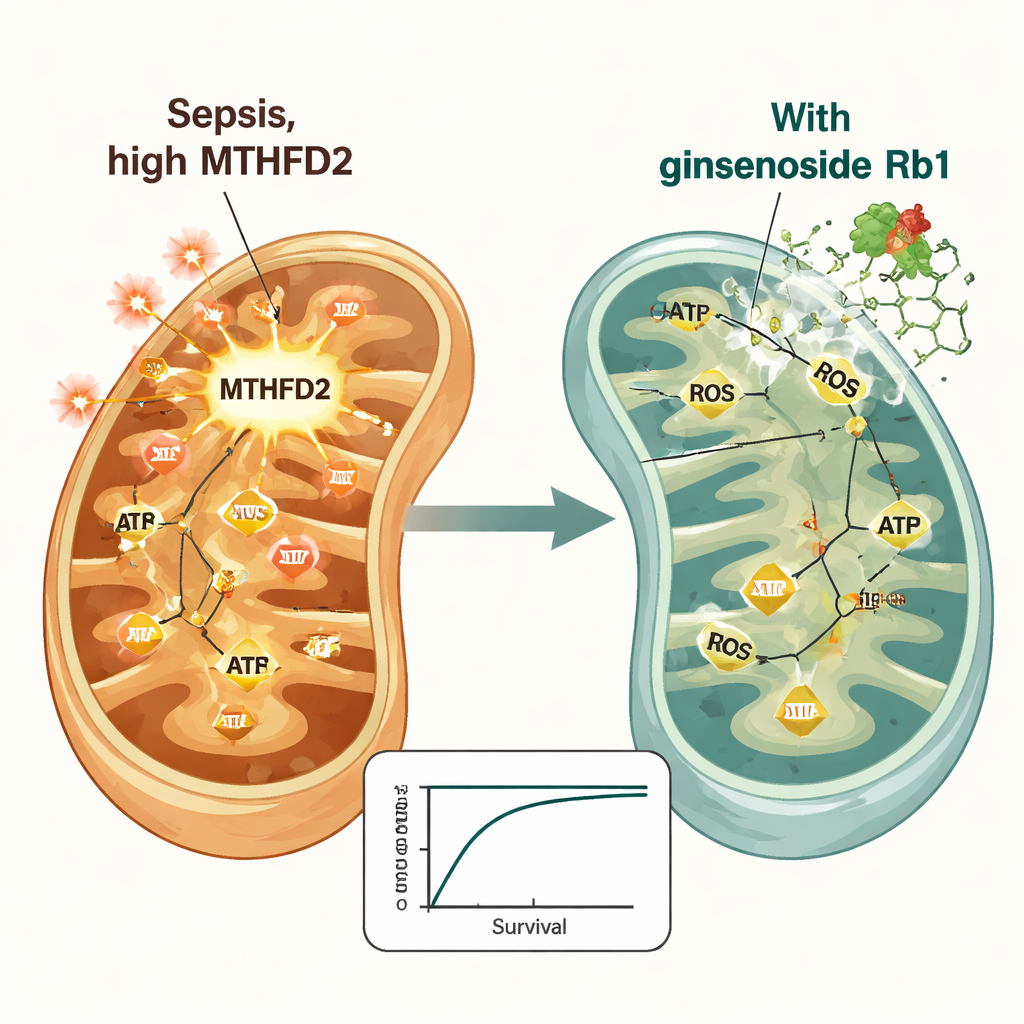
Because MTHFD2 emerged as the most worrisome gene in their score, the researchers searched for small molecules that might bind to and modulate it. Computer docking studies—virtual fitting of drug shapes onto protein structures—flagged ginsenoside Rb1, a major constituent of ginseng, as a promising partner for MTHFD2. The team then tested ginsenoside Rb1 in rats with a standard laboratory model of sepsis. Rats given the compound had lower levels of MTHFD2 in their tissues, reduced blood levels of inflammatory molecules such as IL-6 and TNF-α, less lung and kidney damage, and better survival over 72 hours than untreated septic rats.
What this could mean for future care
For non-specialists, the main takeaway is that this work links a specific mitochondrial gene, MTHFD2, to sepsis severity and proposes a practical gene-based score that might one day help doctors gauge risk more accurately. At the same time, the study suggests that a natural product from ginseng, ginsenoside Rb1, can dampen inflammation and protect organs in septic rats, possibly by acting on this mitochondrial pathway. The authors stress that their mechanistic ideas are still preliminary and based largely on associations, and that much more research is needed before any new treatment reaches patients. Still, this multi-layered analysis opens a fresh avenue: targeting the cell’s energy machinery, not just the invading microbes, to improve outcomes in one of medicine’s deadliest conditions.
Citation: Shu, Q., Luo, H., Zhong, L. et al. Multi-omics analysis reveals that ginsenoside Rb1 improves prognostic outcomes in sepsis by modulating mitochondrial metabolism MTHFD2 targets. Sci Rep 16, 6880 (2026). https://doi.org/10.1038/s41598-026-37362-9
Keywords: sepsis, mitochondria, MTHFD2, ginsenoside Rb1, immune metabolism