Clear Sky Science · en
Mixed-source introductions successfully enhance the genetic diversity of captive forest musk deer (Moschus berezovskii)
Why saving these small deer matters
Forest musk deer are shy, goat-sized animals whose musk has been coveted for centuries in perfume and traditional medicine. Heavy hunting and shrinking forests have pushed them toward extinction in the wild, so China now relies heavily on captive breeding farms to keep the species alive and to meet demand legally. But breeding animals in pens creates a new problem: if too many close relatives mate, harmful genes build up, making the animals weaker and less able to cope with change. This study asks a simple but crucial question for conservation: can mixing animals from several separate farms into one new herd boost their genetic health and future prospects?
Bringing herds together
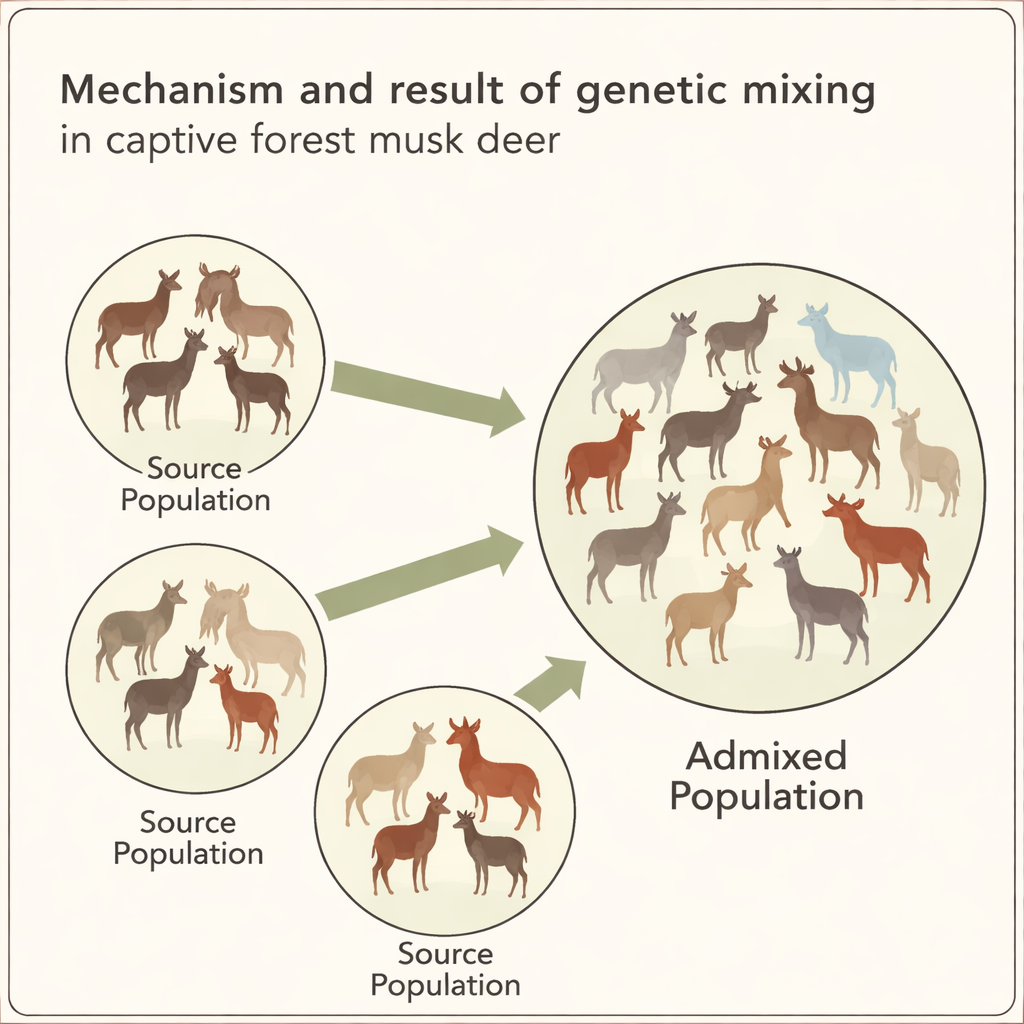
To explore this, researchers examined a new herd of forest musk deer set up in 2019 in Bianba, eastern Tibet. This herd, called BB, started with 44 animals brought in from three long‑running farms in China’s Shaanxi Province. Those source farms—PZH, TZL and GL—were founded decades ago and had been breeding mostly within their own walls. The team compared the new mixed herd with its three sources, using DNA from droppings collected from 683 individual deer in total. Because catching and handling these nervous animals can be risky, using feces allowed the scientists to work non‑invasively while still getting high‑quality genetic information.
Reading history in tiny power plants
The scientists focused on mitochondrial DNA, genetic material found in the cell’s energy‑producing structures and passed down from mothers to offspring. They read three regions of this DNA, which together act like a matrilineal family archive. Across all samples, they uncovered many different genetic variants, or haplotypes, and grouped them into three main maternal lineages. The new BB herd turned out to contain members of all three lineages, whereas some of the older farms had partially lost one or more of them. When the team measured how different individual DNA sequences were from one another, they found that the BB herd had higher nucleotide diversity than any single source herd, even though the overall number of haplotypes remained similar.
Signs of past strain and fresh mixing
By looking at patterns of variation and how often certain genetic types appear, the researchers could infer each herd’s demographic past. The older farms showed signals of historical bottlenecks—periods when only a small number of animals contributed their genes to the next generation. That kind of genetic pruning can leave a population more vulnerable to disease, stress, and environmental change. In contrast, the BB herd showed a pattern consistent with recent mixing and expansion: different maternal lineages had come together, and no single genetic type dominated. Statistical tests of genetic distances between herds confirmed that BB is now genetically distinct from its founders, reflecting a deliberate reshuffling of the gene pool rather than simple cloning of its sources.
Building a stronger safety net
These findings have direct implications for how we manage endangered animals under human care. The study shows that combining founders from multiple farms can recreate some of the genetic variety that would normally be maintained by occasional arrivals from the wild—without putting extra pressure on dwindling wild herds. At the same time, the work highlights that diversity gains can still be fragile: certain rare genetic types may vanish by chance, and genetic changes may not always translate into better survival or reproduction unless they are tracked over many generations and linked to health or behavioral data.
What this means for the future of musk deer
For a layperson, the bottom line is straightforward: when it comes to saving forest musk deer, mixing animals from different backgrounds into a single, well‑managed herd appears to produce a richer and more resilient genetic "toolbox." The new BB population carries more varied versions of key genes and a fuller spread of maternal lineages than any one source farm on its own. That gives conservationists a stronger starting point for future breeding, possible reintroductions into the wild, and for coping with climate and habitat changes. The authors argue that similar mixed‑source strategies, paired with ongoing genetic monitoring and future studies of other parts of the genome, could help many threatened species avoid the hidden trap of inbreeding while they are being saved behind fences.
Citation: Lan, X., Wang, Y., Li, Y. et al. Mixed-source introductions successfully enhance the genetic diversity of captive forest musk deer (Moschus berezovskii). Sci Rep 16, 7351 (2026). https://doi.org/10.1038/s41598-026-37358-5
Keywords: forest musk deer, captive breeding, genetic diversity, conservation translocation, mixed-source introduction