Clear Sky Science · en
Determination of mechanical properties of ceramic microspheres using an improved flat-plate crushing test and global cohesive zone modeling
Why tiny ceramic beads matter
From nuclear fuel pellets to bone repair materials and industrial grinding media, many advanced technologies rely on clouds of tiny ceramic beads—microspheres smaller than a millimeter across. These particles must survive intense squeezing, heating, and wear. If they crack too easily, nuclear fuels can leak, implants can fail, and precision tools can break down. Yet, until now, engineers have lacked a fast, reliable way to measure how strong these miniature spheres really are without cutting or reshaping them. This study introduces a new testing and computer‑modeling approach that directly crushes intact microspheres and reads their hidden mechanical properties from the way they break.
Reinventing the way we crush tiny spheres
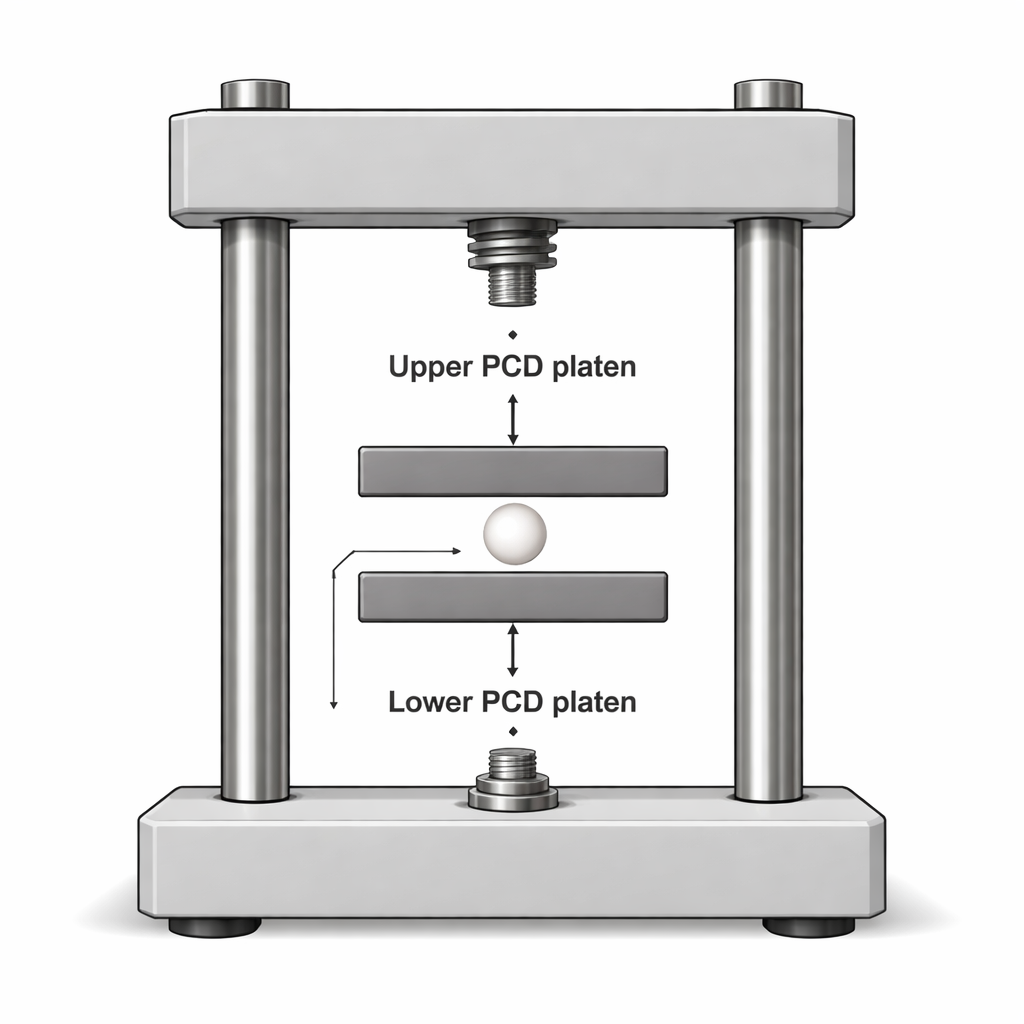
Traditional tests for ceramics usually rely on bars, plates, or specially notched balls. Those methods work for larger parts, but they struggle with sub‑millimeter spheres like nuclear fuel kernels or bone‑filler beads. Preparing samples with tiny grooves or notches is slow, expensive, and often distorts the very flaws that control failure. The authors instead refined a straightforward idea: squeeze a single ceramic microsphere between two flat plates and record how much force and movement it takes before it shatters. This “flat‑plate crushing” test sounds simple, but at very high forces the metal plates themselves can dent, slip, or roughen, blurring the results. To overcome this, the team replaced the usual metal platens with plates made of polycrystalline diamond, an extremely hard, mirror‑smooth composite that stays elastic under load and has very low friction against zirconia ceramics.
Building a precision setup for sub‑millimeter beads
With the new diamond platens, the researchers designed a compact test rig capable of measuring both force and displacement with very high accuracy. They first verified that the diamond plates themselves remained essentially undamaged by crushing much larger, 9‑millimeter ceramic balls, while conventional metal indenters showed permanent dents. Then they turned to the main targets: six groups of zirconia microspheres whose diameters ranged from 0.1 to 1.0 millimeters. For each group, they measured ten particles, carefully determining the true diameter of each bead and checking its roundness under a scanning electron microscope. The test device then squeezed each sphere until it broke, tracing detailed force–displacement curves that captured the entire journey from first contact to sudden fracture.
What the crushing curves reveal
The patterns in these curves showed that not all spheres are created equal. Even among beads of the same nominal size, the load at which they broke scattered widely, reflecting differences in internal defects and surface quality. The smallest spheres, which have the roughest geometry and highest surface‑to‑volume ratio, tended to fail at lower loads and exhibited particularly large variation. When the researchers averaged the data, they found a clear trend: the crushing load rises roughly with the square of the sphere’s diameter, and larger beads can compress more (relative to their size) before shattering. In simple terms, bigger zirconia microspheres were tougher and more resistant to crushing, likely because smaller spheres statistically contain more influential defects per unit volume, especially at their surfaces.
Letting the computer watch the cracks grow
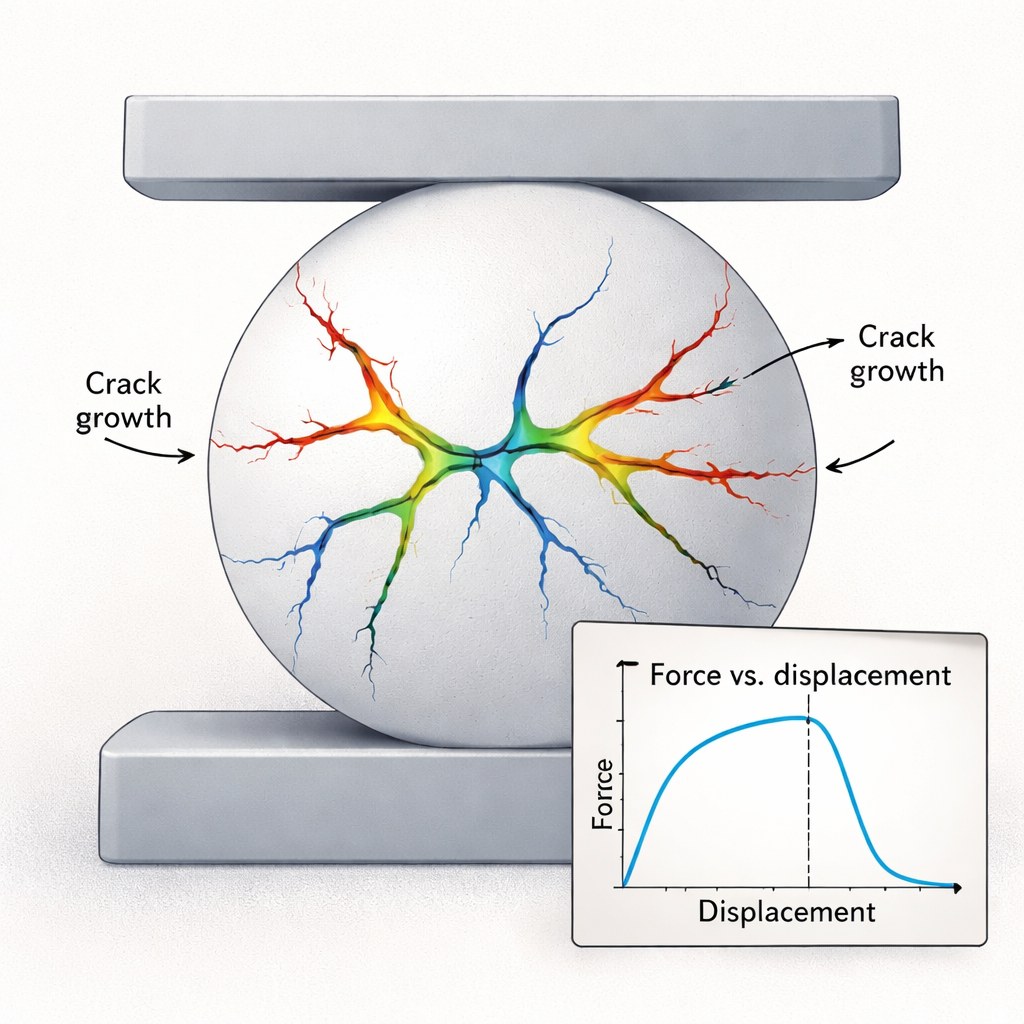
Experiments alone could not directly expose the material properties that designers care about, such as elastic stiffness and fracture toughness. To bridge that gap, the team built a detailed computer model of a zirconia microsphere trapped between two diamond plates. They divided the virtual sphere into many irregular cells using a Voronoi pattern, then inserted special “cohesive” elements along all internal boundaries to mimic how cracks start and spread. These elements follow a simple traction–separation rule: they act like tiny springs that carry load, then soften and finally fail as the local opening or sliding grows. By adjusting a small set of model parameters, the researchers tuned the simulated force–displacement curves until they closely overlapped the measured ones for real spheres.
Reading hidden toughness from a single crush
The calibrated simulations not only reproduced when and how the spheres fractured, but also mapped where strains and stresses concentrated just before failure—near the high‑pressure contact regions and along bands of tensile stress. From these models, the team extracted effective elastic modulus and fracture toughness values for the zirconia material, which matched well with ranges reported in independent studies. That agreement suggests their combined test‑and‑model method can turn a simple crushing curve into a reliable estimate of a microsphere’s mechanical properties. Although the approach still requires reasonably round particles and is not suited to high‑temperature testing, it is far easier than machining tiny notches or bars from each batch of beads. In the future, pairing this technique with machine‑learning tools to read large numbers of curves could provide manufacturers and reactor designers with a rapid screening tool, helping them select or improve ceramic microspheres that are strong enough for some of the most demanding environments on Earth.
Citation: Ma, H., Lv, J., Zhou, Y. et al. Determination of mechanical properties of ceramic microspheres using an improved flat-plate crushing test and global cohesive zone modeling. Sci Rep 16, 6122 (2026). https://doi.org/10.1038/s41598-026-37357-6
Keywords: ceramic microspheres, zirconia, crushing test, fracture toughness, cohesive zone modeling