Clear Sky Science · en
Research on structural damage identification based on temporal power flow graph network
Why the Health of Big Structures Matters
Bridges, high-rises, and other large structures quietly carry our daily lives, but over years of traffic, wind, and weather they slowly wear out. Engineers try to spot hidden cracks or loosened joints before they become disasters, yet traditional inspection can be costly, slow, and occasionally miss early warning signs. This study introduces a new way to “listen” to structures as they vibrate, using a physics-guided artificial intelligence system that can reveal subtle damage without needing labeled examples of failure.
Listening to Vibrations as Early Warnings
When a bridge or frame is shaken by wind or traffic, it vibrates in complex patterns. Engineers often attach small motion sensors (accelerometers) at many points to record these vibrations. Damage such as cracking or corrosion usually changes how stiff a component is, which in turn alters how vibration energy moves through the structure. Many recent methods use deep learning to sift through these signals and flag anomalies. However, most of these tools treat the data purely as numbers to be fit, without building in the underlying physics. They can perform well on clean laboratory data, but in the real world—with noise, changing temperatures, and occasionally faulty sensors—the same models may give false alarms or miss true problems.
Turning a Structure into a Network of Energy Flow
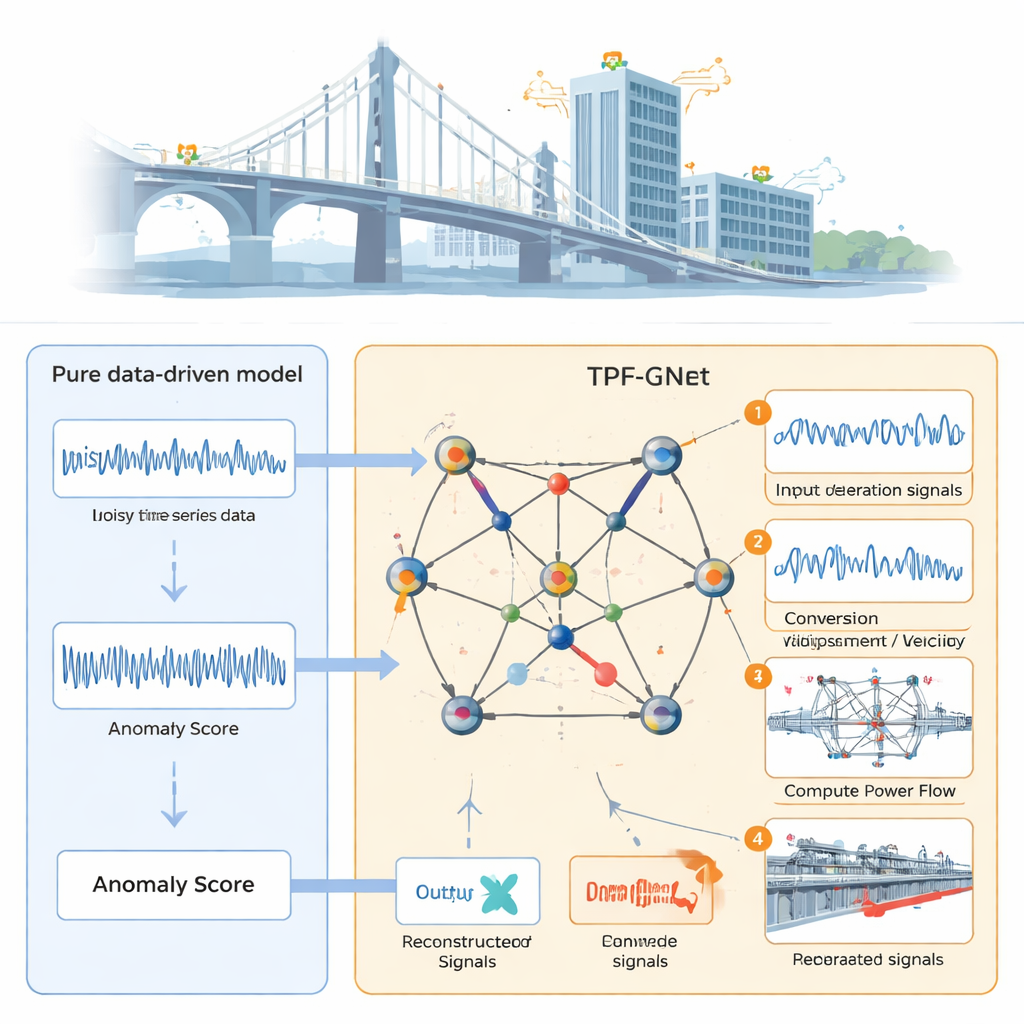
The authors propose a different strategy: represent the structure as a network of connected points and explicitly track how vibration energy flows between them over time. In their Temporal Power Flow Graph Network (TPF-GNet), each sensor becomes a node in a graph, and each physical link between components becomes an edge with learnable stiffness and damping. By numerically integrating sensor accelerations, the method recovers velocity and displacement and then calculates the instantaneous power flow—how much mechanical energy is moving from one node to another at each moment. This power flow becomes the core message passed along the graph, so the model learns patterns that respect the laws of motion rather than just fitting statistics.
Teaching the Network What “Healthy” Looks Like
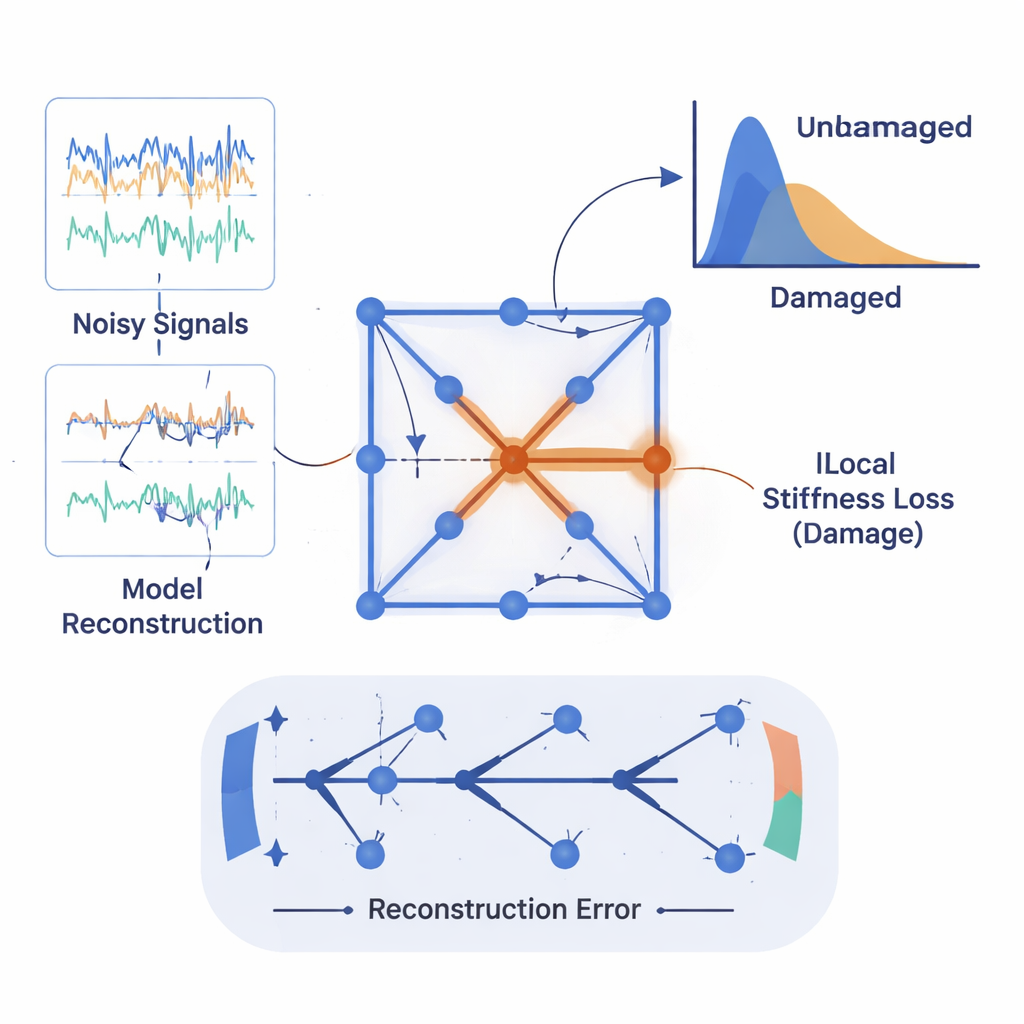
TPF-GNet is trained only on data from a healthy structure, without any examples of damage. In this training phase, the model learns to reconstruct the vibration history of each target sensor from its neighbors by simulating the flow of energy across the network. Once trained, the system receives new vibration data from a structure whose condition is unknown. If the structure is still healthy, the model can predict each sensor’s motion quite accurately, and the reconstruction errors stay small and narrowly distributed. If damage has occurred—especially stiffness loss in a beam or column—the true energy flow now deviates from what the model expects, and reconstruction errors become larger and more spread out. The authors summarize this change with a single damage-sensitive factor derived from how wide and flat the error distribution becomes, and they set thresholds using only healthy data.
Testing on Virtual Bridges and Real Frames
To test their approach, the researchers first used a detailed computer model of a real pedestrian bridge, introducing different levels and locations of stiffness reduction while simulating noisy sensor measurements. They also compared TPF-GNet against a standard graph neural network and a time-series model (LSTM) that lacked explicit physics. Across thirty scenarios—including small 5–10% stiffness losses and challenging noise types like low-frequency drift and non-stationary disturbances—the new method consistently identified damage more accurately, with lower false alarm rates. In many cases, TPF-GNet maintained over 90% detection accuracy where the comparison models dropped near or below 70%. The team then validated the method on a scaled laboratory frame structure equipped with sixteen sensors, where they could introduce controlled damage to selected beams and columns. Again, the largest reconstruction errors and damage factors clustered around the truly damaged components, and performance improved steadily as the damage severity increased.
What This Means for Safer Structures
For a non-specialist, the key takeaway is that this method fuses the strengths of physics and machine learning: it does not just look for patterns in data, it also “knows” how energy should flow through a healthy structure. When reality departs from this expectation, the system flags trouble spots, even under noisy, real-world conditions. Because it requires only healthy baseline data, it is well suited to the many bridges and buildings where we have years of monitoring records but no labeled examples of failure. If adopted widely, approaches like TPF-GNet could help infrastructure owners catch damage earlier, prioritize maintenance more intelligently, and extend the safe service life of critical structures.
Citation: Wu, X., Lan, C., Zhang, C. et al. Research on structural damage identification based on temporal power flow graph network. Sci Rep 16, 6898 (2026). https://doi.org/10.1038/s41598-026-37356-7
Keywords: structural health monitoring, bridge damage detection, physics-informed AI, graph neural networks, vibration sensing