Clear Sky Science · en
Enhancing the shear strength of reinforced concrete deep beams using thin-diameter near-surface mounted steel wires: an experimental study
Stronger beams for safer everyday structures
Buildings, bridges, and parking garages all rely on thick concrete beams to carry heavy loads. When these “deep beams” crack suddenly in shear, the results can be catastrophic and costly to repair. This study explores a simple, low-cost way to make such beams much safer: adding thin steel wires just beneath the concrete surface. By testing how different wire patterns change cracking and failure, the researchers show how a modest upgrade could extend the life and reliability of existing structures.
Why deep beams are a weak link
Deep reinforced concrete beams behave differently from the more slender beams found in many design textbooks. Because of their short span and large depth, forces travel through them along compressed diagonal paths called “struts,” rather than spreading evenly like a bending plank. When these diagonal struts crack in shear, failure can be sudden and brittle, leaving little warning. Conventional fixes—adding more internal stirrups or stronger concrete—are not always practical for existing structures, and modern fiber-based materials, while effective, can be costly, sensitive to heat, or difficult to bond reliably to old concrete. Engineers therefore need strengthening methods that are robust, affordable, and easy to install on real-world projects.
A new twist: thin wires just under the surface
The team investigated a variation of a known strengthening approach called near-surface mounted (NSM) reinforcement. Instead of using thick steel bars or fiber-reinforced strips glued to the outside, they cut very shallow grooves into the outer faces of the beam and placed 2.5-millimeter steel wires inside, then filled the grooves with a strong epoxy. These thin wires are flexible, inexpensive, and require only small cuts in the concrete cover, which makes them attractive for retrofitting existing beams. The researchers cast eleven identical deep beams and loaded them in a three-point bending setup. One beam served as a control, while the others were strengthened on one shear span using vertical, horizontal, diagonal, or mesh (grid-like) wire layouts, with different numbers of wires in each pattern. 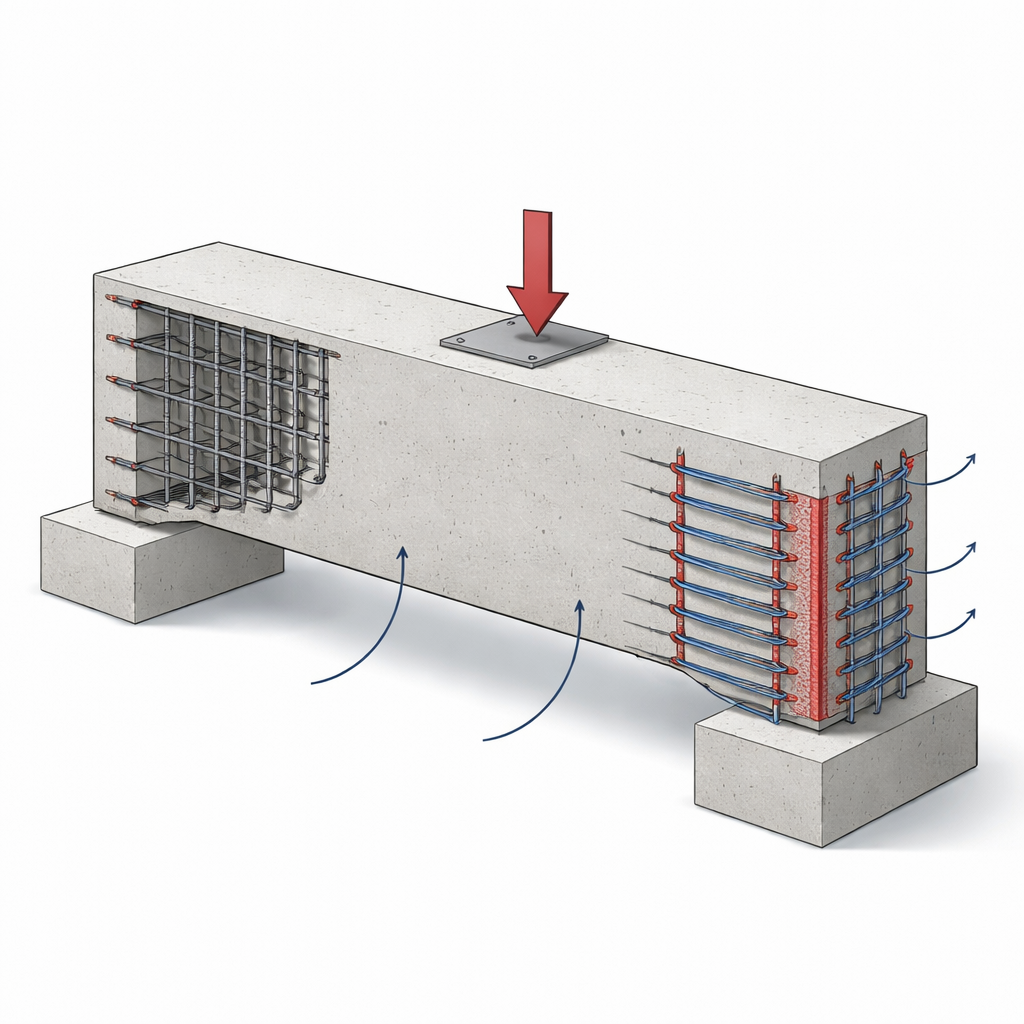
How the beams behaved under load
As the beams were gradually loaded, the team tracked how cracks formed, how much the beams deflected, and how much load and energy each could carry before failing. The unstrengthened control beam developed a single major diagonal crack and failed abruptly in shear at a load of 220 kilonewtons. Adding vertical wires improved matters: by intersecting the diagonal cracks, they raised shear capacity by up to 50 percent but also made the beam stiffer and less able to deform before failure. Horizontal wires had the smallest effect, because they ran mostly parallel to the main diagonal crack; even in the best case, they increased capacity by about one third and did not change the failure mode very much. In contrast, diagonal wires—aligned with the natural strut inside the beam—were particularly effective. The most heavily reinforced diagonal specimen carried about 62 percent more load than the control and absorbed over 170 percent more energy before failure, with cracks becoming finer and more evenly spread.
The power of a simple wire mesh
The standout performer was the mesh configuration, which combined several vertical and horizontal wires in a small grid over the shear-critical region. This simple pattern confined the diagonal compression zone from multiple directions and produced the most refined crack network. The mesh-strengthened beam reached an ultimate load about 59 percent higher than the control and more than doubled its energy absorption, while also showing the highest stiffness of all specimens. In several of the best layouts, the failure shifted away from the strengthened span to the opposite, unreinforced side of the beam, a clear sign that the wires had successfully stabilized what had been the weak link. 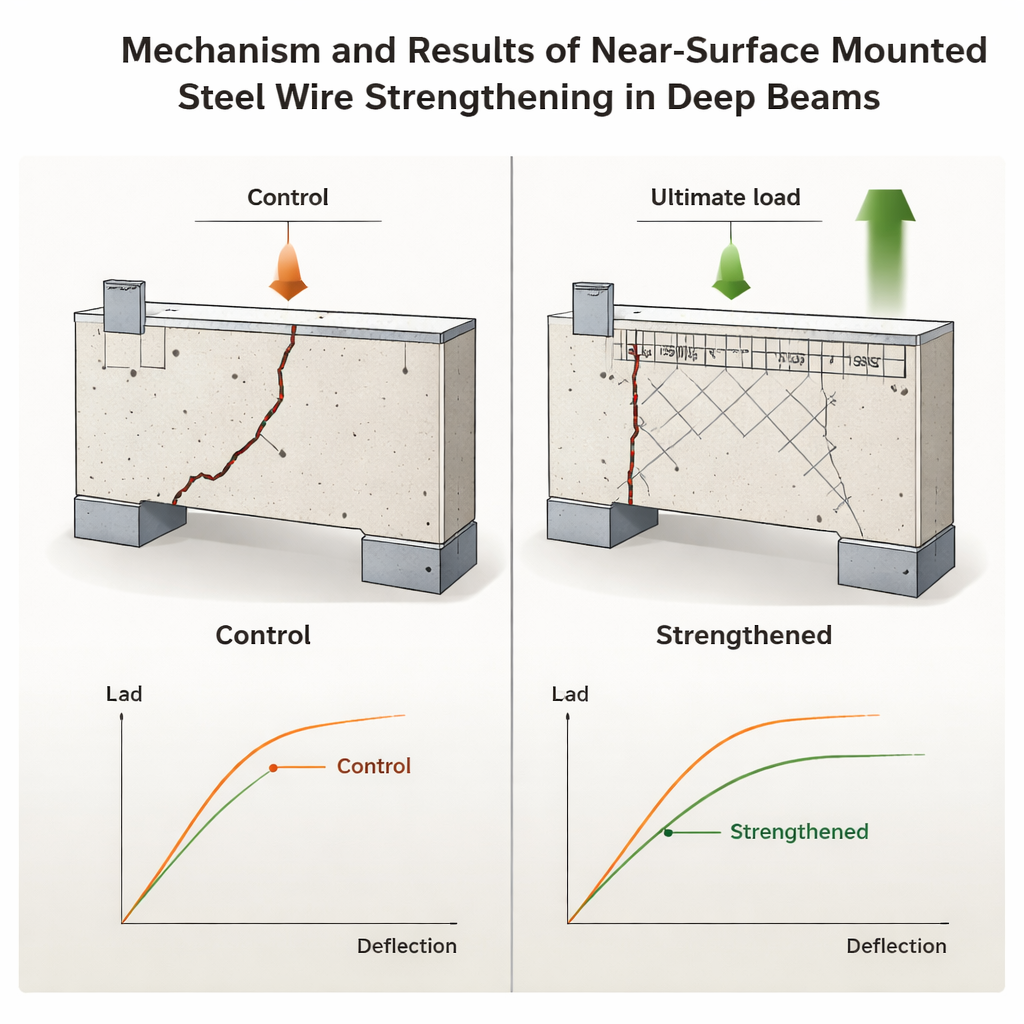
What this means for real structures
To a non-specialist, the key message is that thin, inexpensive steel wires, carefully arranged just beneath the surface of a concrete beam, can dramatically improve how that beam cracks and fails. When placed diagonally or as a simple mesh, these wires help the beam carry more load, resist sudden diagonal cracking, and dissipate more energy before failure, all while requiring only shallow grooves and modest amounts of material. The study suggests that near-surface mounted wire systems could become a practical, cost-effective tool for strengthening aging bridges and buildings, offering engineers a new way to make everyday infrastructure safer without major reconstruction.
Citation: Elkafrawy, M., Altobgy, M.A. & Fayed, S. Enhancing the shear strength of reinforced concrete deep beams using thin-diameter near-surface mounted steel wires: an experimental study. Sci Rep 16, 7186 (2026). https://doi.org/10.1038/s41598-026-37355-8
Keywords: reinforced concrete, shear strengthening, deep beams, near-surface mounted reinforcement, steel wires