Clear Sky Science · en
Scaled up fed-batch production of recombinant alpha-1-antitrypsin by CHO cells in single-use surface aerated orbital shaken bioreactor
Why this protein matters to patients
Alpha-1-antitrypsin (A1AT) is a protective protein that helps shield our lungs and other organs from damage caused by inflammatory enzymes. People born with A1AT deficiency can develop early, severe lung disease and other complications. Today, their main treatment is regular infusions of A1AT purified from human blood donations—a life‑long, costly therapy that depends on a limited supply of plasma. This study explores how to make A1AT in a controlled, factory‑like cell culture system, which could one day provide a more reliable and scalable source of this important medicine.
From blood donations to cell-based factories
Current A1AT therapy relies on proteins extracted from donated human plasma. Besides being expensive, this approach is vulnerable to supply shortages and carries a residual risk of transmitting viruses. At the same time, scientists keep discovering new potential uses for A1AT, including calming harmful inflammation, protecting transplanted organs, and helping in conditions such as diabetes, arthritis, heart attack, stroke, and acute liver failure. All of this increases demand. To break the dependence on human donors, researchers want to manufacture recombinant human A1AT (rhA1AT)—the same human protein, but produced by engineered cells grown in bioreactors.
Why CHO cells and shaken plastic tanks
The team chose Chinese hamster ovary (CHO) cells, the workhorse of modern biopharmaceutical manufacturing. CHO cells grow well in large, serum‑free suspension cultures, add human‑like sugar patterns to proteins, and secrete the product directly into the culture medium, simplifying purification. Instead of traditional stainless‑steel stirred tanks, the researchers used a single‑use, orbitally shaken bioreactor (SB10‑X). This system is essentially a large, sterilized plastic container rocked in a circular motion while gas flows over the liquid surface. Compared with mechanically stirred tanks, these shaken systems are simpler to install, cheaper to run at small scales, and gentler on shear‑sensitive cells, while still resembling the mixing and aeration conditions of standard shake flasks used in early experiments. 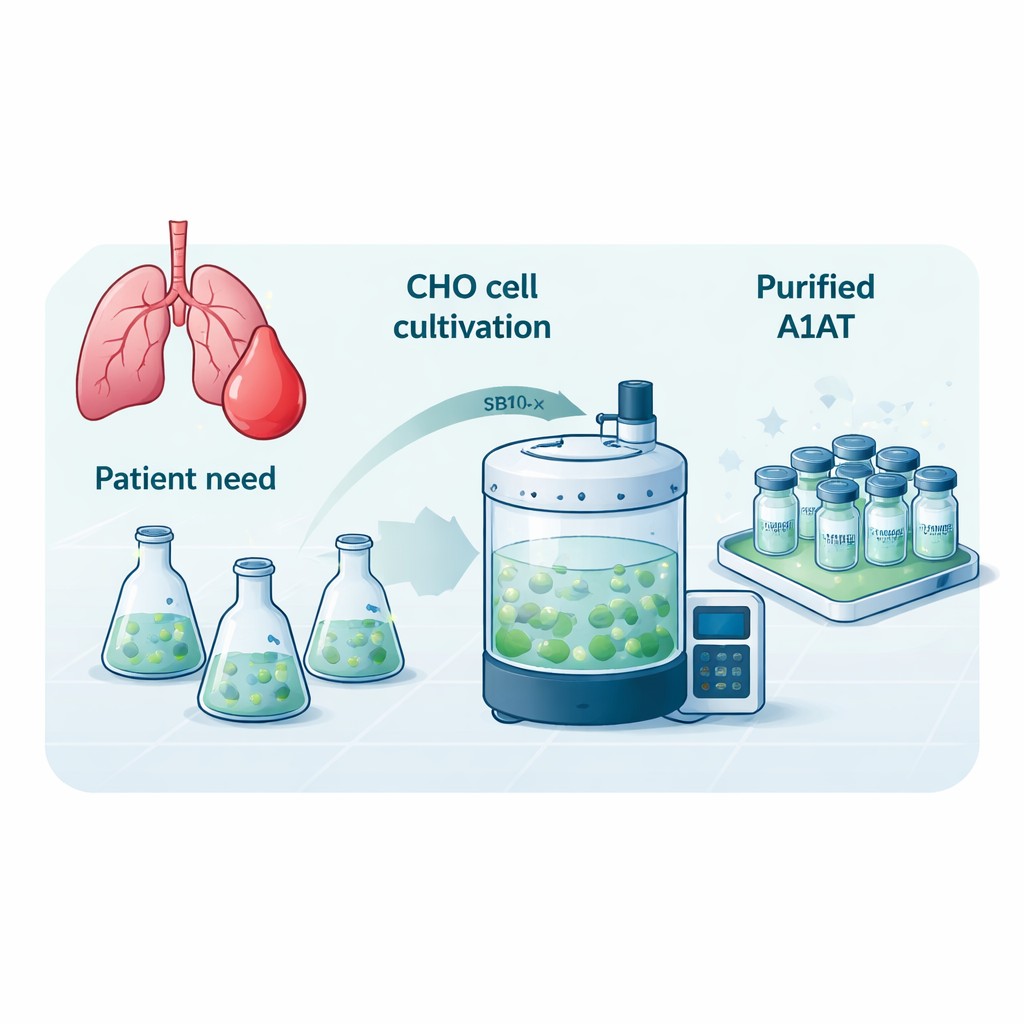
Picking a champion cell line
Starting from previously engineered CHO cells that produce rhA1AT, the researchers isolated ten individual “single cell clones” and monitored them for three months. For each clone, they measured how fast the cells grew and how much A1AT each cell made over time, both with and without a common selection drug (methotrexate). While some clones produced more protein, they tended to grow more slowly. One clone—named Clone 2—offered a good compromise: it grew relatively fast and maintained stable, respectable A1AT output over 12 weeks. Based on these combined traits, Clone 2 was chosen for scale‑up and further process development.
Scaling up and tuning the cell environment
Using Clone 2, the team first ran fed‑batch cultures in standard shake flasks, where cells are given extra nutrients over time to boost yields. They then transferred the same process to a 10‑liter SB10‑X single‑use shaken bioreactor. In both cases, cells reached high densities, but the bioreactor achieved up to about 20% higher peak A1AT levels than flasks, thanks to better control of oxygen and pH. The cell‑specific productivity—how much protein each cell makes per day—was similar between systems (around 10–12 picograms per cell per day), confirming that the process can be scaled without losing performance. The scientists also closely tracked nutrients like glucose and glutamine, and waste products like lactate and ammonium. By lowering the starting glutamine level in the second bioreactor run, they cut ammonium buildup roughly in half without hurting productivity, although this led to more lactate, underscoring the need to carefully balance nutrients and by‑products. 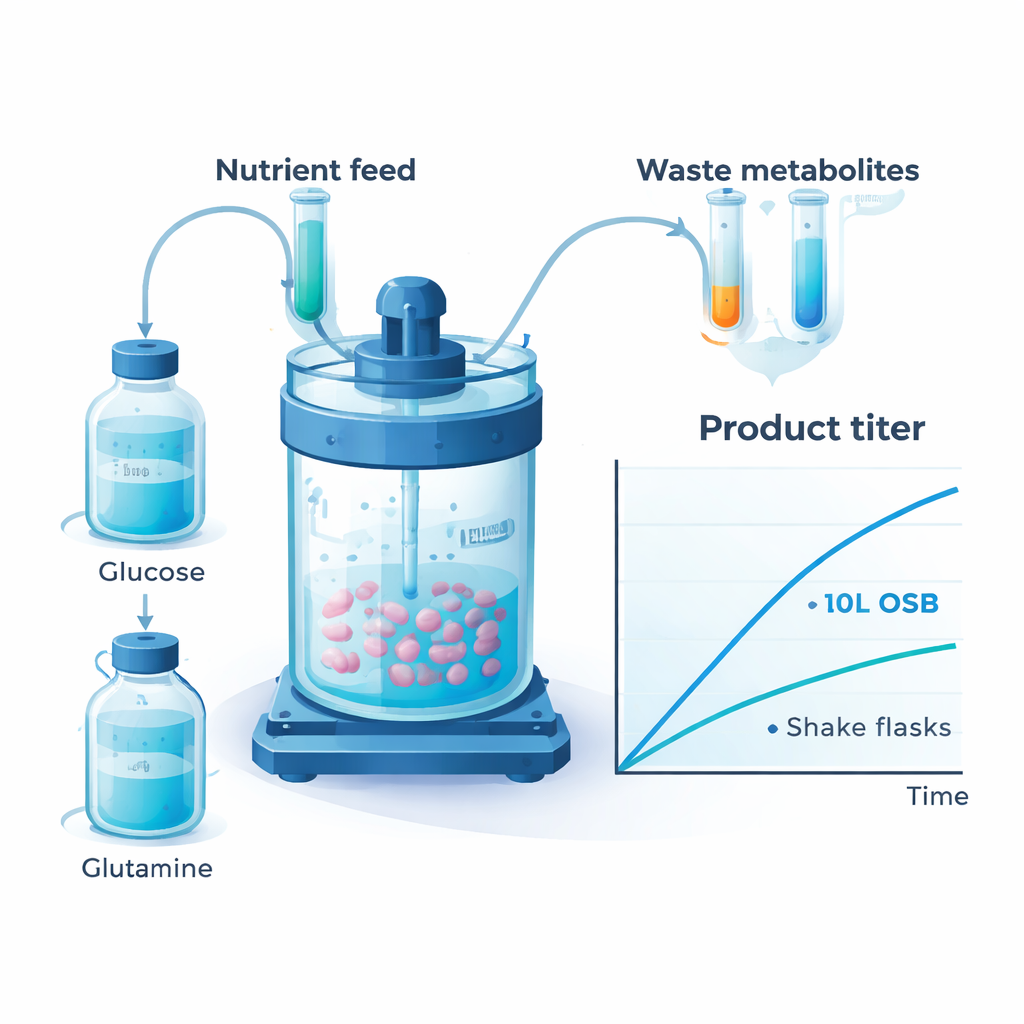
Making a safe, functional final product
Once harvested, the rhA1AT was clarified and purified through two chromatography steps, yielding a single, clean protein peak by HPLC and about 70% overall recovery. Importantly, the biological activity of the protein—its ability to inhibit elastase, the damaging lung enzyme—rose from roughly one‑third active in the starting material to about two‑thirds active after the first purification step and stayed high thereafter. The team also tested how well rhA1AT tolerates acidic conditions that are often used to inactivate viruses in antibody manufacturing. They found that the protein is stable near neutral pH but loses recoverable material at lower pH values, suggesting that standard low‑pH viral inactivation would damage the product and that alternative virus‑removal or inactivation strategies are needed.
What this means for future therapies
In plain terms, this work shows that it is technically feasible to grow engineered CHO cells in disposable, gently shaken bioreactors to produce medically relevant amounts of active alpha‑1‑antitrypsin. While further optimization—such as better feeding strategies, temperature or pH shifts, and metabolite control—could raise yields even more, the study establishes a scalable, flexible platform that could ease reliance on plasma‑derived A1AT. If translated and expanded successfully, such processes may help secure a steadier, safer, and potentially more affordable supply of A1AT for people with genetic deficiency and for new therapeutic uses now being explored.
Citation: Tang, W.Q., Jiang, C.Q.Z., Zheng, Z.Y. et al. Scaled up fed-batch production of recombinant alpha-1-antitrypsin by CHO cells in single-use surface aerated orbital shaken bioreactor. Sci Rep 16, 7790 (2026). https://doi.org/10.1038/s41598-026-37353-w
Keywords: alpha-1-antitrypsin, CHO cells, bioreactor, recombinant protein, biologics manufacturing