Clear Sky Science · en
Mediation role of artificial intelligence exposure in adverse childhood experiences: related mental health risks among college students
Why early life and smart tools matter
Many college students carry invisible scars from difficult childhoods—such as abuse, neglect, or growing up in a troubled home. At the same time, they are among the heaviest users of artificial intelligence, from chatbots used for study help to AI companions for late-night conversations. This study asks a very current question: when students with painful early experiences lean on AI, does it ease their burden—or quietly add to their mental strain?
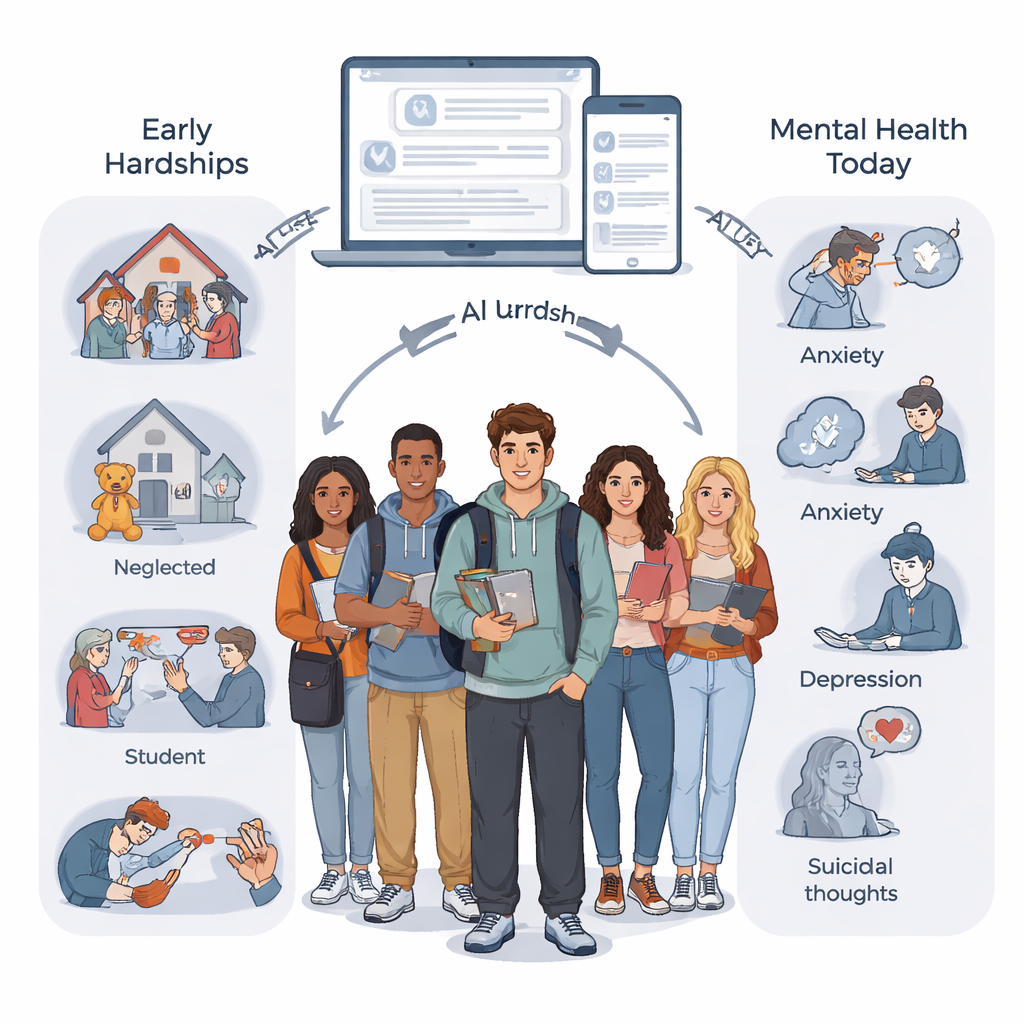
Growing up with hardship
The researchers focused on “adverse childhood experiences,” or ACEs—events like violence, emotional or physical neglect, and serious problems within the family before age 18. Earlier work has shown that the more of these events someone faces, the higher their risk of anxiety, depression, and even suicide attempts later in life. In worldwide surveys, a large share of adults, and an even higher share of teenagers, report at least one such hardship. In China, where this study took place, previous research suggests that over half of college students have lived through at least one ACE. These are not rare exceptions but a common backdrop to young adulthood.
Students, surveys, and screen time
To explore how AI fits into this picture, the team surveyed 2,736 students from three universities in Jiangxi Province, China, in 2025. Students answered detailed questions about their childhood experiences, current levels of stress, anxiety, depression, loneliness, sleep quality, and suicidal thoughts. They also reported how much time they spent each day using AI for three purposes: learning or work (such as writing papers or programming help), social interaction (chatting or seeking companionship from AI), and entertainment (gaming or creative play with AI). The researchers then used statistical techniques to fairly compare students with and without ACEs, making the two groups similar in age, gender, major, and other background factors.
Heavy burdens and digital coping
The results confirmed a sobering pattern: students who had lived through childhood adversity showed higher levels of loneliness, stress, anxiety, depression, and suicidal thoughts, and they slept worse than their peers. But the study went further by examining the role of AI. It found that using AI for social interaction—not for schoolwork—was tied to poorer mental health. Students who spent more time chatting with AI or seeking virtual companionship tended to feel more depressed, more anxious, more stressed, more lonely, and reported more suicidal thoughts. AI used mainly for learning or work showed no clear link to mental health, and AI used for entertainment was associated only with anxiety, not with the other problems.
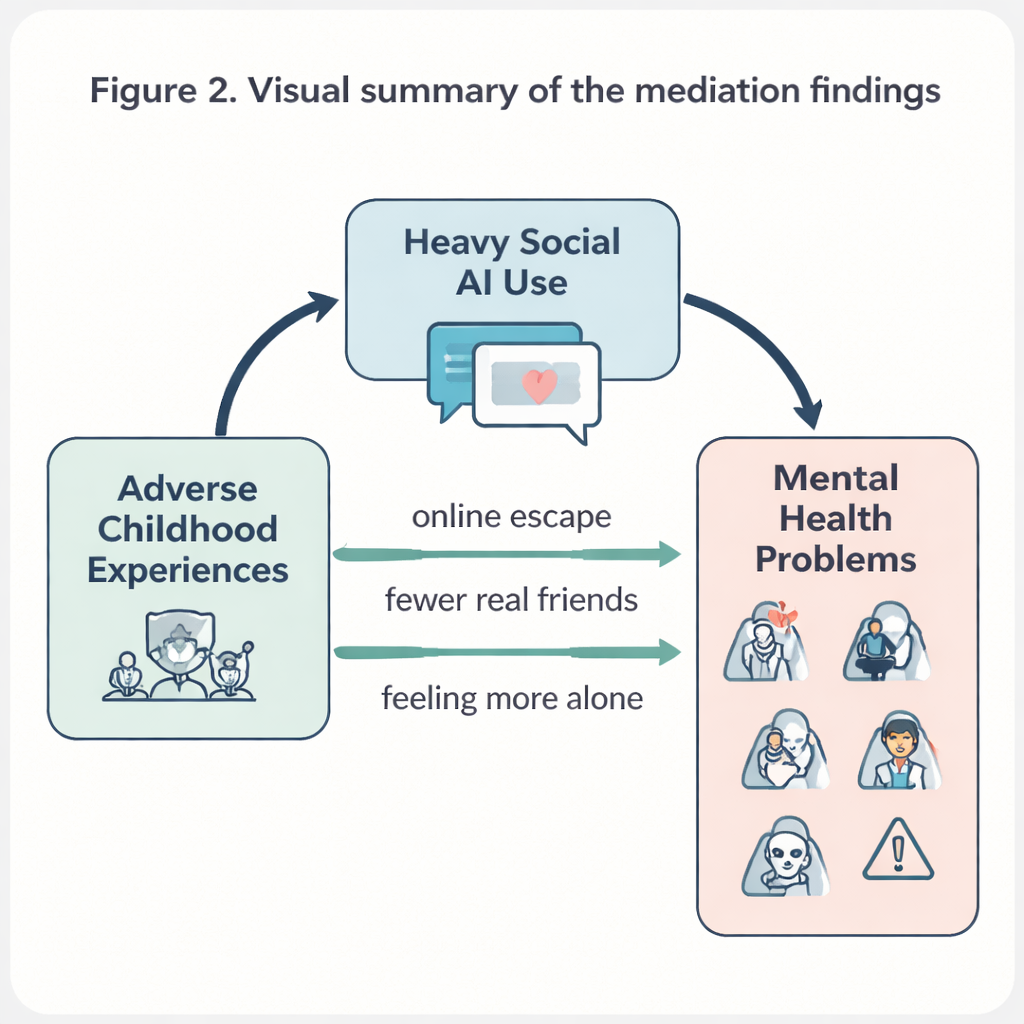
When online comfort deepens the hurt
Using a method called mediation analysis, the researchers tested whether social AI use acts as a kind of bridge carrying part of the impact of early hardship into current mental health. They found that it does—but only partially. For students with ACEs, heavier social AI use explained a small but meaningful slice of their higher loneliness, stress, anxiety, depression, and suicidal thoughts. In other words, painful childhoods still had a strong direct effect on mental health, but some students also seemed to be coping by turning to AI companionship, which, instead of healing their wounds, was linked with feeling even worse. The pattern suggests a cycle: early harm makes social life harder, students retreat into safer AI-based conversations, and this digital escape may increase isolation rather than reduce it.
What this means for students and helpers
For a general reader, the takeaway is not that AI is “bad” but that how we use it matters, especially for young people already at risk. In this study, nearly three in ten students reported adverse childhood experiences, and those students were more likely to be struggling emotionally. Social AI seemed to slightly amplify their problems rather than relieve them. The authors argue that mental health programs should pay attention to patterns of AI use, helping students build real-world support and guiding them toward healthier ways of using digital tools. Thoughtfully designed, therapeutic AI might still offer benefits. But everyday chatbots, used as a substitute for human connection, may quietly deepen loneliness and distress in those who have already been hurt the most.
Citation: Wang, Y., Lv, M., Huang, R. et al. Mediation role of artificial intelligence exposure in adverse childhood experiences: related mental health risks among college students. Sci Rep 16, 6278 (2026). https://doi.org/10.1038/s41598-026-37352-x
Keywords: adverse childhood experiences, college student mental health, social AI use, loneliness and anxiety, digital coping