Clear Sky Science · en
Establishment and application of safety evacuation scheme evaluation model with entropy weight and TOPSIS for university dormitories in China
Why dorm safety escapes matter to everyone
For many students, the dormitory is more than a bedroom; it is where they sleep, study, and socialize. When a fire or earthquake strikes, crowded hallways, cluttered rooms, and confusing exits can turn a familiar building into a maze of danger. This study looks at how to judge whether a university dorm is truly ready for an emergency, using a data-driven method tested in Chinese campuses that could guide safer designs and better drills worldwide.
Life inside packed student housing
Modern university dormitories in China house large numbers of young people, often four to six students to a room in long, multi-story blocks. The buildings are busy almost around the clock, with students of different ages, abilities, and familiarity with the campus. Such high density, combined with narrow corridors, limited exits, and personal belongings spilling into passageways, makes rapid evacuation a serious challenge. Past dormitory fires and other incidents have shown that poor route design, weak management, and lack of training can quickly place lives at risk, despite official safety codes on paper.
Turning messy reality into measurable factors
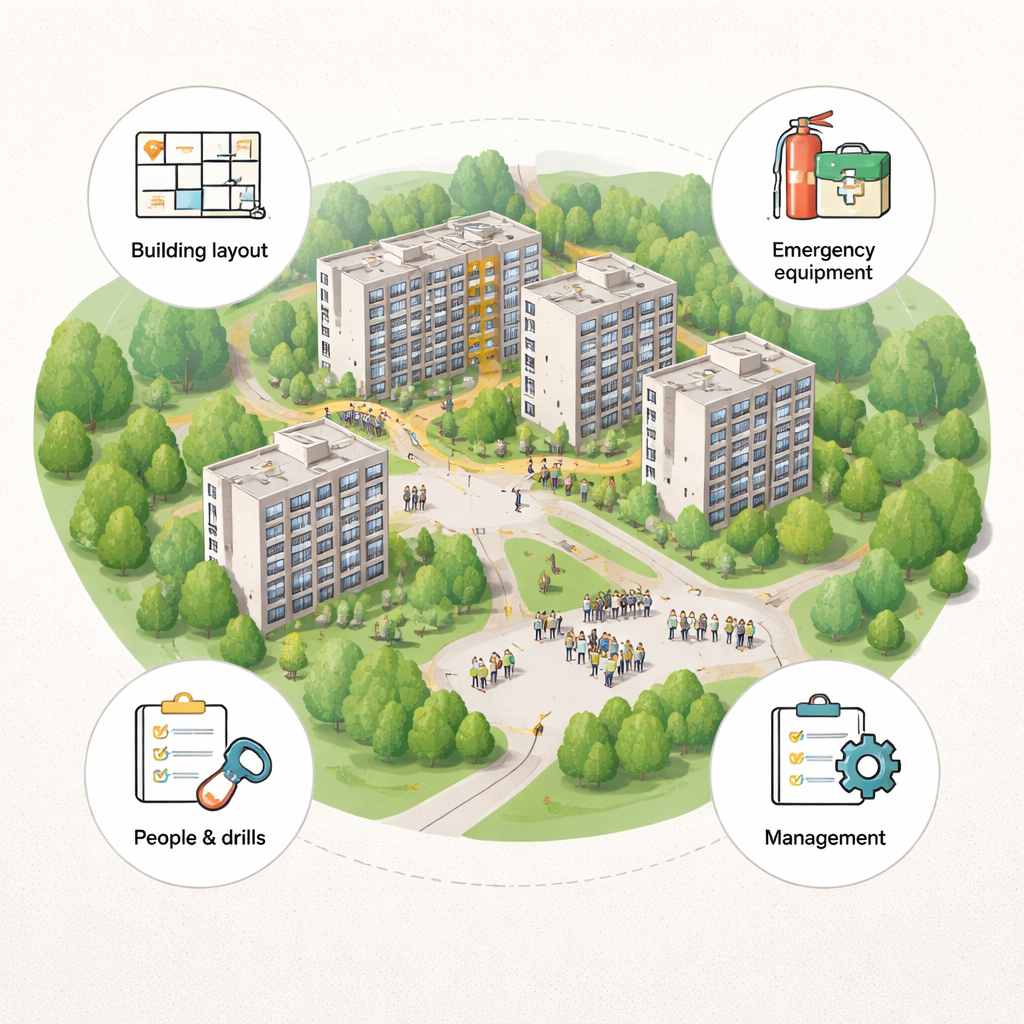
Most evacuation plans still rely on broad rules and expert opinion, which can be inconsistent or overlook local details. The authors set out to build a clearer, more objective way to compare different dormitories and their evacuation schemes. They created an indicator system with three levels: an overall goal (how effective and safe evacuation really is), seven major dimensions, and 32 specific, measurable items. These span the size and shape of the building, corridor width and exit numbers, fire and first-aid equipment, student and staff preparedness, management practices, and how quickly people can leave and return to normal after an emergency. The indicators were refined through site visits, interviews with dorm managers and emergency planners, and surveys of residents, to reflect real everyday conditions rather than idealized designs.
Letting the data decide what matters most
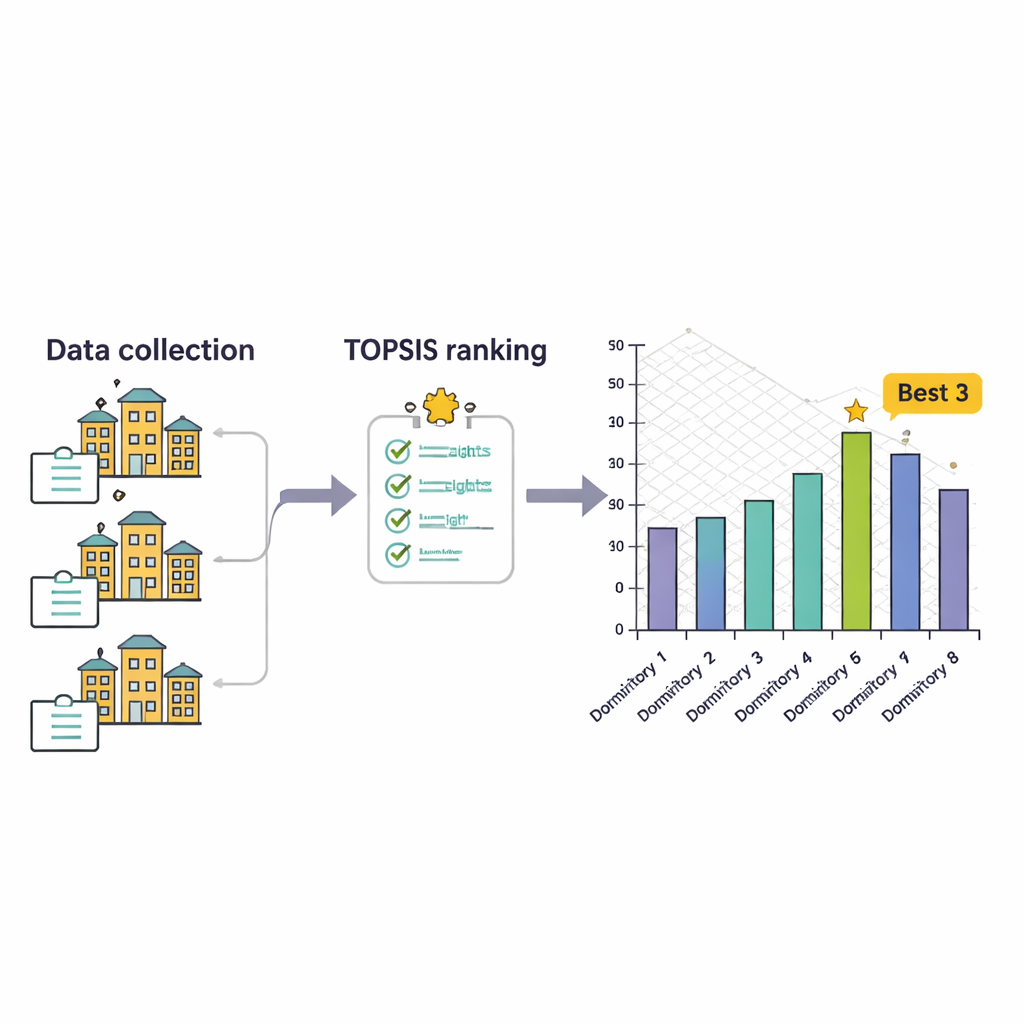
Instead of asking experts to guess which indicators are most important, the study uses an information tool called the entropy weight method. In simple terms, the more an indicator varies across dormitories, the more information it carries about differences in safety performance, and the higher its weight. This avoids some of the bias and inconsistency found in traditional scoring systems. Once each indicator’s weight is determined, another method, known as TOPSIS, compares the dormitories with an imaginary “ideal” case (where all indicators are as good as possible) and a “worst” case. By calculating how close each real dormitory is to these two extremes, the method assigns a single score and ranking that summarizes its overall evacuation readiness.
What eight real dormitories revealed
The researchers tested their model on eight dormitories in Chengdu, China, collecting data from blueprints, on-site measurements, safety inventories, drills, and management records. They entered information such as corridor widths, number of exits, fire extinguisher coverage, emergency lighting, student cooperation, drill frequency, and evacuation times into their model. One dormitory, labeled #6, emerged as the top performer: it had wider passages, more exits, better-maintained fire and first-aid equipment, frequent staff and student training, and shorter evacuation and recovery times. Dormitory #5, in contrast, ranked lowest, with weaker equipment maintenance and less use of modern information technology, even though its basic structure was not the worst. The authors also ran sensitivity tests—nudging the weights up and down—and found that the rankings remained stable, suggesting the method is robust rather than fragile.
Practical lessons for safer campuses
The findings translate into several concrete lessons. Physical design still matters: wider corridors, enough exits, and clear, unobstructed routes greatly reduce congestion in a crisis. But equipment and people are just as important. Complete and well-maintained emergency lighting, clear signage, sprinkler coverage, and accessible first-aid kits all improve outcomes. Regular drills, staff training, and good communication between students and managers further strengthen preparedness. The model also highlights how integrated planning—aligning building layout with management practices and, increasingly, with digital tools like surveillance and real-time tracking—can make a decisive difference.
What this means for students and universities
For a lay reader, the central message is straightforward: dorm safety is not just about having fire doors and extinguishers; it is about how buildings, equipment, people, and management work together under stress. By using objective data rather than guesswork, the evaluation model developed in this study helps universities pinpoint which dorms are truly ready for an emergency and which need urgent improvement. Although it was built for Chinese campuses, the approach could be adapted anywhere, giving parents, students, and administrators a clearer way to ask: if the alarm sounds tonight, how quickly and safely can everyone get out?
Citation: Huang, Y., Lu, S., He, Z. et al. Establishment and application of safety evacuation scheme evaluation model with entropy weight and TOPSIS for university dormitories in China. Sci Rep 16, 6824 (2026). https://doi.org/10.1038/s41598-026-37350-z
Keywords: university dormitory safety, emergency evacuation, fire safety planning, student housing design, risk assessment model