Clear Sky Science · en
Intelligent decision-making for mine ventilation systems based on graph neural network and deep reinforcement learning fusion
Smarter Air for Safer Mines
Deep underground, miners depend on a constant flow of fresh air to dilute dangerous gases and control temperature. Traditionally, engineers adjust huge fans and vents using rules of thumb and periodic measurements—a slow process that can waste energy or, in the worst case, miss a hazardous buildup of gas. This paper explores how a new kind of artificial intelligence can watch the mine’s "breathing" in real time and automatically fine‑tune the airflow, improving both safety and energy use.
Why Mine Airflow Is Hard to Control
Modern coal mines resemble underground cities, with dozens of tunnels, intersections, and working faces connected in a tangled network. Air pushed in by giant fans must navigate this maze, splitting and rejoining as it encounters changing tunnel shapes, moving equipment, and unpredictable gas emissions from the rock. Old‑style control schemes treat the system as a set of isolated points and rely heavily on human experience. They struggle to keep up when the network layout changes or when gas levels spike unexpectedly, and they rarely achieve the best balance between safety and power consumption.
Turning Tunnels into a Digital Map
The authors tackle this challenge by first turning the entire ventilation system into a mathematical map, or graph. In this map, nodes stand for junctions, fans, and work areas, while links represent tunnels with properties such as length, cross‑section, and resistance to airflow. Sensor readings—air pressure, gas concentration, temperature, and humidity—are attached to the nodes and links. A specialised neural network designed for graphs then scans this structure and learns how conditions in one part of the mine influence the rest. By using a multi‑level representation, the system can see both local details near a working face and global patterns across the whole mine at once. 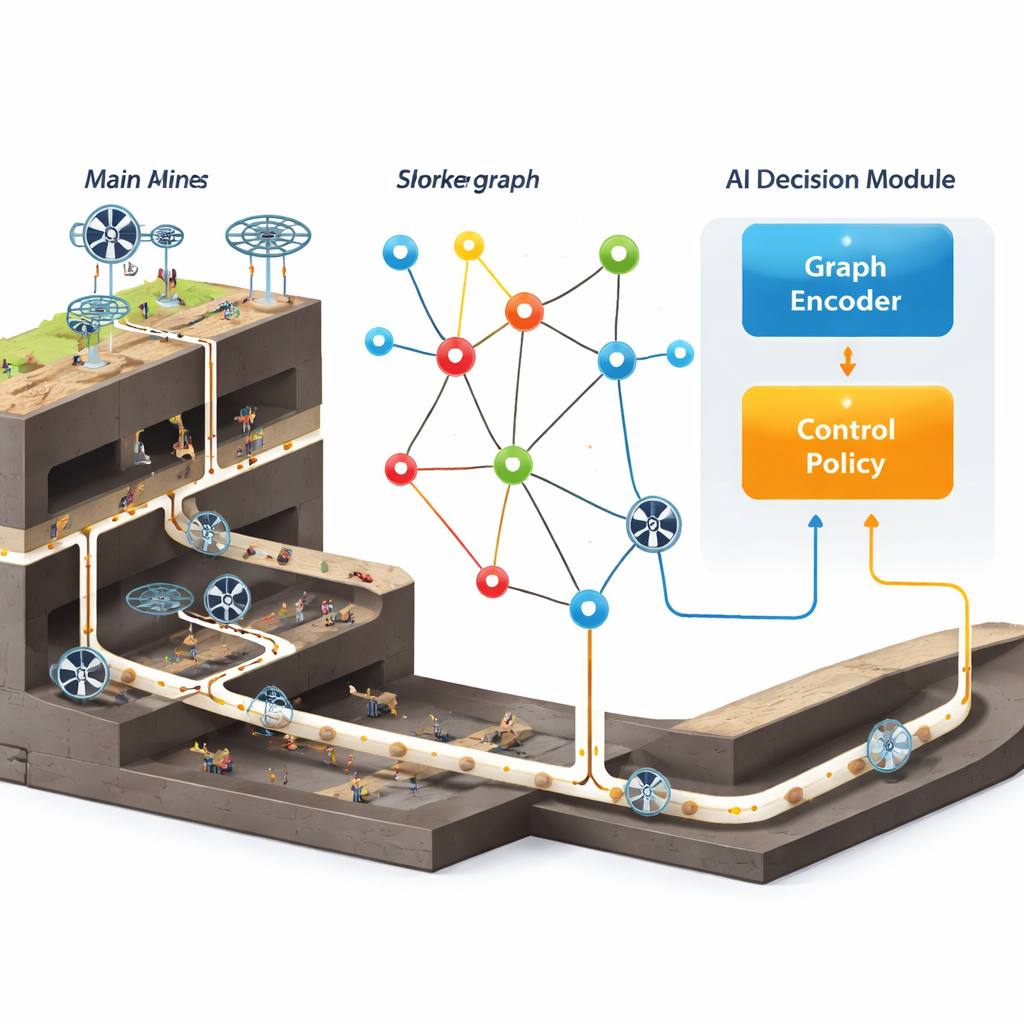
Teaching an AI to Steer the Air
On top of this graph‑based view, the researchers build a reinforcement learning agent—software that learns by trial and error. The agent experiments, at first in a high‑fidelity simulator, with different settings for fan speeds and vent openings. For each set of actions it receives a reward that reflects three goals: keeping gas levels safely low, delivering comfortable air conditions, and minimizing electricity use. An enhanced "actor‑critic" design, together with a smart memory that replays the most informative experiences, helps the system learn reliable control policies without crossing safety limits. Over time, the AI discovers patterns that human operators would struggle to see, such as how a small change in a distant regulator can relieve a gas hotspot elsewhere.
From Computer Model to Working Mine
To see whether this approach works in the real world, the team tested it on data from a deep coal mine in China with more than 150 monitored locations and over 200 connected tunnels. After training in simulation, the system was deployed alongside the mine’s supervisory control and data systems. It read live sensor data every few seconds and suggested control actions, guarded by multiple safety checks and instant manual override. Across months of operation, the intelligent controller improved a composite performance score by 34.7% compared with conventional methods, cut fan energy use by 23.7%, and kept safety rules satisfied 98.4% of the time—even during events such as fan failures and sudden bursts of gas. Visual tools that show which parts of the network the AI is "paying attention" to helped engineers understand and trust its choices. 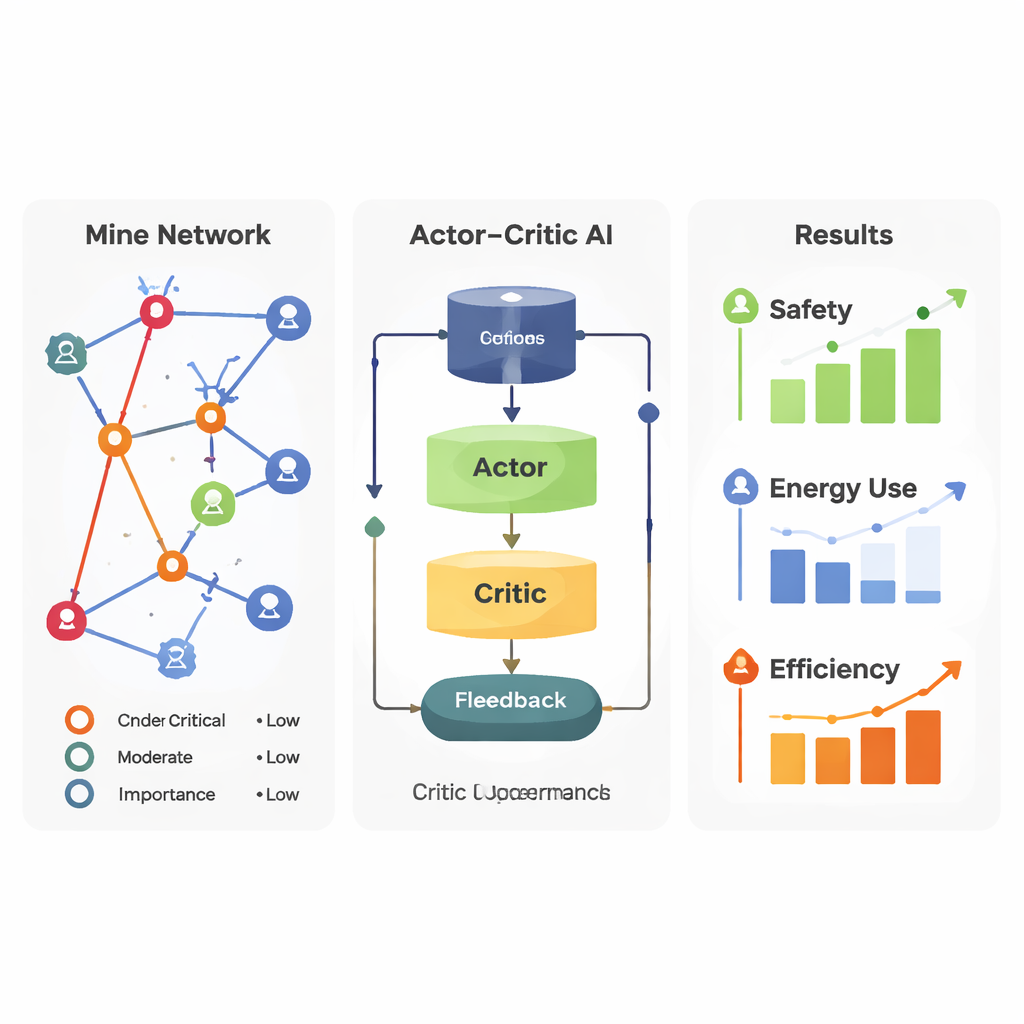
What This Means for Mining and Beyond
For non‑specialists, the key message is that this system turns a mine’s complex airways into a living digital model that an AI can learn to manage, much like an autopilot stabilizes an aircraft. By continuously nudging fans and regulators, it maintains safer, cleaner air for workers while shaving a significant fraction off the power bill. Although the study focuses on one coal mine, the underlying approach—combining graph‑based learning with trial‑and‑error control—could be applied to other sprawling networks such as city traffic, power grids, or heating and cooling in large buildings. The work suggests a future in which critical industrial systems quietly optimize themselves, with humans supervising the big picture rather than wrestling with thousands of individual settings.
Citation: Zhang, K., Yang, X. & Li, H. Intelligent decision-making for mine ventilation systems based on graph neural network and deep reinforcement learning fusion. Sci Rep 16, 6704 (2026). https://doi.org/10.1038/s41598-026-37347-8
Keywords: mine ventilation, graph neural networks, deep reinforcement learning, industrial safety, energy efficiency