Clear Sky Science · en
Optimal cluster-based energy efficient routing scheme for QoS aware IoT-enabled wireless body area network
Keeping an Eye on Your Health, All the Time
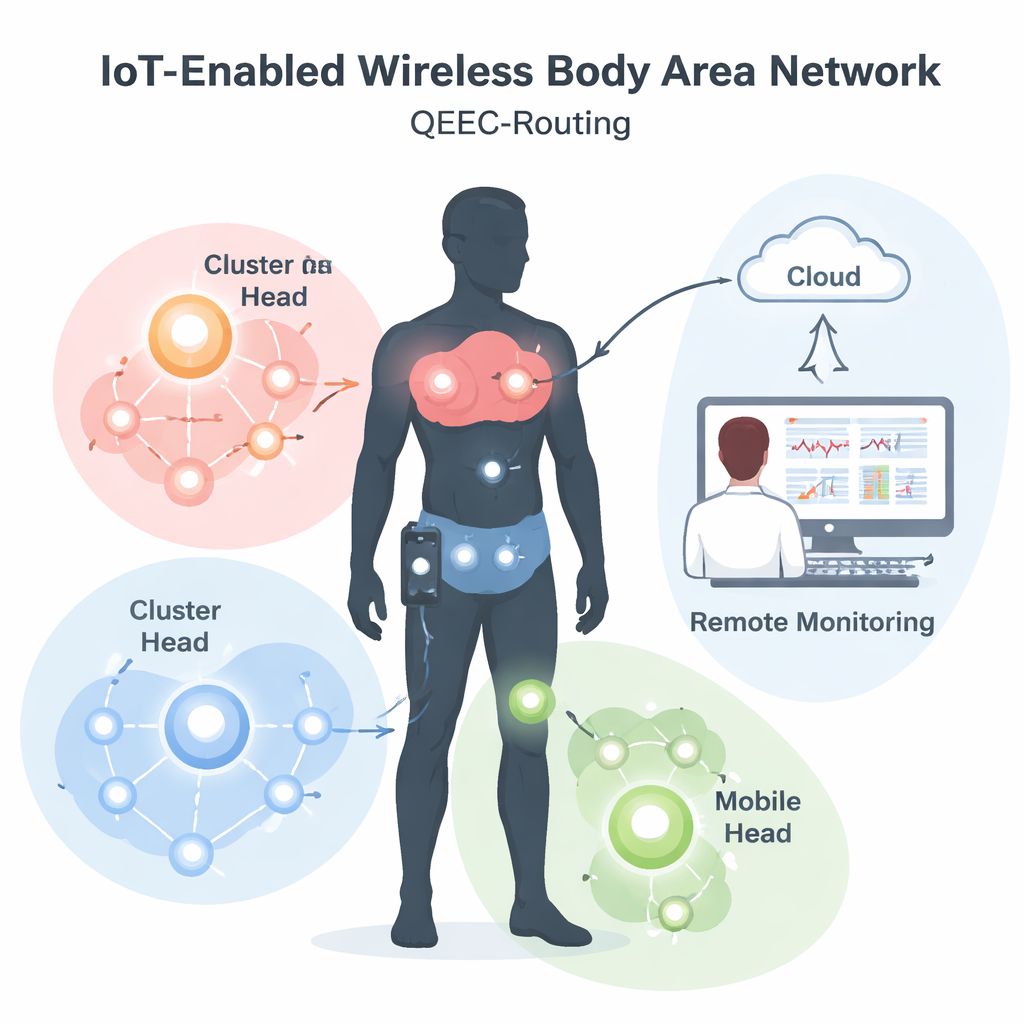
As more people live longer with chronic illnesses, doctors increasingly rely on wearable sensors that can continuously track vital signs such as heart rate, temperature, and blood pressure. These small devices, placed on or inside the body, form a wireless body area network that must deliver medical data quickly and reliably, often in real time. The challenge is that these sensors run on tiny batteries, move with the patient, and share crowded airwaves with many other devices. This paper introduces a smarter way to organize and route data in such networks so that life‑critical information reaches caregivers on time while preserving battery life.
How Wearable Networks Talk to the Cloud
In an Internet of Things–enabled body area network, dozens of sensors around a patient send measurements to a nearby gateway, such as a smartphone or a small hub worn on the body. The gateway forwards this information to hospital servers or cloud platforms, where doctors and algorithms can monitor health conditions from afar. But if every sensor talks directly to the gateway all the time, batteries drain quickly and messages can collide, causing delays or lost data. To avoid this, sensors are grouped into clusters. Each cluster elects a cluster head, which gathers data from nearby sensors and forwards it onward, reducing the number of transmissions. Making these clusters energy‑efficient, stable during movement, and secure against misbehaving nodes is the central problem the authors tackle.
Smarter Grouping of Sensors on the Body
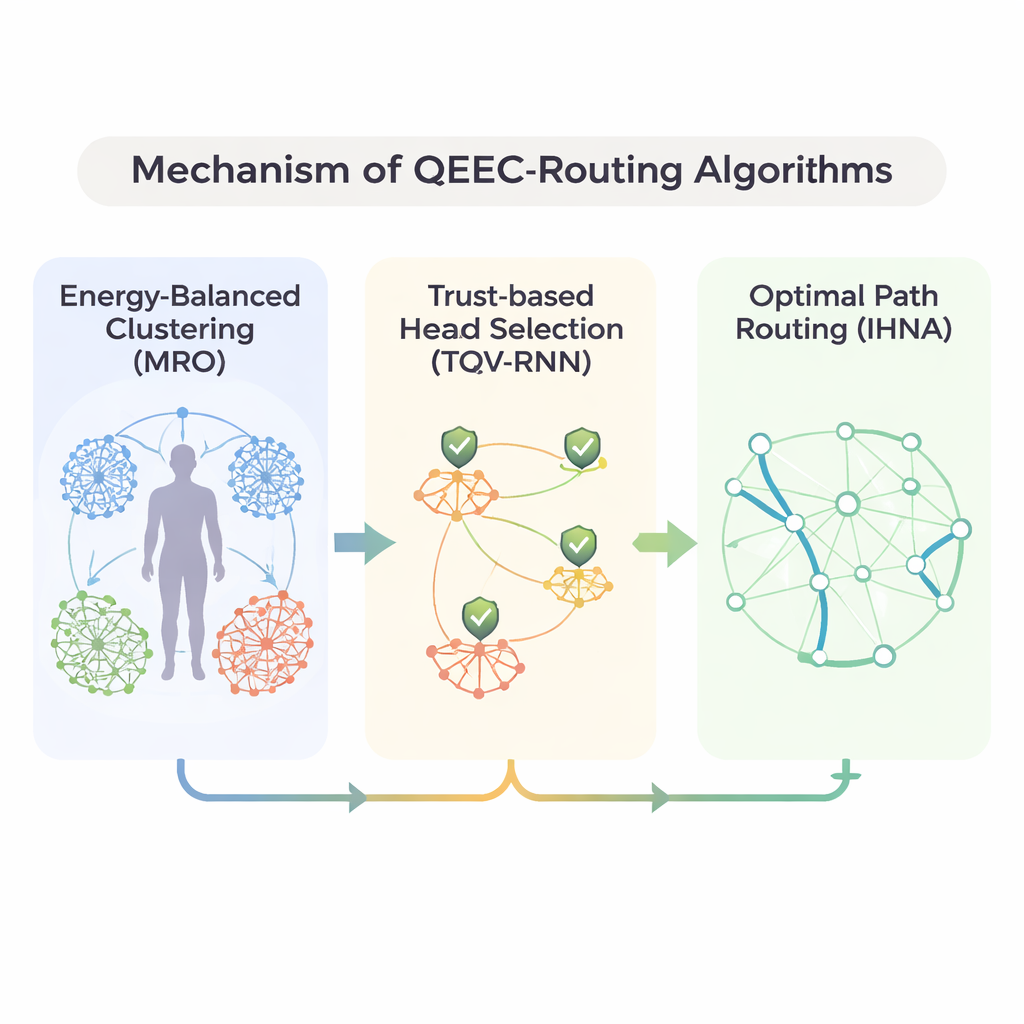
The first part of the proposed system, called QEEC‑Routing, focuses on forming well‑balanced clusters of sensors. The authors adapt a nature‑inspired technique they term Modified Raccoon Optimization. In simple terms, this algorithm behaves like a group of search agents that explore different ways to group sensors based on how much battery they have left, how close they are to one another, and how quickly data must move. Instead of settling too early on a mediocre arrangement, the method keeps exploring and refining cluster boundaries as the patient moves. The result is that no single sensor is overused as a relay, energy is spread more evenly, and the overall network lasts longer before batteries need replacing or recharging.
Choosing Which Sensors to Trust
Not every sensor is equally reliable. Some may have weak signals, be frequently disconnected due to body movement, or even be compromised. To decide which sensors should act as cluster heads or forward important data, the system calculates a trust score for each node. Here the authors use a specialized neural network—Two‑level Quaternion‑Valued Recurrent Neural Network—that can handle several related trust factors at once, such as mobility, signal strength, congestion, and past success in forwarding packets. By learning how these factors change over time, the model can more accurately pick trustworthy nodes and avoid misclassifying weak or suspicious sensors as leaders. This trust‑aware selection improves both data integrity and security without manual tuning.
Finding the Best Route Through a Moving Crowd
Once clusters and trusted heads are in place, the remaining question is how to move data from the body to the mobile gateway and then to the cloud with minimal delay and energy use, even as the patient walks around. For this, the authors apply an Improved Hypercube Natural Aggregation algorithm. This method evaluates many possible multi‑hop paths at once, trading off energy consumption, link reliability, congestion, and delay. It gradually zooms in on the most promising paths while avoiding getting stuck on short‑lived or unstable options. Because it constantly adapts as nodes move or traffic changes, the network can maintain smooth, low‑latency communication even in busy hospital or home environments.
What the Simulations Reveal
To test their design, the researchers used a detailed network simulator and compared QEEC‑Routing with several well‑known protocols used in body area and sensor networks. Across scenarios with different numbers of mobile nodes, different walking speeds, and even very dense deployments, the new scheme consumed significantly less energy, delivered a higher fraction of data packets, and kept the network alive for longer. It also reduced end‑to‑end delay—the time it takes for a measurement to reach the server—and cut the extra control messages needed to manage the network. In some cases, energy use dropped by more than half, while packet delivery and network lifetime saw double‑digit percentage gains over competing methods.
Why This Matters for Everyday Care
For patients, the technical advances in QEEC‑Routing translate into simpler but important benefits: wearable sensors that last longer between charges, fewer gaps or delays in monitoring, and more reliable alerts when something is wrong. For clinicians and healthcare providers, it promises denser, more flexible deployments of body‑worn devices without overwhelming networks or draining batteries. While the work is currently validated in simulation, the authors plan future experiments with real wearable hardware and cloud‑connected testbeds. If those results match the simulations, this routing approach could help make continuous, at‑home health monitoring more robust, affordable, and trustworthy.
Citation: Irine Shyja, V., Ranganathan, G., Chandrakanth, P. et al. Optimal cluster-based energy efficient routing scheme for QoS aware IoT-enabled wireless body area network. Sci Rep 16, 6689 (2026). https://doi.org/10.1038/s41598-026-37344-x
Keywords: wireless body area network, wearable health sensors, energy efficient routing, IoT healthcare, quality of service